Laboratory of Molecular Pharmacology, Department of Biomedical Sciences, Faculty of Health and Medical Sciences, University of Copenhagen, Copenhagen, Denmark.
Bainan Biotech, Copenhagen, Denmark.
Br J Pharmacol. 2022 May;179(9):1998-2015. doi: 10.1111/bph.15766. Epub 2022 Jan 11.
Glucagon-like peptide-2 (GLP-2) is a pro-glucagon-derived hormone secreted from intestinal enteroendocrine L cells with actions on gut and bones. GLP-2(1-33) is cleaved by DPP-4, forming GLP-2(3-33), having low intrinsic activity and competitive antagonism properties at GLP-2 receptors. We created radioligands based on these two molecules.
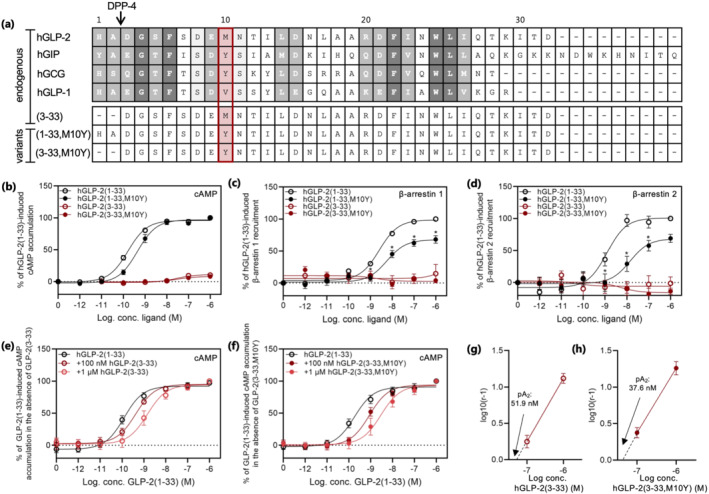
The methionine in position 10 of GLP-2(1-33) and GLP-2(3-33) was substituted with tyrosine (M10Y) enabling oxidative iodination, creating [ I]-hGLP-2(1-33,M10Y) and [ I]-hGLP-2(3-33,M10Y). Both were characterized by competition binding, on-and-off-rate determination and receptor activation. Receptor expression was determined by target-tissue autoradiography and immunohistochemistry.
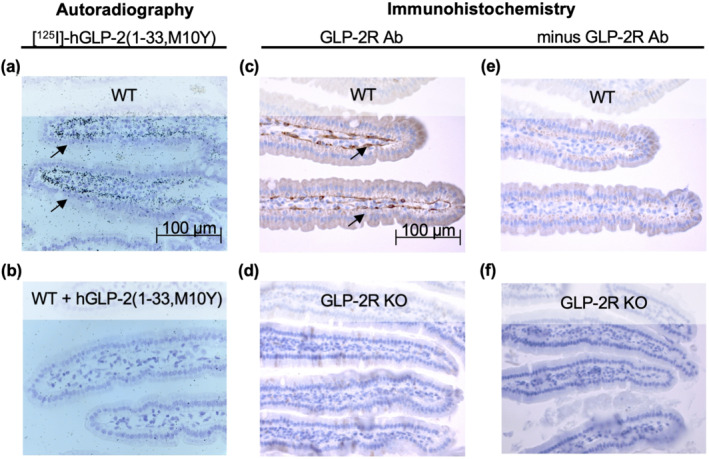
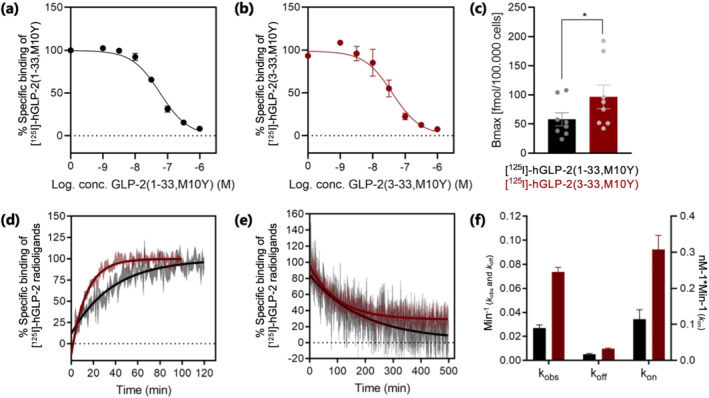
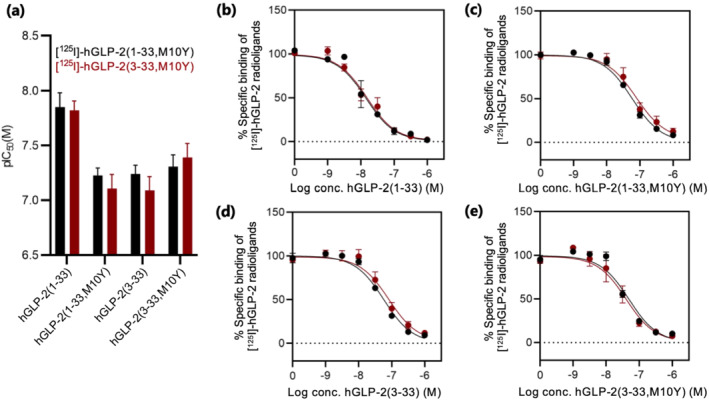
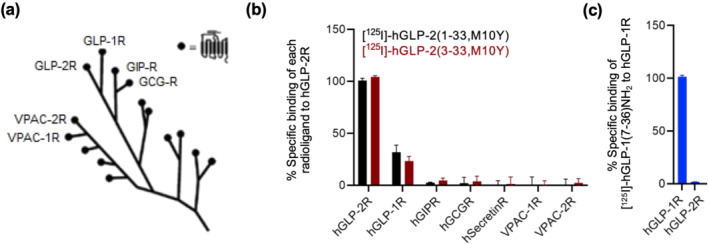
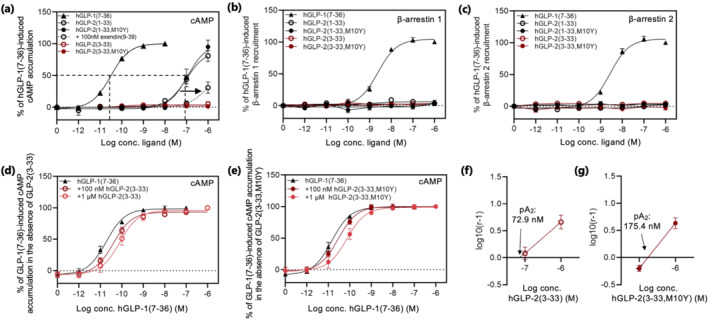
Both M10Y-substituted peptides induced cAMP production via the GLP-2 receptor comparable to the wildtype peptides. GLP-2(3-33,M10Y) maintained the antagonistic properties of GLP-2(3-33). However, hGLP-2(1-33,M10Y) had lower arrestin recruitment than hGLP-2(1-33). High affinities for the hGLP-2 receptor were observed using [ I]-hGLP-2(1-33,M10Y) and [ I]-hGLP-2(3-33,M10Y) with K values of 59.3 and 40.6 nM. The latter (with antagonistic properties) had higher B and faster on and off rates compared to the former (full agonist). Both bound the hGLP-1 receptor with low affinity (K of 130 and 330 nM, respectively). Autoradiography in wildtype mice revealed strong labelling of subepithelial myofibroblasts, confirmed by immunohistochemistry using a GLP-2 receptor specific antibody that in turn was confirmed in GLP-2 receptor knock-out mice.
Two new radioligands with different binding kinetics, one a full agonist and the other a weak partial agonist with antagonistic properties were developed and subepithelial myofibroblasts identified as a major site for GLP-2 receptor expression.
胰高血糖素样肽-2(GLP-2)是一种由肠道内分泌 L 细胞分泌的前胰高血糖素衍生激素,对肠道和骨骼均有作用。GLP-2(1-33)被 DPP-4 切割,形成 GLP-2(3-33),具有低内在活性和 GLP-2 受体竞争性拮抗特性。我们基于这两种分子创建了放射性配体。
GLP-2(1-33)和 GLP-2(3-33)中的第 10 位甲硫氨酸被酪氨酸取代(M10Y),使其能够进行氧化碘化,形成[I]-hGLP-2(1-33,M10Y)和[I]-hGLP-2(3-33,M10Y)。两者均通过竞争结合、on-and-off-rate 测定和受体激活进行了表征。受体表达通过靶组织放射自显影和免疫组织化学确定。
两种 M10Y 取代肽均通过 GLP-2 受体诱导 cAMP 产生,与野生型肽相当。GLP-2(3-33,M10Y)保留了 GLP-2(3-33)的拮抗特性。然而,hGLP-2(1-33,M10Y)的 arrestin 募集率低于 hGLP-2(1-33)。使用[I]-hGLP-2(1-33,M10Y)和[I]-hGLP-2(3-33,M10Y)观察到对 hGLP-2 受体的高亲和力,K 值分别为 59.3 和 40.6 nM。后者(具有拮抗特性)与前者(完全激动剂)相比,具有更高的 B 值和更快的 on 和 off 速率。两者与 hGLP-1 受体的亲和力均较低(分别为 130 和 330 nM)。在野生型小鼠中的放射自显影显示出上皮下肌成纤维细胞的强烈标记,这通过使用 GLP-2 受体特异性抗体的免疫组织化学得到证实,而该抗体在 GLP-2 受体敲除小鼠中得到了进一步证实。
开发了两种具有不同结合动力学的新放射性配体,一种是完全激动剂,另一种是具有拮抗特性的弱部分激动剂,并鉴定出上皮下肌成纤维细胞是 GLP-2 受体表达的主要部位。