Department of Biomedical Sciences, Faculty of Health and Medical Sciences, University of Copenhagen, Copenhagen, Denmark.
Novo Nordisk Foundation Center for Basic Metabolic Research, Faculty of Health and Medical Sciences, University of Copenhagen, Copenhagen, Denmark.
Br J Pharmacol. 2022 Sep;179(18):4473-4485. doi: 10.1111/bph.15866. Epub 2022 Jun 8.
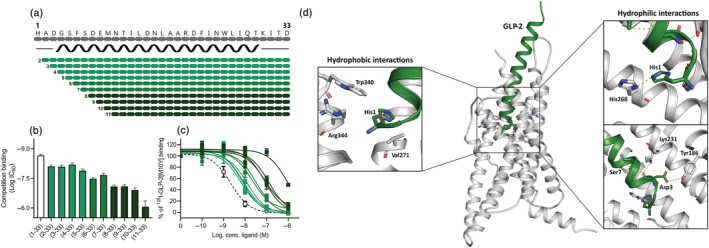
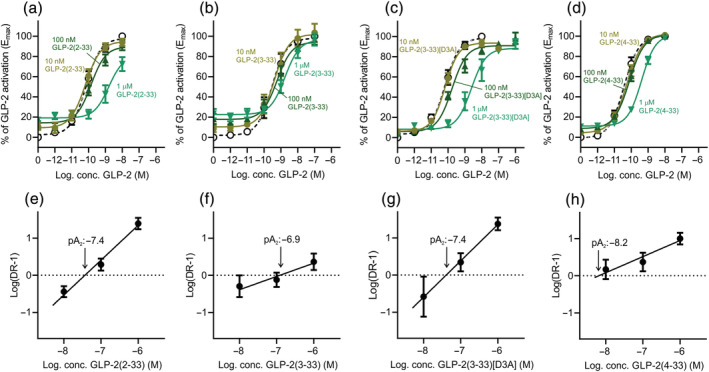
To fully elucidate the regulatory role of the GLP-2 system in the gut and the bones, potent and selective GLP-2 receptor (GLP-2R) antagonists are needed. Searching for antagonist activity, we performed systematic N-terminal truncations of human GLP-2(1-33).
COS-7 cells were transfected with the human GLP-2R and assessed for cAMP accumulation or competition binding using I-GLP-2(1-33)[M10Y]. To examine selectivity, COS-7 cells expressing human GLP-1 or GIP receptors were assessed for cAMP accumulation.
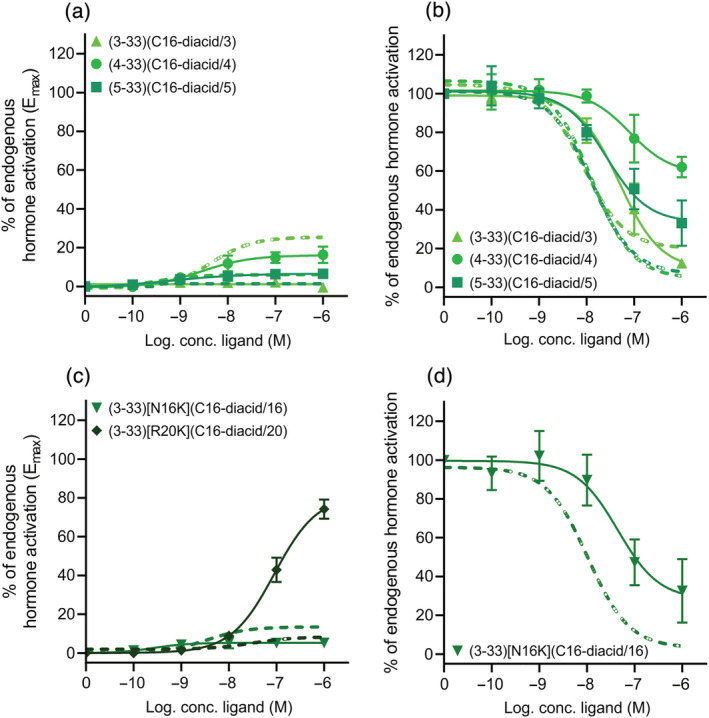
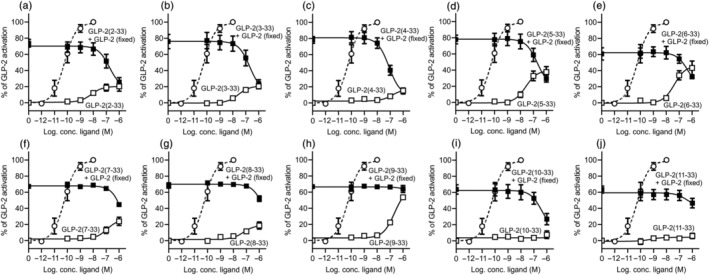
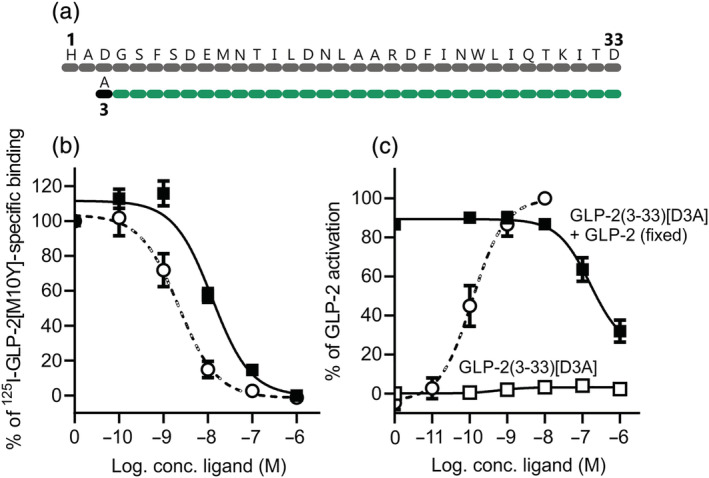
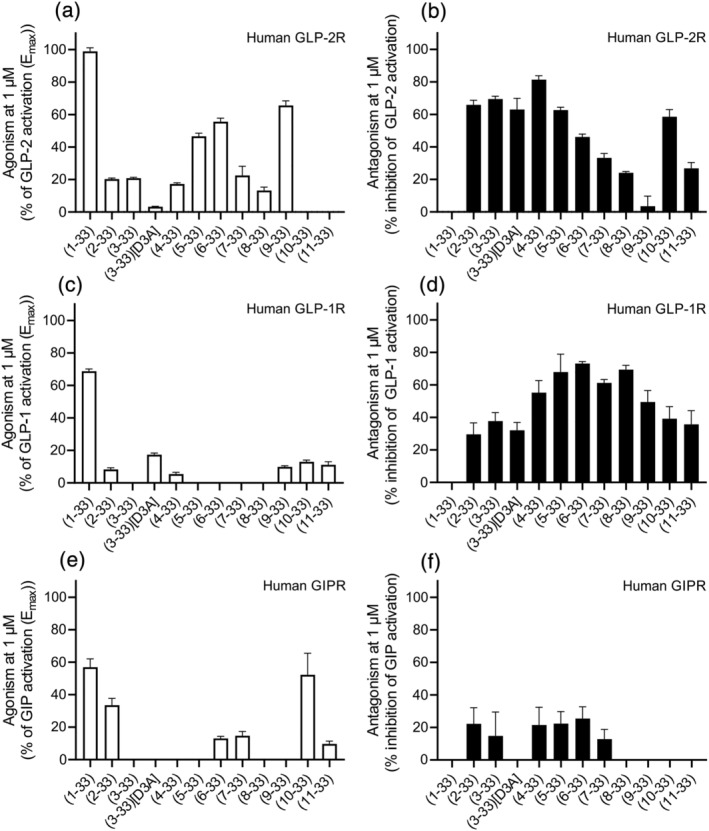
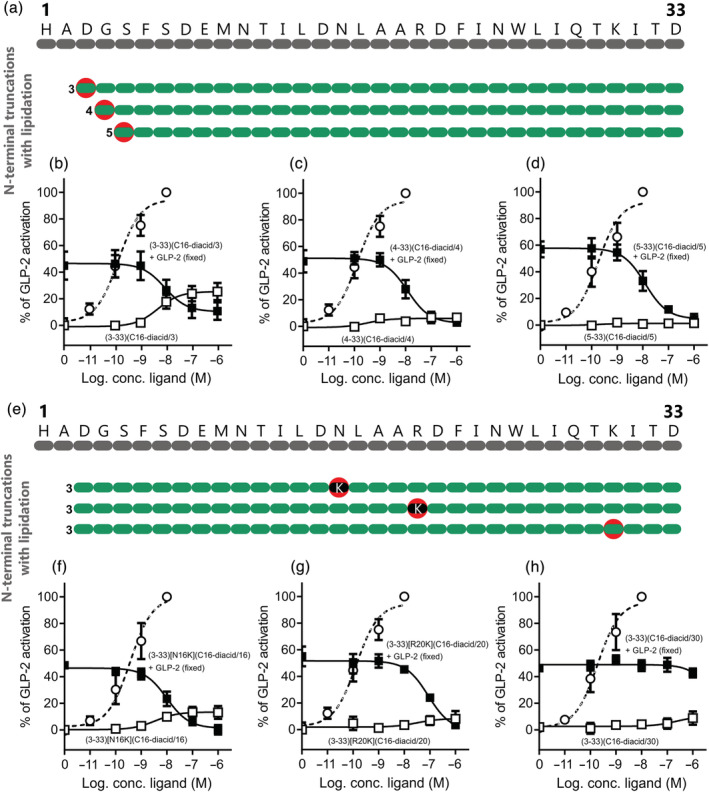
Affinity of the N-terminally truncated GLP-2 peptides for the GLP-2 receptor decreased with reduced N-terminal peptide length (K 6.5-871 nM), while increasing antagonism appeared with inhibitory potencies (IC ) values from 79 to 204 nM for truncation up to GLP-2(4-33) and then declined. In contrast, truncation-dependent increases in intrinsic activity were observed from an E of only 20% for GLP-(2-33) up to 46% for GLP-2(6-33) at 1 μM, followed by a decline. GLP-2(9-33) had the highest intrinsic efficacy (E 65%) and no antagonistic properties. Moreover, with truncations up to GLP-2(8-33), a gradual loss in selectivity for the GLP-2 receptor appeared with increasing GLP-1 receptor (GLP-1R) inhibition (up to 73% at 1 μM). Lipidation of the peptides improved antagonism (IC down to 7.9 nM) for both the GLP-2 and the GLP-1R.
The N-terminus of GLP-2 is crucial for GLP-2R activity and selectivity. Our observations form the basis for the development of tool compounds for further characterization of the GLP-2 system.
为了充分阐明 GLP-2 系统在肠道和骨骼中的调节作用,需要有强效且选择性的 GLP-2 受体(GLP-2R)拮抗剂。为了寻找拮抗剂活性,我们对人 GLP-2(1-33)进行了系统的 N 端截断。
用人类 GLP-2R 转染 COS-7 细胞,并使用 I-GLP-2(1-33)[M10Y]评估 cAMP 积累或竞争结合。为了检查选择性,用 GLP-1 或 GIP 受体表达的 COS-7 细胞评估 cAMP 积累。
N 端截断的 GLP-2 肽与 GLP-2 受体的亲和力随 N 端肽长度的减少而降低(K 6.5-871 nM),而随着抑制效力(IC )值从 79 到 204 nM 的增加,截断至 GLP-2(4-33)的拮抗作用增加,然后下降。相比之下,从 GLP-(2-33)的 E 仅为 20%到 GLP-2(6-33)的 46%,观察到截断依赖性内在活性增加,在 1 μM 时达到 46%,然后下降。GLP-2(9-33)具有最高的内在功效(E 65%)和无拮抗特性。此外,随着截断至 GLP-2(8-33),对 GLP-2 受体的选择性逐渐丧失,同时 GLP-1 受体(GLP-1R)抑制作用增加(在 1 μM 时高达 73%)。肽的脂化改善了对 GLP-2 和 GLP-1R 的拮抗作用(IC 降低至 7.9 nM)。
GLP-2 的 N 端对于 GLP-2R 的活性和选择性至关重要。我们的观察结果为进一步表征 GLP-2 系统的工具化合物的开发奠定了基础。