Department of Psychology, Emory University, Atlanta, GA 30322, USA.
Department of Brain and Cognitive Sciences, Massachusetts Institute of Technology, Cambridge, MA 02139, USA.
Trends Cogn Sci. 2022 Feb;26(2):117-127. doi: 10.1016/j.tics.2021.11.002. Epub 2021 Nov 29.
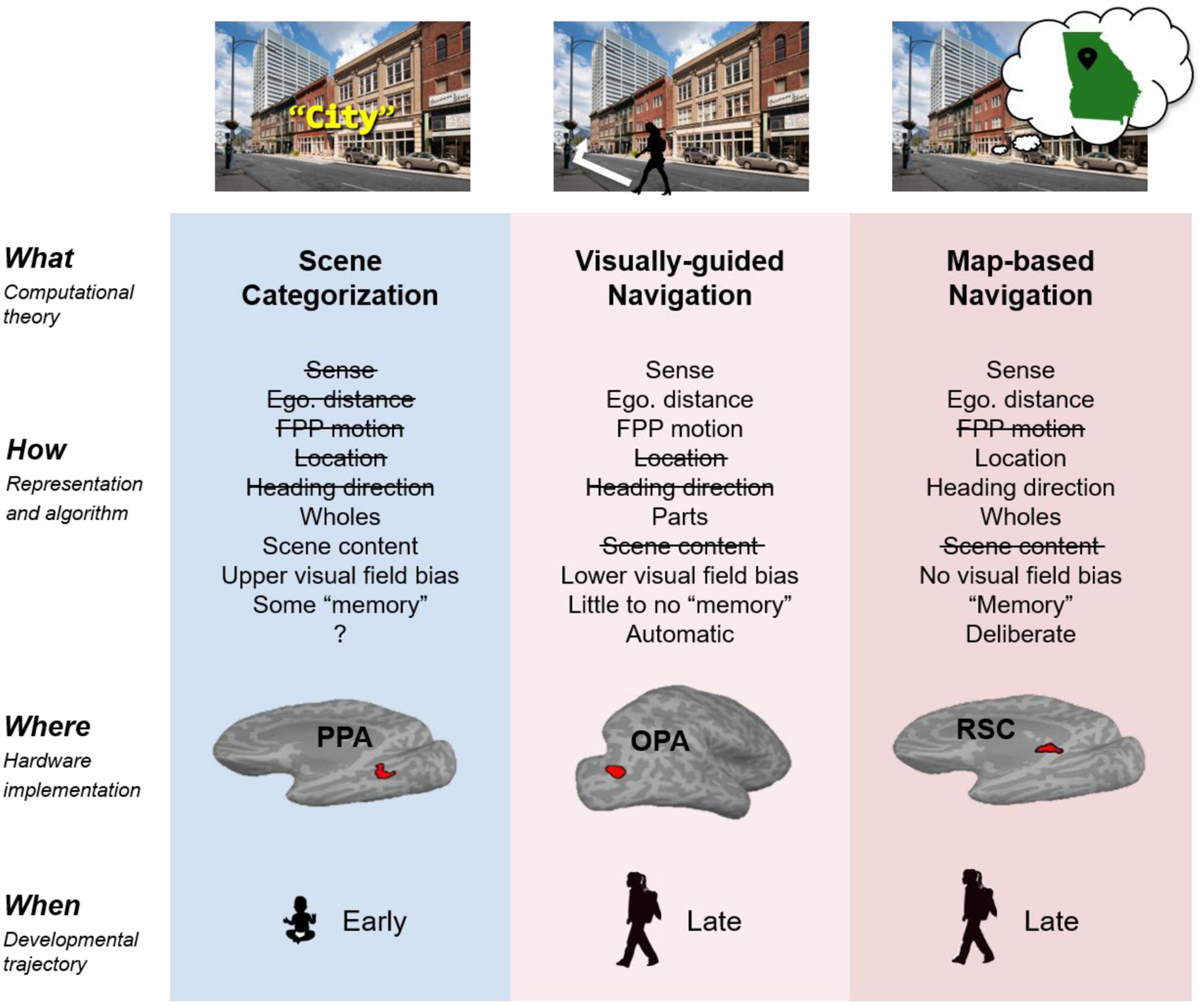
Since the discovery of three scene-selective regions in the human brain, a central assumption has been that all three regions directly support navigation. We propose instead that cortical scene processing regions support three distinct computational goals (and one not for navigation at all): (i) The parahippocampal place area supports scene categorization, which involves recognizing the kind of place we are in; (ii) the occipital place area supports visually guided navigation, which involves finding our way through the immediately visible environment, avoiding boundaries and obstacles; and (iii) the retrosplenial complex supports map-based navigation, which involves finding our way from a specific place to some distant, out-of-sight place. We further hypothesize that these systems develop along different timelines, with both navigation systems developing slower than the scene categorization system.
自从在人类大脑中发现三个场景选择性区域以来,一个核心假设是这三个区域都直接支持导航。相反,我们提出皮质场景处理区域支持三个不同的计算目标(而一个则完全不用于导航):(i)旁海马体位置区域支持场景分类,涉及识别我们所处的地方的类型;(ii)枕叶位置区域支持视觉引导导航,涉及找到通过我们立即可见的环境的方式,避免边界和障碍物;(iii)后穹窿复合体支持基于地图的导航,涉及找到从特定位置到远处视线之外的位置的方式。我们进一步假设这些系统沿着不同的时间线发展,两个导航系统的发展都比场景分类系统慢。