Department of Medicine, University of South Florida Morsani College of Medicine, Tampa, FL 33612.
Materials and Process Simulation Center, California Institute of Technology, Pasadena, CA 91125.
Proc Natl Acad Sci U S A. 2021 Dec 7;118(49). doi: 10.1073/pnas.2026668118.
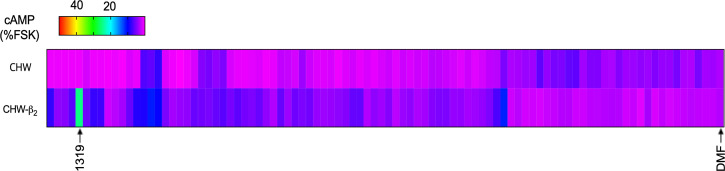
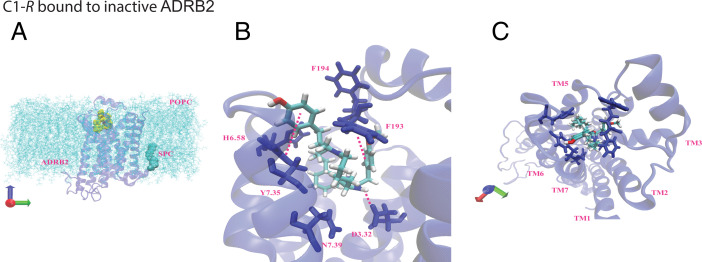
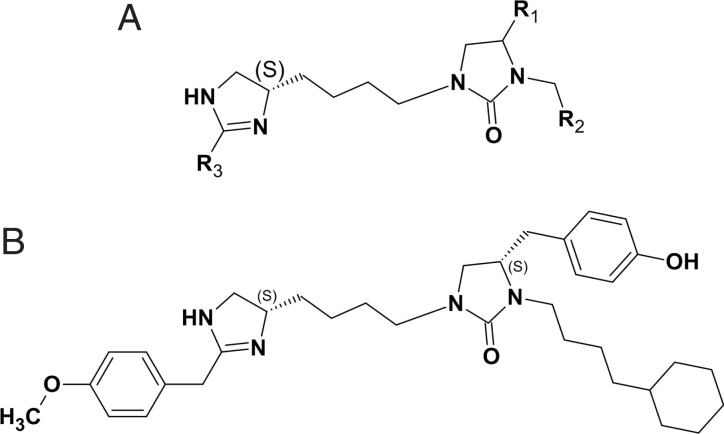
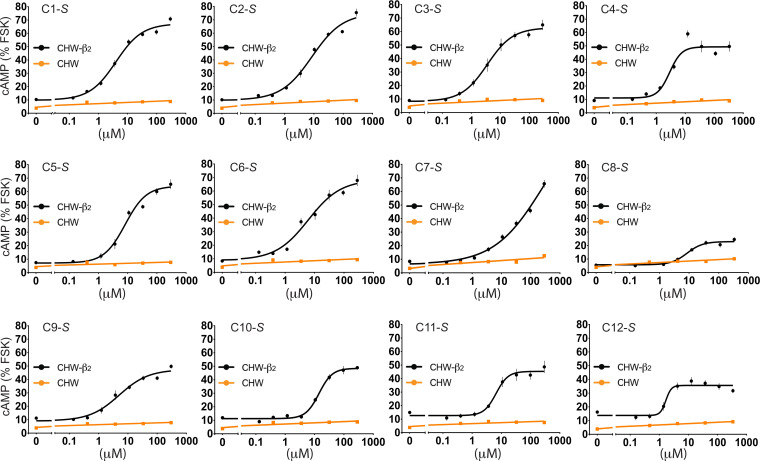
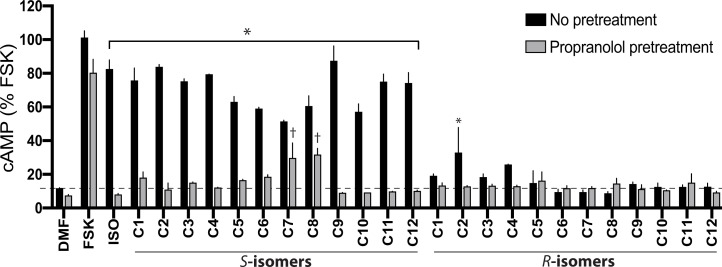
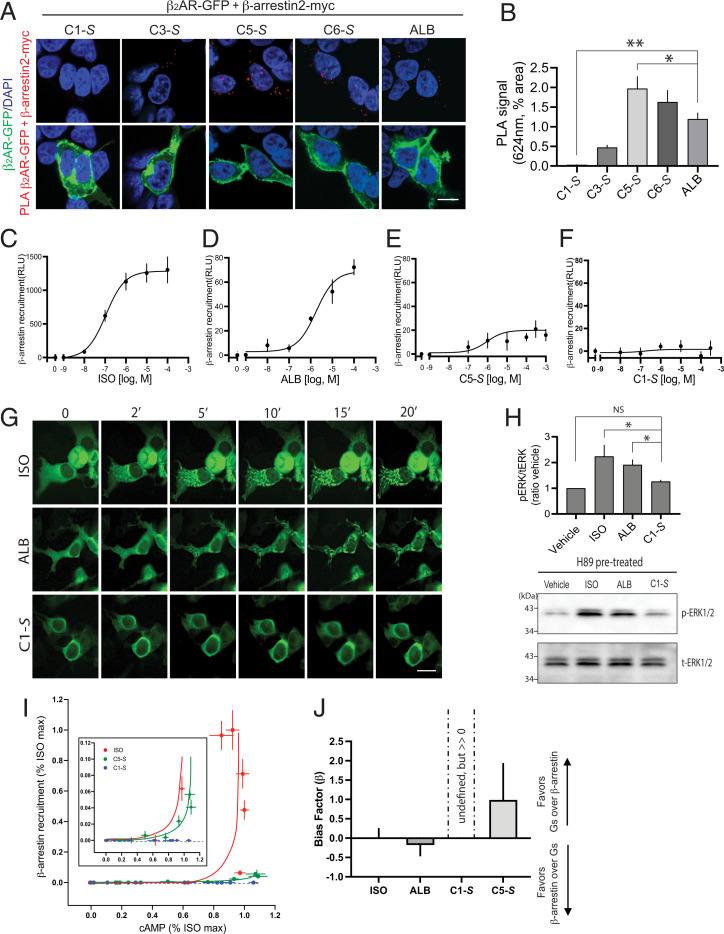
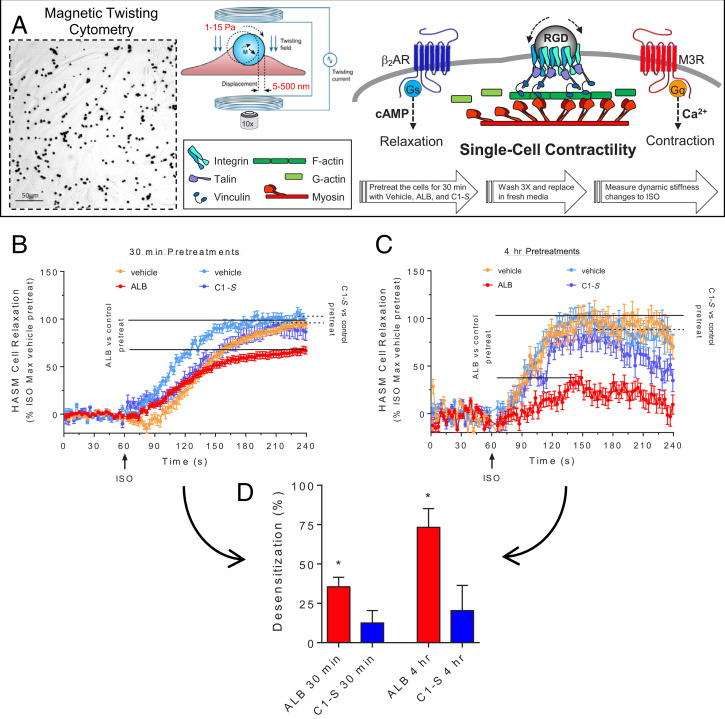
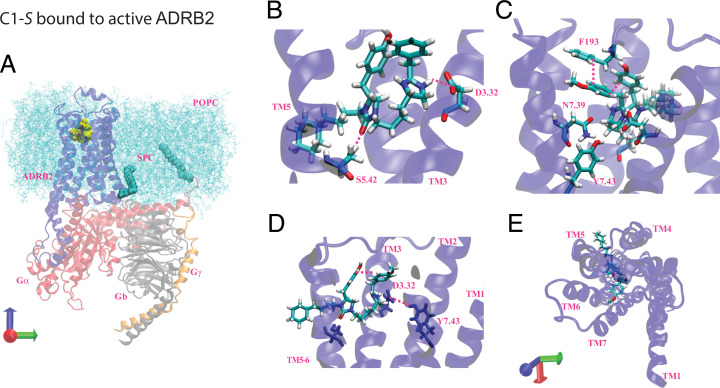
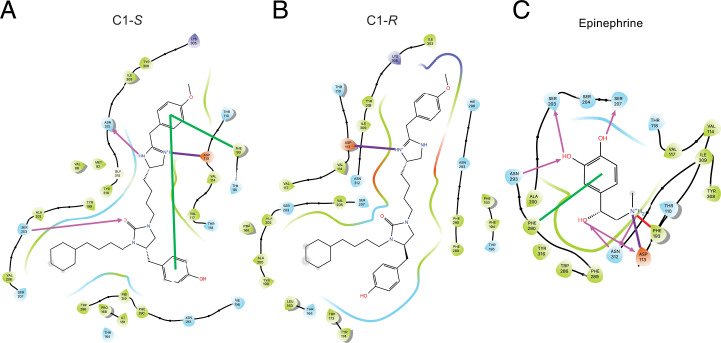
G protein-coupled receptors display multifunctional signaling, offering the potential for agonist structures to promote conformational selectivity for biased outputs. For β-adrenergic receptors (βAR), unbiased agonists stabilize conformation(s) that evoke coupling to Gαs (cyclic adenosine monophosphate [cAMP] production/human airway smooth muscle [HASM] cell relaxation) and β-arrestin engagement, the latter acting to quench Gαs signaling, contributing to receptor desensitization/tachyphylaxis. We screened a 40-million-compound scaffold ranking library, revealing unanticipated agonists with dihydroimidazolyl-butyl-cyclic urea scaffolds. The -stereoisomer of compound C1 shows no detectable β-arrestin engagement/signaling by four methods. However, C1- retained Gαs signaling-a divergence of the outputs favorable for treating asthma. Functional studies with two models confirmed the biasing: βAR-mediated cAMP signaling underwent desensitization to the unbiased agonist albuterol but not to C1-, and desensitization of HASM cell relaxation was observed with albuterol but not with C1- These HASM results indicate biologically pertinent biasing of C1-, in the context of the relevant physiologic response, in the human cell type of interest. Thus, C1- was apparently strongly biased away from βarrestin, in contrast to albuterol and C5- C1- structural modeling and simulations revealed binding differences compared with unbiased epinephrine at transmembrane (TM) segments 3,5,6,7 and ECL2. C1- (R2 = cyclohexane) was repositioned in the pocket such that it lost a TM6 interaction and gained a TM7 interaction compared with the analogous unbiased C5- (R2 = benzene group), which appears to contribute to C1- biasing away from β-arrestin. Thus, an agnostic large chemical-space library identified agonists with receptor interactions that resulted in relevant signal splitting of βAR actions favorable for treating obstructive lung disease.
G 蛋白偶联受体显示出多功能信号传导,为激动剂结构提供了促进偏向输出的构象选择性的潜力。对于β-肾上腺素能受体(βAR),非选择性激动剂稳定了诱发与 Gαs(环磷酸腺苷单磷酸[cAMP]产生/人气道平滑肌[HASM]细胞松弛)和β-抑制蛋白结合的构象,后者作用是抑制 Gαs 信号传导,有助于受体脱敏/快速耐受。我们筛选了一个包含 4000 万个化合物的支架排名文库,揭示了具有二氢咪唑基-丁基-环脲支架的出乎意料的激动剂。化合物 C1 的 - 对映异构体通过四种方法均未检测到β-抑制蛋白结合/信号传导。然而,C1-保留了 Gαs 信号传导 - 有利于治疗哮喘的输出分歧。两种模型的功能研究证实了这种偏向性:βAR 介导的 cAMP 信号传导对非选择性激动剂沙丁胺醇发生脱敏,但对 C1-不发生脱敏,并且观察到 HASM 细胞松弛对沙丁胺醇的脱敏,但对 C1-不发生脱敏。这些 HASM 结果表明,在相关生理反应的背景下,C1-在感兴趣的人类细胞类型中具有生物学相关的偏向性。因此,C1-显然明显偏向于β-arrestin,与沙丁胺醇和 C5-形成对比。C1-的结构建模和模拟显示与非选择性肾上腺素相比,在跨膜(TM)片段 3、5、6、7 和 ECL2 处存在结合差异。与类似的非选择性 C5-(R2 = 苯基团)相比,C1-(R2 = 环己烷)在口袋中的位置发生了变化,从而失去了与 TM6 的相互作用,获得了与 TM7 的相互作用,这似乎有助于 C1-偏向β-arrestin。因此,一个无偏见的大型化学空间文库确定了具有受体相互作用的激动剂,这些相互作用导致了βAR 作用的相关信号分裂,有利于治疗阻塞性肺疾病。