Department of Mechanical Engineering, Sharif University of Technology, Azadi Ave., Tehran, Iran.
Sci Rep. 2021 Dec 2;11(1):23338. doi: 10.1038/s41598-021-02535-1.
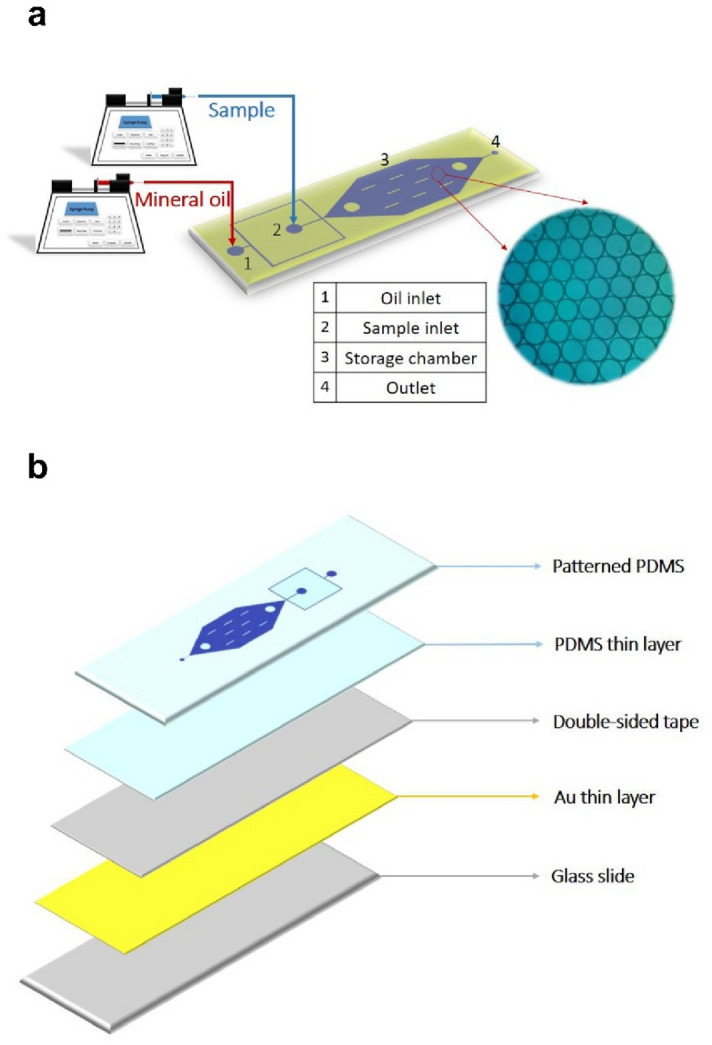
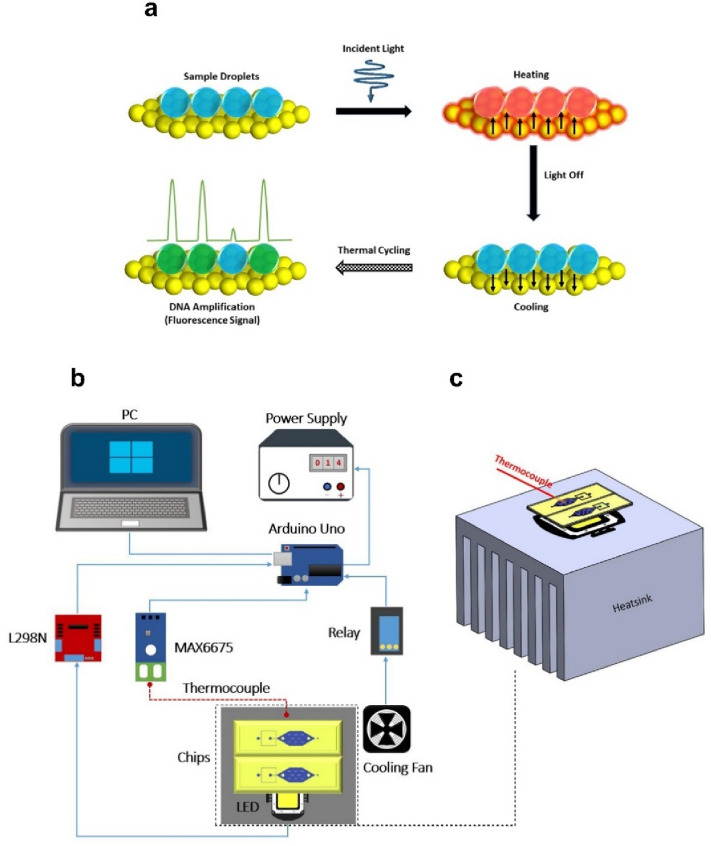
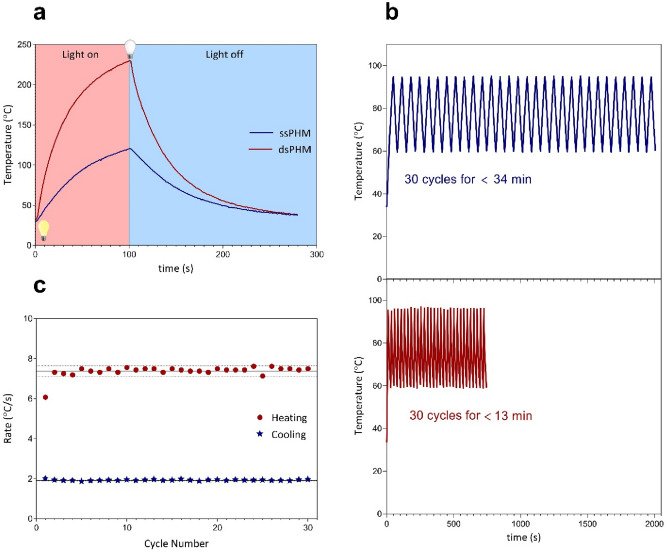
Polymerase chain reaction (PCR) is a powerful tool for nucleic acid amplification and quantification. However, long thermocycling time is a major limitation of the commercial PCR devices in the point-of-care (POC). Herein, we have developed a rapid droplet-based photonic PCR (dpPCR) system, including a gold (Au) nanofilm-based microfluidic chip and a plasmonic photothermal cycler. The chip is fabricated by adding mineral oil to uncured polydimethylsiloxane (PDMS) to suppress droplet evaporation in PDMS microfluidic chips during PCR thermocycling. A PDMS to gold bonding technique using a double-sided adhesive tape is applied to enhance the bonding strength between the oil-added PDMS and the gold nanofilm. Moreover, the gold nanofilm excited by two light-emitting diodes (LEDs) from the top and bottom sides of the chip provides fast heating of the PCR sample to 230 °C within 100 s. Such a design enables 30 thermal cycles from 60 to 95 °C within 13 min with the average heating and cooling rates of 7.37 ± 0.27 °C/s and 1.91 ± 0.03 °C/s, respectively. The experimental results demonstrate successful PCR amplification of the alcohol oxidase (AOX) gene using the rapid plasmonic photothermal cycler and exhibit the great performance of the microfluidic chip for droplet-based PCR.
聚合酶链式反应(PCR)是一种强大的核酸扩增和定量工具。然而,商业 PCR 设备在即时检测(POC)中的主要限制是长的热循环时间。在此,我们开发了一种快速基于液滴的光学生物 PCR(dpPCR)系统,包括基于金(Au)纳米膜的微流控芯片和等离子体光热循环器。该芯片是通过向未固化的聚二甲基硅氧烷(PDMS)中添加矿物油来制造的,以抑制 PCR 热循环过程中 PDMS 微流控芯片中的液滴蒸发。采用双面胶带的 PDMS 到金键合技术来增强添加油的 PDMS 和金纳米膜之间的键合强度。此外,芯片上下两侧的两个发光二极管(LED)激发的金纳米膜可在 100 s 内将 PCR 样品快速加热至 230°C。这种设计可在 13 分钟内完成 30 个从 60 到 95°C 的热循环,平均加热和冷却速率分别为 7.37±0.27°C/s 和 1.91±0.03°C/s。实验结果表明,快速等离子体光热循环器成功地扩增了酒精氧化酶(AOX)基因,并展示了微流控芯片在基于液滴的 PCR 中的出色性能。