Division of Nephrology, Department of Internal Medicine, CHA Bundang Medical Center, CHA University, Seongnam, South Korea.
Division of Nephrology, Department of Internal Medicine, Kyung Hee University School of Medicine, Seoul, South Korea.
Front Endocrinol (Lausanne). 2021 Nov 9;12:774436. doi: 10.3389/fendo.2021.774436. eCollection 2021.
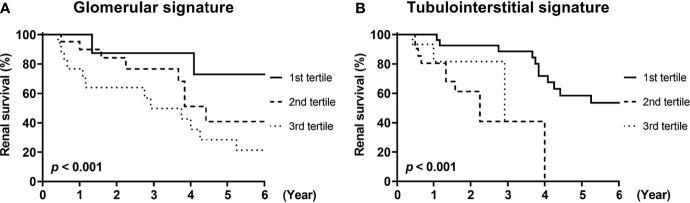
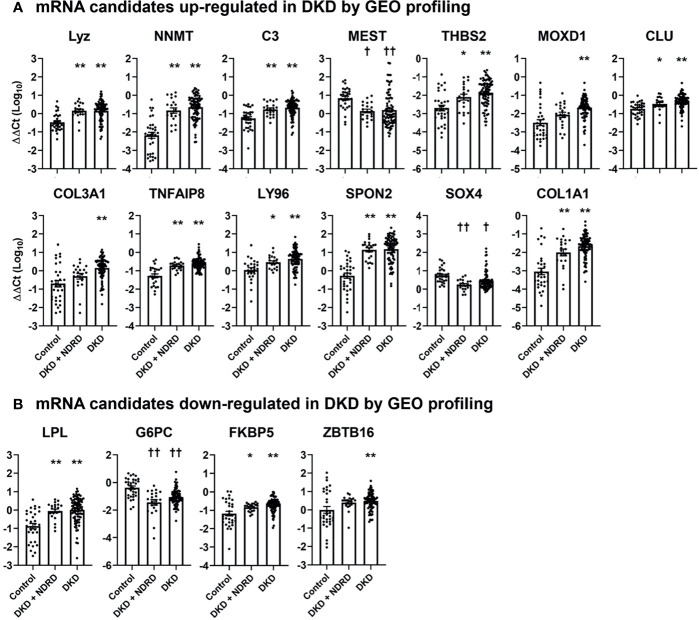
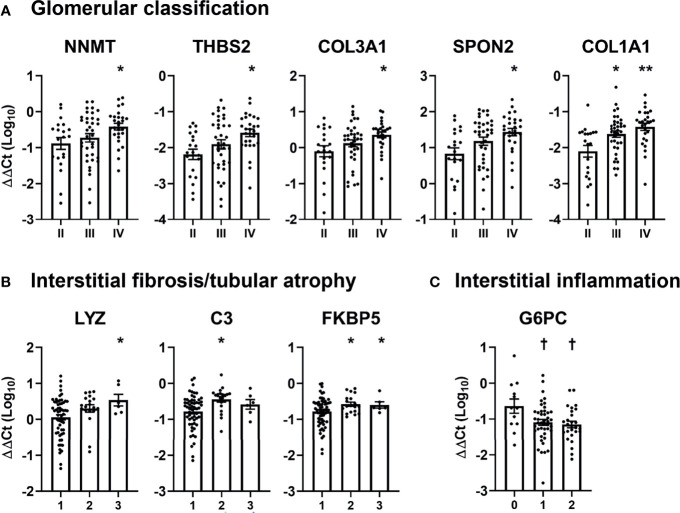
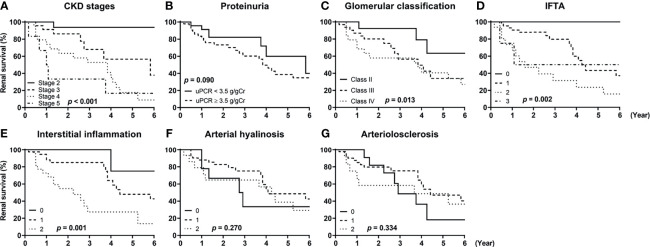
The clinical manifestations of diabetic kidney disease (DKD) are more heterogeneous than those previously reported, and these observations mandate the need for the recruitment of patients with biopsy-proven DKD in biomarker research. In this study, using the public gene expression omnibus (GEO) repository, we aimed to identify urinary mRNA biomarkers that can predict histological severity and disease progression in patients with DKD in whom the diagnosis and histologic grade has been confirmed by kidney biopsy. We identified 30 DKD-specific mRNA candidates based on the analysis of the GEO datasets. Among these, there were significant alterations in the urinary levels of 17 mRNAs in patients with DKD, compared with healthy controls. Four urinary mRNAs-, and -reflected tubulointerstitial inflammation and fibrosis in kidney biopsy and could predict rapid progression to end-stage kidney disease independently of the baseline eGFR (tertile 1 . tertile 3; adjusted hazard ratio of 9.68 and 95% confidence interval of 2.85-32.87, < 0.001). In conclusion, we demonstrated that urinary mRNA signatures have a potential to indicate the pathologic status and predict adverse renal outcomes in patients with DKD.
糖尿病肾病(DKD)的临床表现比以前报道的更为复杂,这些观察结果要求在生物标志物研究中招募经活检证实的 DKD 患者。在这项研究中,我们使用公共基因表达综合数据库(GEO),旨在确定尿 mRNA 生物标志物,以预测经肾活检确诊 DKD 患者的组织学严重程度和疾病进展。我们根据 GEO 数据集的分析,确定了 30 个 DKD 特异性 mRNA 候选物。其中,与健康对照组相比,在 DKD 患者的尿液中,有 17 个 mRNA 的水平有显著改变。在肾活检中,4 个尿 mRNA(和)反映了肾小管间质炎症和纤维化,并且可以独立于基线 eGFR(三分位 1 . 三分位 3;调整后的危险比为 9.68,95%置信区间为 2.85-32.87, < 0.001)预测快速进展为终末期肾病。总之,我们证明尿 mRNA 特征具有指示病理状态和预测 DKD 患者不良肾脏结局的潜力。