Reissier Sophie, Le Neindre Killian, Bordeau Valérie, Dejoies Loren, Le Bot Audrey, Felden Brice, Cattoir Vincent, Revest Matthieu
Unité Inserm U1230, Université de Rennes 1, Rennes, France.
Service de Bactériologie-Hygiène Hospitalière & CNR de la Résistance aux Antibiotiques (Laboratoire Associé 'Entérocoques'), CHU de Rennes, Rennes, France.
Front Microbiol. 2021 Nov 10;12:757227. doi: 10.3389/fmicb.2021.757227. eCollection 2021.
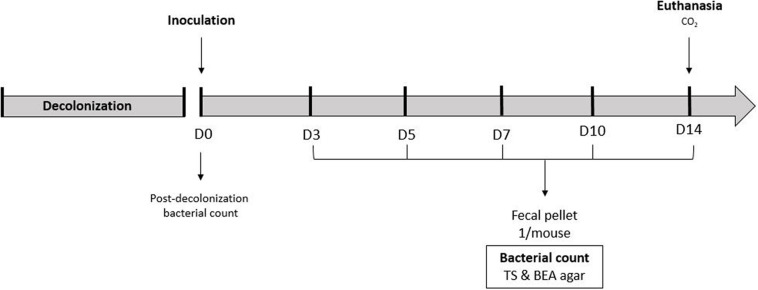
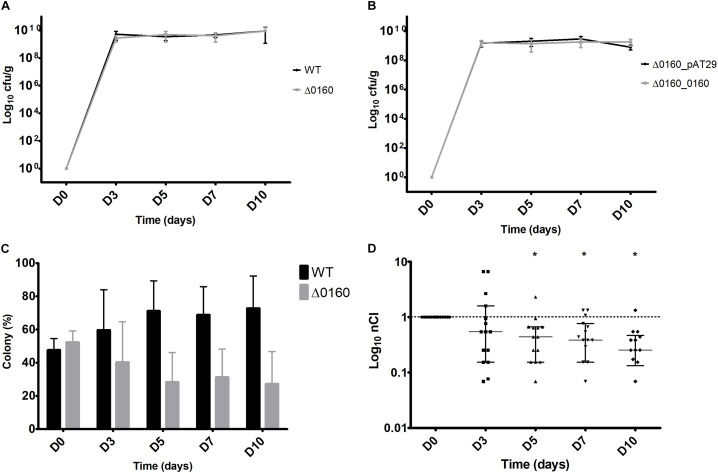
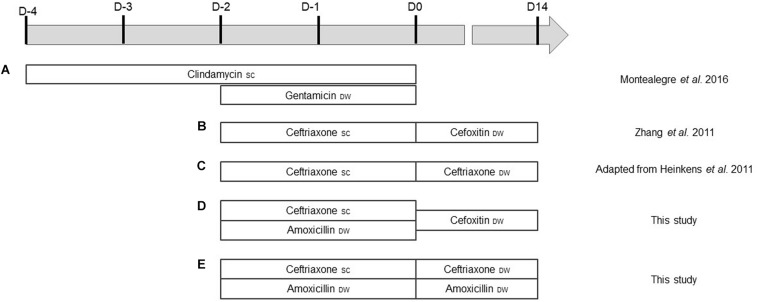
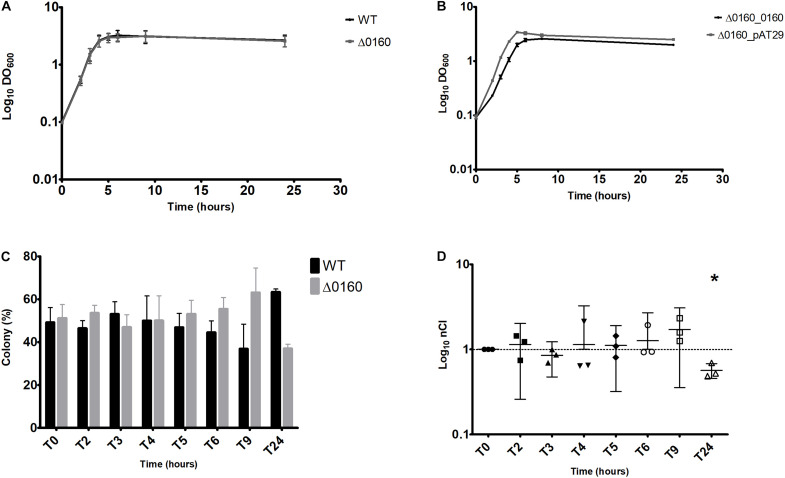
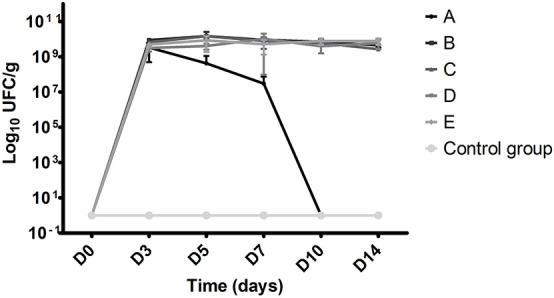
The aim of this study was to evaluate the role of the regulatory small RNA (sRNA) Ern0160 in gastrointestinal tract (GIT) colonization by . For this purpose, four strains of were used, Aus0004 (WT), an -deleted Aus0004 mutant (Δ0160), a -complemented Δ0160 strain overexpressing (Δ0160_0160), and a strain Δ0160 with an empty pAT29 vector (Δ0160_pAT29). Strains were studied both and , alone and in competitive assays. In experiments, no difference was observed between WT and Δ0160 strains cultured single while Δ0160_0160 strain grew more slowly than Δ0160_pAT29. In competitive assays, the WT strain was predominant compared to the deleted strain Δ0160 at the end of the experiment. Then, experiments were performed using a GIT colonization mouse model. Several existing models of GIT colonization were compared while a novel one, combining ceftriaxone and amoxicillin, was developed. A GIT colonization was performed with each strain alone, and no significant difference was noticed. By contrast, significant results were obtained with co-colonization experiments. With WT + Δ0160 suspension, a significant advantage for the WT strain was observed from day 5 to the end of the protocol, suggesting the involvement of 0160 in GIT colonization. With Δ0160_0160 + Δ0160_pAT29 suspension, the strain with the empty vector took the advantage from day 3 to the end of the protocol, suggesting a deleterious effect of overexpression. Altogether, these findings demonstrate the potential implication of Ern0160 in GIT colonization of . Further investigations are needed for the identification of sRNA target(s) in order to decipher underlying molecular mechanisms.
本研究的目的是评估调控小RNA(sRNA)Ern0160在[具体细菌名称]胃肠道(GIT)定植中的作用。为此,使用了四株[具体细菌名称],Aus0004(野生型)、缺失[具体基因名称]的Aus0004突变体(Δ0160)、过表达[具体基因名称]的[具体基因名称]互补Δ0160菌株(Δ0160_0160)以及带有空pAT29载体的菌株Δ0160(Δ0160_pAT29)。对这些菌株分别进行了体外和体内研究,包括单独培养和竞争试验。在体外实验中,单独培养时野生型和Δ0160菌株之间未观察到差异,而Δ0160_0160菌株的生长速度比Δ0160_pAT29慢。在竞争试验中,实验结束时野生型菌株相对于缺失菌株Δ0160占主导地位。然后,使用GIT定植小鼠模型进行了体内实验。比较了几种现有的GIT定植模型,同时开发了一种新的模型,该模型结合了头孢曲松和阿莫西林。分别用每种菌株进行GIT定植,未发现显著差异。相比之下,共定植实验获得了显著结果。对于野生型 + Δ0160悬液,从第5天到实验结束观察到野生型菌株具有显著优势,表明0160参与了GIT定植。对于Δ0160_0160 + Δ0160_pAT29悬液,带有空载体的菌株从第3天到实验结束占优势,表明[具体基因名称]过表达具有有害作用。总之,这些发现证明了Ern0160在[具体细菌名称]GIT定植中的潜在影响。为了解析潜在的分子机制,需要进一步研究以鉴定sRNA靶点。