Pozzuto Lara, Silveira Marina Nogueira, Mendes Maria Carolina Santos, Macedo Lígia Traldi, Costa Felipe Osório, Martinez Carlos Augusto Real, Coy Cláudio Saddy Rodrigues, da Cunha Júnior Ademar Dantas, Carvalheira José Barreto Campello
Division of Oncology, Department of Anesthesiology, Oncology and Radiology, School of Medical Sciences, State University of Campinas (UNICAMP), Campinas, Brazil.
Division of Gatrointestinal Surgery, Department of Surgery, School of Medical Sciences, State University of Campinas (UNICAMP), Campinas, Brazil.
Front Oncol. 2021 Nov 11;11:762444. doi: 10.3389/fonc.2021.762444. eCollection 2021.
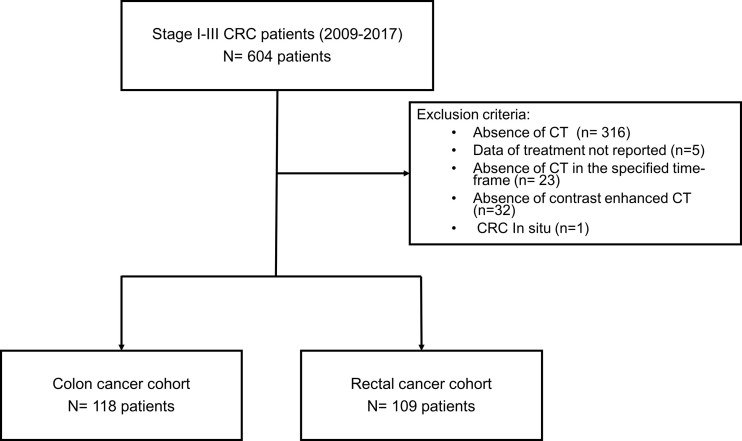
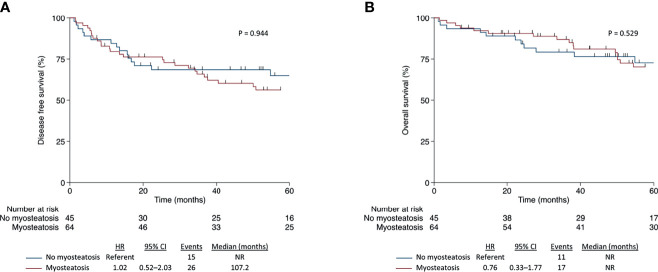
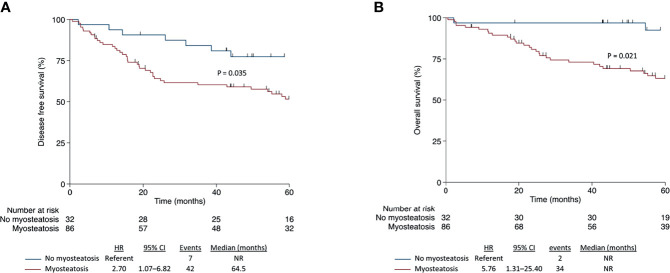
Body composition performed by computed tomography (CT) impacts on cancer patients' prognoses and responses to treatment. Myosteatosis has been related to overall survival (OS) and disease-specific survival in colorectal cancer (CRC); however, the independent impact of the association of myosteatosis with prognosis in colon cancer (CC) and rectal cancer (RC) is still unclear. CT was performed at the L3 level to assess body composition features in 227 patients with CRC. Clinical parameters were collected. Overall survival (OS) was the primary outcome, and the secondary outcome was disease-free survival (DFS). Skeletal muscle attenuation and intramuscular adipose tissue area were associated with DFS (p = 0.003 and p = 0.011, respectively) and OS (p < 0.001 and p < 0.001, respectively) in CC patients but not in RC patients. Only the skeletal muscle area was associated with better prognosis related to OS in RC patients (p = 0.009). When CC and RC were analyzed separately, myosteatosis influenced survival negatively in CC patients, worsening DFS survival (hazard ratio [HR], 2.70; 95% confidence interval [CI], 1.07-6.82; p = 0.035) and OS (HR, 5.76; 95% CI, 1.31-25.40; p = 0.021). By contrast, the presence of myosteatosis did not influence DFS (HR, 1.02; 95% CI, 0.52-2.03; p = 0.944) or OS (HR, 0.76; 95% CI, 0.33-1.77; p = 0.529) in RC patients. Our study revealed the interference of myosteatosis in the therapy and survival of patients with CC but not in those with RC, strengthening the value of grouping the two types of cancer in body composition analyses.
通过计算机断层扫描(CT)进行的身体成分分析会影响癌症患者的预后和对治疗的反应。肌脂变已与结直肠癌(CRC)的总生存期(OS)和疾病特异性生存期相关;然而,肌脂变与结肠癌(CC)和直肠癌(RC)预后之间关联的独立影响仍不清楚。对227例CRC患者在L3水平进行CT扫描以评估身体成分特征。收集临床参数。总生存期(OS)是主要结局,无病生存期(DFS)是次要结局。CC患者的骨骼肌衰减和肌内脂肪组织面积与DFS(分别为p = 0.003和p = 0.011)及OS(分别为p < 0.001和p < 0.001)相关,但RC患者无此关联。仅骨骼肌面积与RC患者更好的OS相关预后有关(p = 0.009)。当分别分析CC和RC时,肌脂变对CC患者的生存有负面影响,使DFS生存期恶化(风险比[HR],2.70;95%置信区间[CI],1.07 - 6.82;p = 0.035)和OS(HR,5.76;95% CI,1.31 - 25.40;p = 0.021)。相比之下,肌脂变的存在对RC患者的DFS(HR,1.02;95% CI,0.52 - 2.03;p = 0.944)或OS(HR,0.76;95% CI,0.33 - 1.77;p = 0.529)无影响。我们的研究揭示了肌脂变对CC患者治疗和生存的干扰,但对RC患者无此干扰,强化了在身体成分分析中将这两种癌症分组的价值。