Cosyns Bernard, Roosens Bram, Lancellotti Patrizio, Laroche Cécile, Dulgheru Raluca, Scheggi Valentina, Vilacosta Isidre, Pasquet Agnès, Piper Cornelia, Reyes Graciela, Mahfouz Essam, Kobalava Zhanna, Piroth Lionel, Kasprzak Jarosław D, Moreo Antonella, Faucher Jean-François, Ternacle Julien, Meshaal Marwa, Maggioni Aldo P, Iung Bernard, Habib Gilbert
Centrum Voor Hart- en Vaatziekten (CHVZ), Vrije Universiteit Brussel (VUB), Universitair Ziekenhuis Brussel (UZ Brussel), Brussels, Belgium.
In vivo Cellular and Molecular Imaging (ICMI) Center, Vrije Universiteit Brussel (VUB), Brussels, Belgium.
Front Cardiovasc Med. 2021 Nov 11;8:766996. doi: 10.3389/fcvm.2021.766996. eCollection 2021.
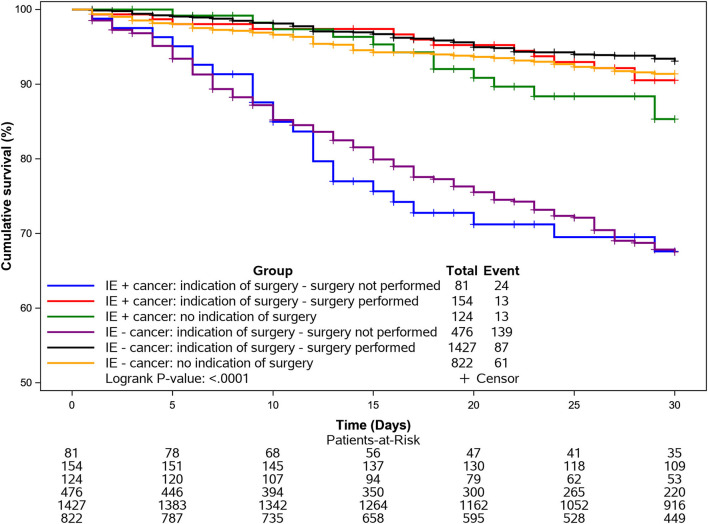
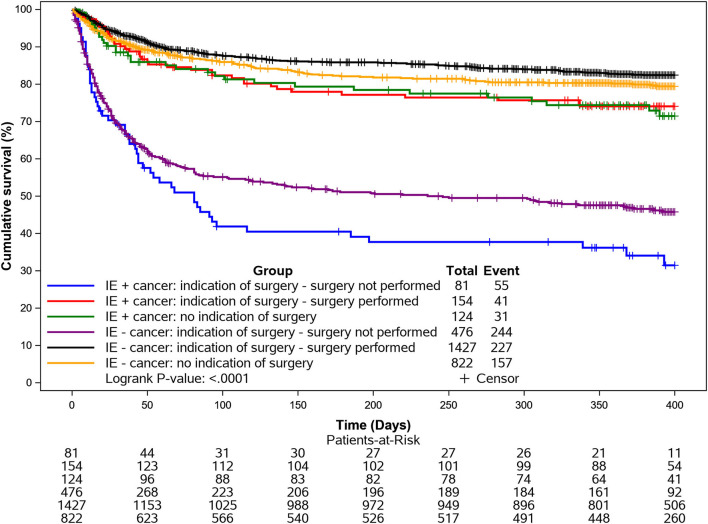
The interplay between cancer and IE has become of increasing interest. This study sought to assess the prevalence, baseline characteristics, management, and outcomes of IE cancer patients in the ESC EORP EURO-ENDO registry. Three thousand and eighty-five patients with IE were identified based on the ESC 2015 criteria. Three hundred and fifty-nine (11.6%) IE cancer patients were compared to 2,726 (88.4%) cancer-free IE patients. In cancer patients, IE was mostly community-acquired (74.8%). The most frequently identified microorganisms were (25.4%) and Enterococci (23.8%). The most frequent complications were acute renal failure (25.9%), embolic events (21.7%) and congestive heart failure (18.1%). Theoretical indication for cardiac surgery was not significantly different between groups (65.5 vs. 69.8%, = 0.091), but was effectively less performed when indicated in IE patients with cancer (65.5 vs. 75.0%, = 0.002). Compared to cancer-free IE patients, in-hospital and 1-year mortality occurred in 23.4 vs. 16.1%, = 0.006, and 18.0 vs. 10.2%; < 0.001, respectively. In IE cancer patients, predictors of mortality by multivariate analysis were creatinine > 2 mg/dL, congestive heart failure and unperformed cardiac surgery (when indicated). Cancer in IE patients is common and associated with a worse outcome. This large, observational cohort provides new insights concerning the contemporary profile, management, and clinical outcomes of IE cancer patients across a wide range of countries.
癌症与感染性心内膜炎(IE)之间的相互作用已越来越受到关注。本研究旨在评估欧洲心脏病学会(ESC)心内膜炎注册研究(EORP EURO-ENDO)中感染性心内膜炎合并癌症患者的患病率、基线特征、治疗及预后情况。根据ESC 2015标准,共识别出3085例感染性心内膜炎患者。将359例(11.6%)感染性心内膜炎合并癌症患者与2726例(88.4%)无癌症的感染性心内膜炎患者进行比较。在合并癌症的患者中,感染性心内膜炎大多为社区获得性(74.8%)。最常鉴定出的微生物是[此处原文缺失具体微生物名称](25.4%)和肠球菌(23.8%)。最常见的并发症是急性肾衰竭(25.9%)、栓塞事件(21.7%)和充血性心力衰竭(18.1%)。两组之间心脏手术的理论指征无显著差异(65.5%对69.8%,P = 0.091),但在合并癌症的感染性心内膜炎患者中,当有指征时实际进行心脏手术的比例较低(65.5%对75.0%,P = 0.002)。与无癌症的感染性心内膜炎患者相比,住院死亡率和1年死亡率分别为23.4%对16.1%,P = 0.006,以及18.0%对10.2%,P < 0.001。在感染性心内膜炎合并癌症的患者中,多因素分析显示死亡率的预测因素为肌酐>2mg/dL、充血性心力衰竭以及未进行心脏手术(有指征时)。感染性心内膜炎患者合并癌症很常见,且预后较差。这项大型观察性队列研究为广泛国家中感染性心内膜炎合并癌症患者的当代特征、治疗及临床结局提供了新的见解。