Digestion Center, Beijing Hospital of Traditional Chinese Medicine, Capital Medical University, Beijing, China.
Beijing University of Chinese Medicine, Beijing, China.
Biomed Res Int. 2021 Nov 23;2021:4579850. doi: 10.1155/2021/4579850. eCollection 2021.
Metabolomics was used to detect the secondary metabolites in SLBZP; the target protein was acquired by target fishing according to the compound's structure. The SymMap database was used to search herbal medicines for the target protein. The target gene of IBS gave rise to the common gene protein which is the potential target of SLBZP in IBS therapy. The interactions between target proteins were analyzed in a STRING database, the protein relationship network was analyzed using Cytoscape software, and the Kyoto Encyclopedia of Genes and Genomes enrichment analysis of the core target gene group was carried out in a DAVID database in order to construct the "compound-traditional Chinese medicine/molecule-target-pathway" network. Molecular docking was used to verify the core protein and its related small molecular compounds.
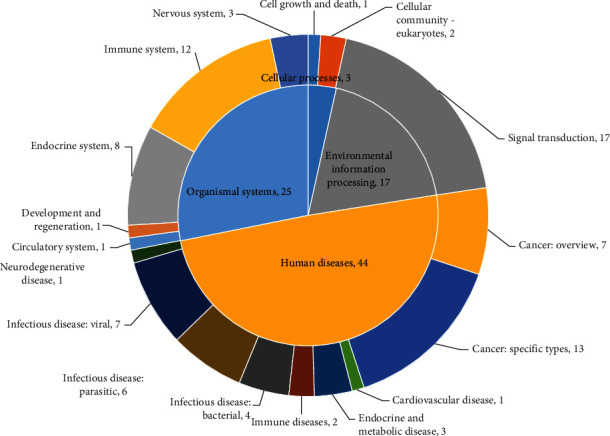
There were 129 types of secondary metabolites in SLBZP. 80 target proteins of these metabolites were potential core targets for IBS treatment including acetylcholinesterase (AChE), arachidonate-5-lipoxygenase (ALOX5), B-cell lymphoma-2 (BCL2), recombinant cyclin D1 (CCND1), and catenin-1 (CTNNB1), among others. Results from these targets indicated that the most enriched pathway was the tumor necrosis factor (TNF) signaling pathway ( < 0.001) and that the most abundant pathway was signal transduction. In the network nodes of the TNF signaling pathway, the Chinese medicines with the highest aggregation were Lablab semen album and Glycyrrhizae radix et rhizoma (degree = 11). The small molecules with the highest aggregation were oxypeucedanin and 3,5,6,7,8,3',4'-heptamethoxyflavone (degree = 4). Molecular docking results confirmed that daidzein 7-O-glucoside (daidzin) had the highest degree of binding to TNF proteins in the TNF signaling pathway.
This study shows that SLBZP can treat IBS by influencing multiple targets and pathways, of which the TNF signaling pathway may be the most significant. This typifies the pharmacological characteristics of traditional Chinese medicine, i.e., multiple targets, numerous pathways, and specific therapeutic effects on diseases. SLBZP can therefore be used as a candidate drug for clinical IBS by intervening in human signal transduction.
采用代谢组学方法检测 SLBZP 中的次生代谢产物;根据化合物结构,通过靶标捕捞获得靶标蛋白。使用 SymMap 数据库搜索目标蛋白的草药。IBS 的靶基因导致共同基因蛋白,这是 SLBZP 治疗 IBS 的潜在靶标。在 STRING 数据库中分析靶蛋白之间的相互作用,使用 Cytoscape 软件分析蛋白质关系网络,并在 DAVID 数据库中对核心靶基因组进行京都基因与基因组百科全书富集分析,构建“化合物-中药/分子-靶标-通路”网络。采用分子对接验证核心蛋白及其相关小分子化合物。
SLBZP 中有 129 种次生代谢产物。这些代谢产物的 80 个靶蛋白是治疗 IBS 的潜在核心靶标,包括乙酰胆碱酯酶(AChE)、花生四烯酸 5-脂氧合酶(ALOX5)、B 细胞淋巴瘤-2(BCL2)、重组周期蛋白 D1(CCND1)和连环蛋白-1(CTNNB1)等。这些靶标结果表明,最富集的途径是肿瘤坏死因子(TNF)信号通路(<0.001),最丰富的途径是信号转导。在 TNF 信号通路的网络节点中,聚集度最高的中药是莱菔子和甘草(度=11)。聚集度最高的小分子是 Oxypeucedanin 和 3,5,6,7,8,3',4'-heptamethoxyflavone(度=4)。分子对接结果证实,TNF 信号通路中 TNF 蛋白与大豆苷元 7-O-葡萄糖苷(大豆苷)的结合程度最高。
本研究表明,SLBZP 可以通过影响多个靶点和通路来治疗 IBS,其中 TNF 信号通路可能是最重要的。这体现了中药多靶点、多通路、对疾病有特异性治疗作用的药理学特点。因此,SLBZP 可以通过干预人体信号转导,作为治疗临床 IBS 的候选药物。