Longtin Yves, Gervais Philippe, Birnie David H, Wang Jia, Alings Marco, Philippon François, Parkash Ratika, Manlucu Jaimie, Angaran Paul, Rinne Claus, Coutu Benoit, Low R Aaron, Essebag Vidal, Morillo Carlos, Redfearn Damian, Toal Satish, Becker Giuliano, Degrâce Michel, Thibault Bernard, Crystal Eugene, Tung Stanley, LeMaitre John, Sultan Omar, Bennett Matthew, Bashir Jamil, Ayala-Paredes Felix, Rioux Leon, Hemels Martin E W, Bouwels Leon H R, Exner Derek V, Dorian Paul, Connolly Stuart J, Krahn Andrew D
Jewish General Hospital Sir Mortimer B. Davis, McGill University, Montreal, Quebec, Canada.
Lady Davis Research Institute, Montreal, Quebec, Canada.
Open Forum Infect Dis. 2021 Oct 14;8(11):ofab513. doi: 10.1093/ofid/ofab513. eCollection 2021 Nov.
The Prevention of Arrhythmia Device Infection Trial (PADIT) investigated whether intensification of perioperative prophylaxis could prevent cardiac implantable electronic device (CIED) infections. Compared with a single dose of cefazolin, the perioperative administration of cefazolin, vancomycin, bacitracin, and cephalexin did not significantly decrease the risk of infection. Our objective was to compare the microbiology of infections between study arms in PADIT.
This was a post hoc analysis. Differences between study arms in the microbiology of infections were assessed at the level of individual patients and at the level of microorganisms using the Fisher exact test.
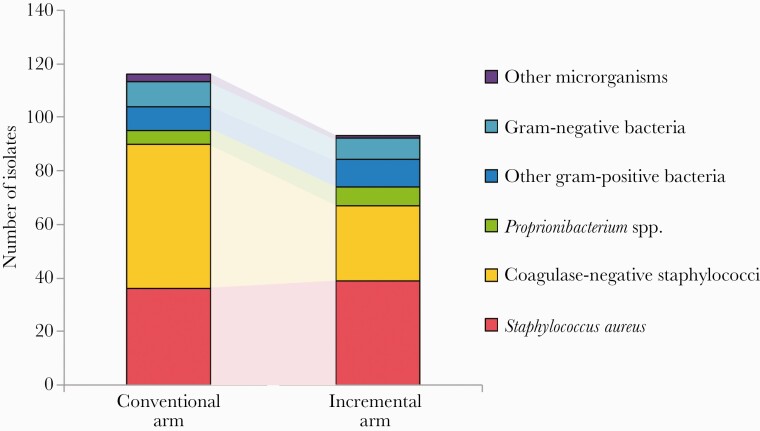
Overall, 209 microorganisms were reported from 177 patients. The most common microorganisms were coagulase-negative staphylococci (CoNS; 82/209 [39.2%]) and (75/209 [35.9%]). There was a significantly lower proportion of CoNS in the incremental arm compared with the standard arm (30.1% vs 46.6%; = .04). However, there was no significant difference between study arms in the frequency of recovery of other microorganisms. In terms of antimicrobial susceptibility, 26.5% of microorganisms were resistant to cefazolin. CoNS were more likely to be cefazolin-resistant in the incremental arm (52.2% vs 26.8%, respectively; = .05). However, there was no difference between study arms in terms of infections in which the main pathogen was sensitive to cefazolin (77.8% vs 64.3%; = .10) or vancomycin (90.8% vs 90.2%; = .90).
Intensification of the prophylaxis led to significant changes in the microbiology of infections, despite the absence of a decrease in the overall risk of infections. These findings provide important insight on the physiopathology of CIED infections.
NCT01002911.
心律失常装置感染预防试验(PADIT)研究了围手术期预防措施的强化是否可预防心脏植入式电子装置(CIED)感染。与单剂量头孢唑林相比,围手术期给予头孢唑林、万古霉素、杆菌肽和头孢氨苄并未显著降低感染风险。我们的目的是比较PADIT研究组间感染的微生物学情况。
这是一项事后分析。使用Fisher精确检验在个体患者层面和微生物层面评估研究组间感染微生物学的差异。
总体而言,177例患者报告了209种微生物。最常见的微生物是凝固酶阴性葡萄球菌(CoNS;82/209 [39.2%])和[此处原文缺失部分内容](75/209 [35.9%])。与标准组相比,强化组CoNS的比例显著更低(30.1%对46.6%;P = 0.04)。然而,研究组间其他微生物的检出频率无显著差异。在抗菌药敏方面,26.5%的微生物对头孢唑林耐药。强化组CoNS对头孢唑林耐药的可能性更高(分别为52.2%对26.8%;P = 0.05)。然而,研究组间主要病原体对头孢唑林敏感的感染(77.8%对64.3%;P = 0.10)或对万古霉素敏感的感染(90.8%对90.2%;P = 0.90)方面无差异。
尽管总体感染风险未降低,但预防措施的强化导致了感染微生物学的显著变化。这些发现为CIED感染的病理生理学提供了重要见解。
NCT01002911。