Blethen Kathryn E, Arsiwala Tasneem A, Fladeland Ross A, Sprowls Samuel A, Panchal Dhruvi M, Adkins Chris E, Kielkowski Brooke N, Earp Leland E, Glass Morgan J, Pritt Trenton A, Cabuyao Yssabela M, Aulakh Sonikpreet, Lockman Paul R
Department of Basic Pharmaceutical Sciences, School of Pharmacy, West Virginia University, Morgantown, West Virginia, USA.
Department of Chemical and Biomedical Engineering, Benjamin M. Statler College of Engineering and Mineral Resources, West Virginia University, Morgantown, West Virginia, USA.
Neurooncol Adv. 2021 Nov 27;3(Suppl 5):v133-v143. doi: 10.1093/noajnl/vdab123. eCollection 2021 Nov.
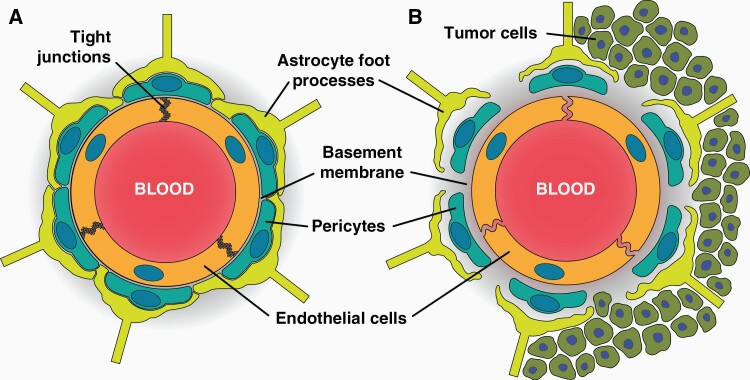
The blood-brain barrier is the selectively permeable vasculature of the brain vital for maintaining homeostasis and neurological function. Low permeability is beneficial in the presence of toxins and pathogens in the blood. However, in the presence of metastatic brain tumors, it is a challenge for drug delivery. Although the blood-tumor barrier is slightly leaky, it still is not permissive enough to allow the accumulation of therapeutic drug concentrations in brain metastases. Herein, we discuss the differences between primary brain tumors and metastatic brain tumors vasculature, effects of therapeutics on the blood-tumor barrier, and characteristics to be manipulated for more effective drug delivery.
血脑屏障是大脑具有选择性通透性的脉管系统,对维持体内平衡和神经功能至关重要。在血液中存在毒素和病原体的情况下,低通透性是有益的。然而,在存在转移性脑肿瘤的情况下,药物递送是一项挑战。尽管血瘤屏障有轻微渗漏,但它的通透性仍不足以使治疗药物浓度在脑转移瘤中蓄积。在此,我们讨论原发性脑肿瘤和转移性脑肿瘤脉管系统之间的差异、治疗方法对血瘤屏障的影响,以及为实现更有效的药物递送而需操控的特征。