Clinical Department of Neurology, Medical University of Innsbruck, 6020 Innsbruck, Austria.
Int J Mol Sci. 2023 Aug 11;24(16):12699. doi: 10.3390/ijms241612699.
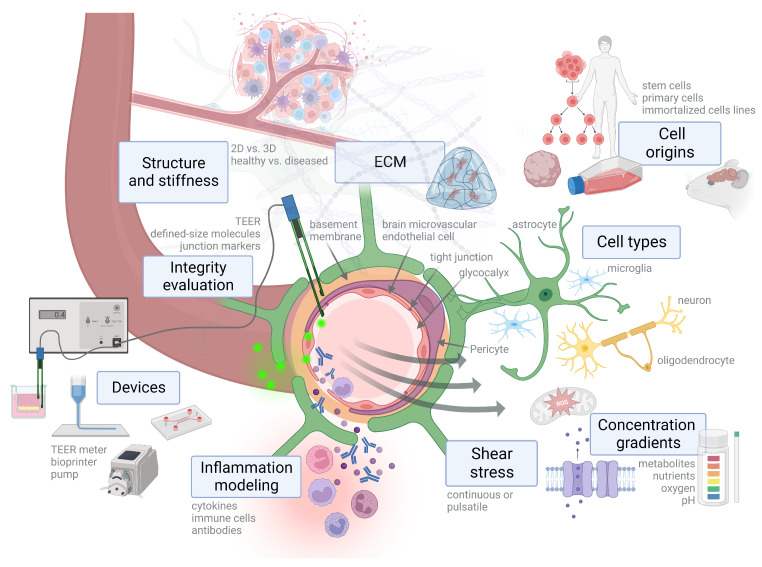
The blood-brain barrier, which is formed by tightly interconnected microvascular endothelial cells, separates the brain from the peripheral circulation. Together with other central nervous system-resident cell types, including pericytes and astrocytes, the blood-brain barrier forms the neurovascular unit. Upon neuroinflammation, this barrier becomes leaky, allowing molecules and cells to enter the brain and to potentially harm the tissue of the central nervous system. Despite the significance of animal models in research, they may not always adequately reflect human pathophysiology. Therefore, human models are needed. This review will provide an overview of the blood-brain barrier in terms of both health and disease. It will describe all key elements of the in vitro models and will explore how different compositions can be utilized to effectively model a variety of neuroinflammatory conditions. Furthermore, it will explore the existing types of models that are used in basic research to study the respective pathologies thus far.
血脑屏障由紧密连接的微血管内皮细胞组成,将大脑与外周循环隔开。血脑屏障与其他中枢神经系统驻留细胞类型(包括周细胞和星形胶质细胞)一起形成神经血管单元。在神经炎症时,这种屏障会变得渗漏,允许分子和细胞进入大脑,并有可能损害中枢神经系统的组织。尽管动物模型在研究中具有重要意义,但它们并不总是能充分反映人类的病理生理学。因此,需要人类模型。这篇综述将从健康和疾病两个方面概述血脑屏障。它将描述体外模型的所有关键要素,并探讨如何利用不同的成分来有效地模拟各种神经炎症状态。此外,它还将探讨目前用于基础研究的各种模型,以研究迄今为止的各种病理学。