Neurology, Neurophysiology and Neurobiology Unit, Department of Medicine, Università Campus Bio-Medico di Roma, Via Alvaro del Portillo 200, Rome, 00128, Italy.
UOC Neurologia, Fondazione Policlinico Universitario Agostino Gemelli IRCCS, Rome, Italy.
Neurotherapeutics. 2022 Jan;19(1):325-333. doi: 10.1007/s13311-021-01165-9. Epub 2021 Dec 3.
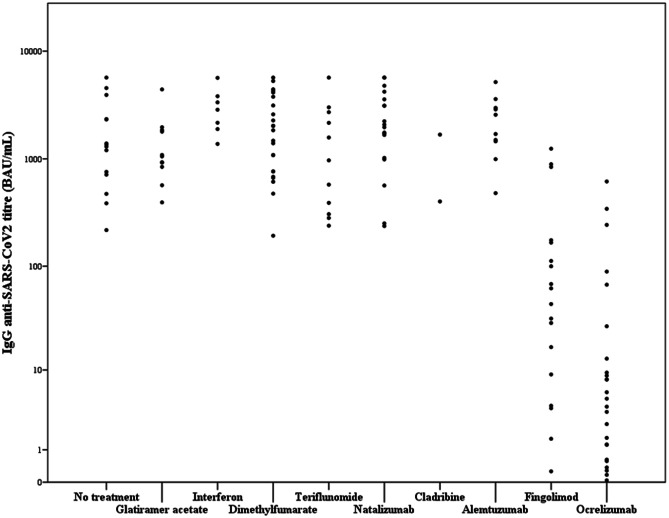
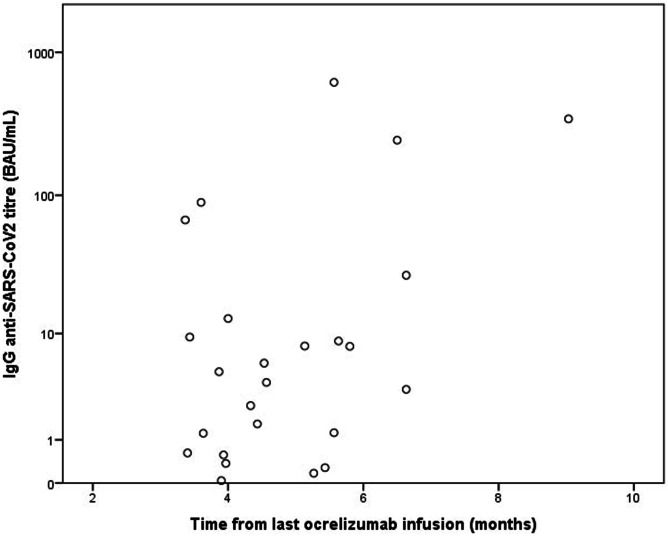
The potential impact of disease-modifying therapies (DMTs) for multiple sclerosis (MS) on COVID-19 vaccination is poorly understood. According to recent observations, the humoral immune response could be impaired in patients treated with ocrelizumab or fingolimod. Our study evaluated the immunogenicity and safety of mRNA COVID-19 vaccines in a convenience sample of 140 MS patients treated with different DMTs, undergoing vaccination between April and June 2021. Humoral immune response was tested 1 month after the second dose, using a chemiluminescent microparticle immunoassay to detect IgG against SARS-CoV-2 nucleoprotein. We explored the potential correlation between the IgG titer and DMTs. All patients in treatment with first-line DMTs, natalizumab, cladribine, and alemtuzumab, developed a measurable humoral response. In patients treated with ocrelizumab and fingolimod, the IgG level was significantly lower, but only some patients (22.2% for fingolimod and 66% for ocrelizumab) failed to develop a measurable humoral response. In the ocrelizumab group, the IgG level was positively correlated with the time from last infusion. No SARS-CoV-2 infections were reported after vaccination. The most reported side effects were pain at the injection site (57.1%) and fatigue (37.9%). No patient experienced severe side effects requiring hospitalization. Our study confirms that COVID-19 vaccination is safe and well-tolerated in MS patients and should be recommended to all patients regardless of their current DMTs. Since fingolimod and ocrelizumab could reduce the humoral immune response, in patients treated with these drugs, detecting SARS-CoV-2 antibodies could be helpful to monitor the immune response after vaccination.
疾病修正疗法 (DMTs) 对多发性硬化症 (MS) 患者接种 COVID-19 疫苗的潜在影响知之甚少。根据最近的观察结果,奥瑞珠单抗或芬戈利莫德治疗的患者可能会损害体液免疫反应。我们的研究评估了在接受不同 DMT 治疗的 140 名 MS 患者的方便样本中,mRNA COVID-19 疫苗的免疫原性和安全性,这些患者在 2021 年 4 月至 6 月期间接受了疫苗接种。在第二次接种后 1 个月,使用化学发光微粒子免疫测定法检测针对 SARS-CoV-2 核蛋白的 IgG,以测试体液免疫反应。我们探讨了 IgG 滴度与 DMT 之间的潜在相关性。接受一线 DMT(那他珠单抗、克拉屈滨和阿仑单抗)治疗的所有患者均产生可测量的体液反应。接受奥瑞珠单抗和芬戈利莫德治疗的患者 IgG 水平明显较低,但只有部分患者(芬戈利莫德为 22.2%,奥瑞珠单抗为 66%)未能产生可测量的体液反应。在奥瑞珠单抗组中,IgG 水平与最后一次输注之间的时间呈正相关。接种疫苗后没有报告 COVID-19 感染。报告最多的副作用是注射部位疼痛(57.1%)和疲劳(37.9%)。没有患者出现需要住院治疗的严重副作用。我们的研究证实,COVID-19 疫苗在 MS 患者中是安全且耐受良好的,应推荐给所有患者,无论其当前的 DMT 如何。由于芬戈利莫德和奥瑞珠单抗可能会降低体液免疫反应,因此在接受这些药物治疗的患者中,检测 SARS-CoV-2 抗体可能有助于监测接种疫苗后的免疫反应。