Department of Ophthalmology, Peking University People's Hospital Eye diseases and optometry institute, Beijing, China.
Beijing Key Laboratory of Diagnosis and Therapy of Retinal and Choroid Diseases, Beijing, China.
Invest Ophthalmol Vis Sci. 2021 Dec 1;62(15):4. doi: 10.1167/iovs.62.15.4.
To investigate the clinical findings in Chinese patients diagnosed with familial exudative vitreoretinopathy (FEVR) and carrying pathogenic mutations.
One hundred twenty unrelated patients with FEVR were enrolled in this study. Genomic DNA and ophthalmic examinations were collected from all the patients and their available relatives. Targeted next-generation sequencing was performed to detect mutations. In silico programs were used to evaluate the pathogenicity of all the mutations.
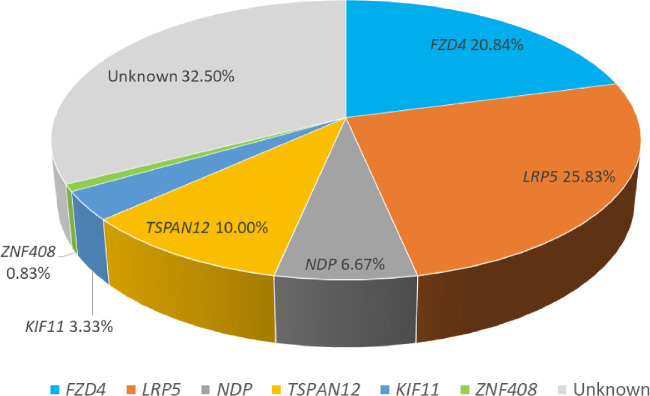
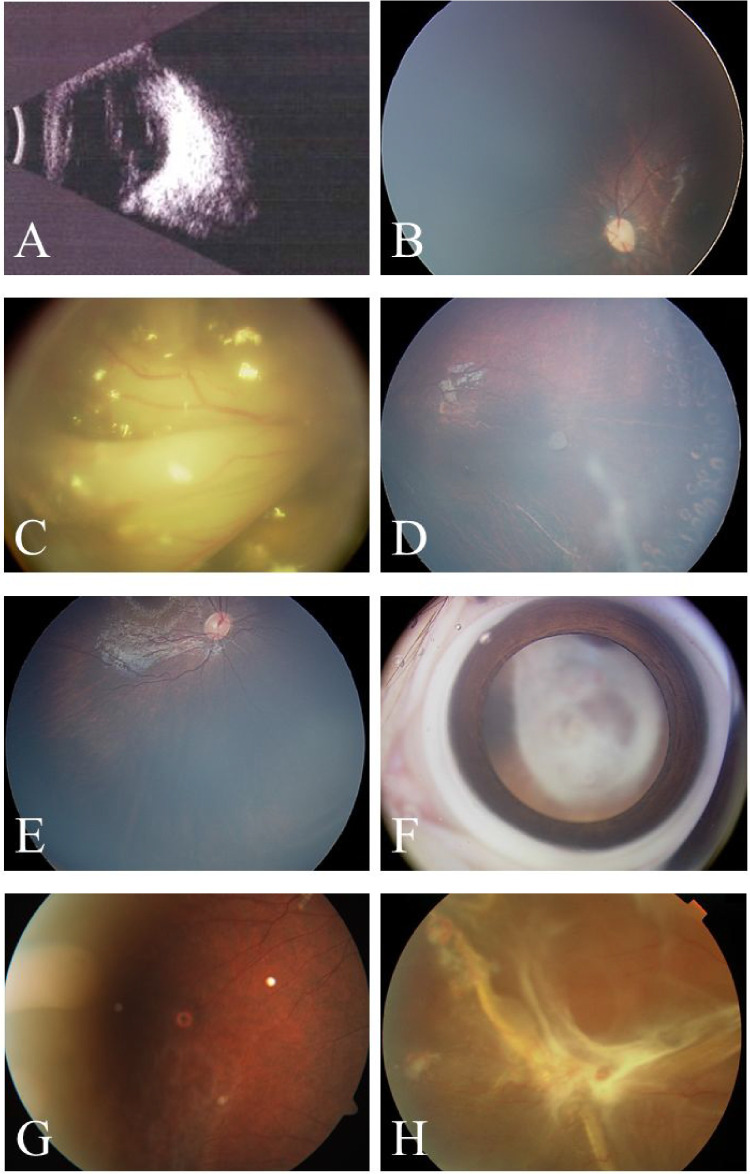
Eighty identified mutations were found in 81 unrelated patients (31/81 in LRP5, 25/81 in FZD4, 12/81 in TSPAN12, 8/81 in NDP, 4/81 in KIF11, and 1/81 in ZNF408). Among those mutations, 53 were novel (23/35 in LRP5, 15/21 in FZD4, 8/11 in TSPAN12, 3/8 in NDP, 3/4 in KIF11, 1/1 in ZNF408). Patients with LRP5, FZD4, TSPAN12, or NDP mutations were mainly classified into stage 4 and stage 5 and one-half of patients with KIF11 mutations were in stage 4. In addition, all the patients in NDP group were found to have bilateral symmetry in FEVR stage.
Our results present profound phenotypic variability and a wide mutation spectrum of FEVR in the Chinese population, which could be useful for a precise and comprehensive genetic diagnosis for patients with FEVR in the future.
研究诊断为家族渗出性玻璃体视网膜病变(FEVR)并携带致病性突变的中国患者的临床发现。
本研究纳入了 120 名无血缘关系的 FEVR 患者。从所有患者及其可利用的亲属中采集基因组 DNA 和眼科检查。进行靶向下一代测序以检测突变。使用计算机程序评估所有突变的致病性。
在 81 名无血缘关系的患者中发现了 80 个已识别的突变(31/81 在 LRP5 中,25/81 在 FZD4 中,12/81 在 TSPAN12 中,8/81 在 NDP 中,4/81 在 KIF11 中,1/81 在 ZNF408 中)。这些突变中有 53 个是新的(23/35 在 LRP5 中,15/21 在 FZD4 中,8/11 在 TSPAN12 中,3/8 在 NDP 中,3/4 在 KIF11 中,1/1 在 ZNF408 中)。携带 LRP5、FZD4、TSPAN12 或 NDP 突变的患者主要被分类为 4 期和 5 期,一半的 KIF11 突变患者处于 4 期。此外,NDP 组的所有患者均发现 FEVR 分期存在双侧对称性。
我们的结果显示,中国人群中的 FEVR 表现出深刻的表型变异性和广泛的突变谱,这对未来 FEVR 患者的精确和全面遗传诊断可能有用。