Kang Sungsu, Kim Ji-Hyun, Lee Minyoung, Yu Ji Woong, Kim Joodeok, Kang Dohun, Baek Hayeon, Bae Yuna, Kim Byung Hyo, Kang Seulki, Shim Sangdeok, Park So-Jung, Lee Won Bo, Hyeon Taeghwan, Sung Jaeyoung, Park Jungwon
School of Chemical and Biological Engineering, and Institute of Chemical Process, Seoul National University, Seoul 08826, Republic of Korea.
Center for Nanoparticle Research, Institute for Basic Science (IBS), Seoul 08826, Republic of Korea.
Sci Adv. 2021 Dec 3;7(49):eabi5419. doi: 10.1126/sciadv.abi5419.
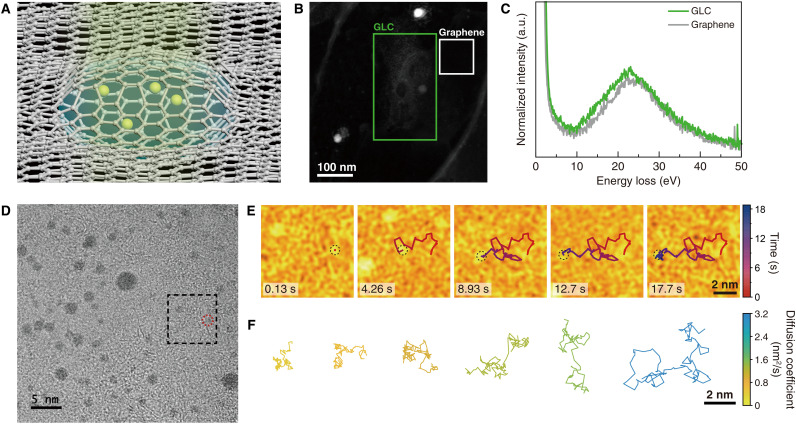
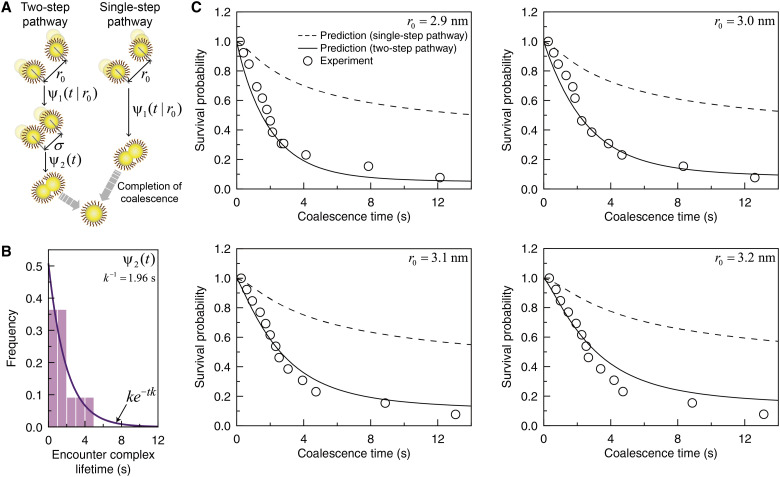
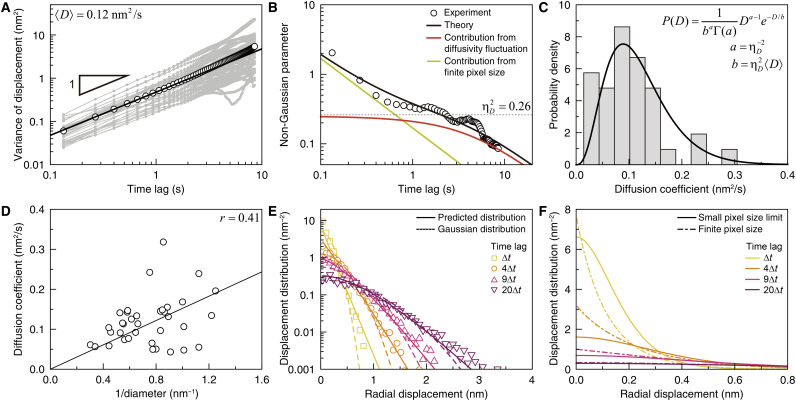
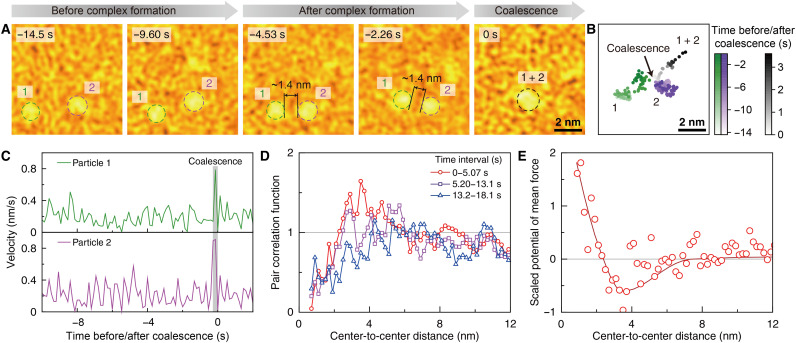
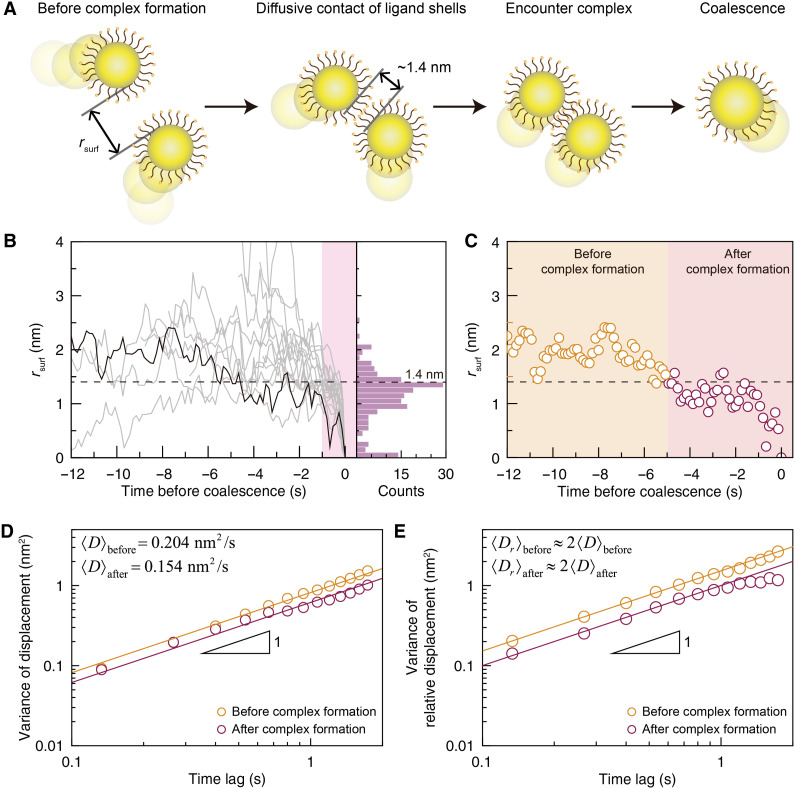
Thermal motion of colloidal nanoparticles and their cohesive interactions are of fundamental importance in nanoscience but are difficult to access quantitatively, primarily due to the lack of the appropriate analytical tools to investigate the dynamics of individual particles at nanoscales. Here, we directly monitor the stochastic thermal motion and coalescence dynamics of gold nanoparticles smaller than 5 nm, using graphene liquid cell (GLC) transmission electron microscopy (TEM). We also present a novel model of nanoparticle dynamics, providing a unified, quantitative explanation of our experimental observations. The nanoparticles in a GLC exhibit non-Gaussian, diffusive motion, signifying dynamic fluctuation of the diffusion coefficient due to the dynamically heterogeneous environment surrounding nanoparticles, including organic ligands on the nanoparticle surface. Our study shows that the dynamics of nanoparticle coalescence is controlled by two elementary processes: diffusion-limited encounter complex formation and the subsequent coalescence of the encounter complex through rotational motion, where surface-passivating ligands play a critical role.
胶体纳米颗粒的热运动及其内聚相互作用在纳米科学中具有至关重要的意义,但难以进行定量研究,主要原因是缺乏合适的分析工具来研究纳米尺度下单个颗粒的动力学。在此,我们使用石墨烯液体池(GLC)透射电子显微镜(TEM)直接监测小于5 nm的金纳米颗粒的随机热运动和聚结动力学。我们还提出了一种新颖的纳米颗粒动力学模型,对我们的实验观察结果提供了统一的定量解释。GLC中的纳米颗粒表现出非高斯扩散运动,这表明由于纳米颗粒周围动态异质的环境(包括纳米颗粒表面的有机配体),扩散系数存在动态波动。我们的研究表明,纳米颗粒聚结的动力学由两个基本过程控制:扩散限制的相遇复合物形成以及随后相遇复合物通过旋转运动的聚结,其中表面钝化配体起着关键作用。