Ye Ye, Barapatre Seemran, Davis Michael K, Elliston Keith O, Davatzikos Christos, Fedorov Andrey, Fillion-Robin Jean-Christophe, Foster Ian, Gilbertson John R, Lasso Andras, Miller James V, Morgan Martin, Pieper Steve, Raumann Brigitte E, Sarachan Brion D, Savova Guergana, Silverstein Jonathan C, Taylor Donald P, Zelnis Joyce B, Zhang Guo-Qiang, Cuticchia Jamie, Becich Michael J
Department of Biomedical Informatics, School of Medicine, University of Pittsburgh, Pittsburgh, PA, United States.
Axiomedix, Inc., Bedford, MA, United States.
J Med Internet Res. 2021 Dec 2;23(12):e20028. doi: 10.2196/20028.
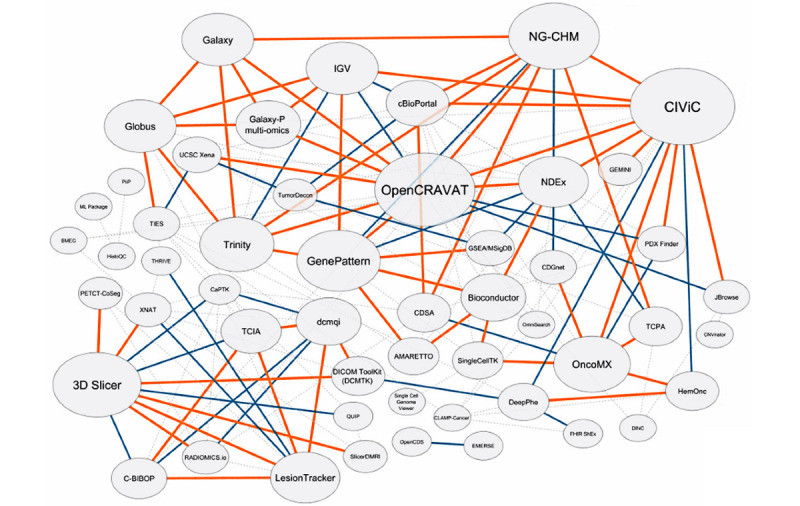
The National Cancer Institute Informatics Technology for Cancer Research (ITCR) program provides a series of funding mechanisms to create an ecosystem of open-source software (OSS) that serves the needs of cancer research. As the ITCR ecosystem substantially grows, it faces the challenge of the long-term sustainability of the software being developed by ITCR grantees. To address this challenge, the ITCR sustainability and industry partnership working group (SIP-WG) was convened in 2019.
The charter of the SIP-WG is to investigate options to enhance the long-term sustainability of the OSS being developed by ITCR, in part by developing a collection of business model archetypes that can serve as sustainability plans for ITCR OSS development initiatives. The working group assembled models from the ITCR program, from other studies, and from the engagement of its extensive network of relationships with other organizations (eg, Chan Zuckerberg Initiative, Open Source Initiative, and Software Sustainability Institute) in support of this objective.
This paper reviews the existing sustainability models and describes 10 OSS use cases disseminated by the SIP-WG and others, including 3D Slicer, Bioconductor, Cytoscape, Globus, i2b2 (Informatics for Integrating Biology and the Bedside) and tranSMART, Insight Toolkit, Linux, Observational Health Data Sciences and Informatics tools, R, and REDCap (Research Electronic Data Capture), in 10 sustainability aspects: governance, documentation, code quality, support, ecosystem collaboration, security, legal, finance, marketing, and dependency hygiene.
Information available to the public reveals that all 10 OSS have effective governance, comprehensive documentation, high code quality, reliable dependency hygiene, strong user and developer support, and active marketing. These OSS include a variety of licensing models (eg, general public license version 2, general public license version 3, Berkeley Software Distribution, and Apache 3) and financial models (eg, federal research funding, industry and membership support, and commercial support). However, detailed information on ecosystem collaboration and security is not publicly provided by most OSS.
We recommend 6 essential attributes for research software: alignment with unmet scientific needs, a dedicated development team, a vibrant user community, a feasible licensing model, a sustainable financial model, and effective product management. We also stress important actions to be considered in future ITCR activities that involve the discussion of the sustainability and licensing models for ITCR OSS, the establishment of a central library, the allocation of consulting resources to code quality control, ecosystem collaboration, security, and dependency hygiene.
美国国立癌症研究所癌症研究信息技术(ITCR)项目提供了一系列资助机制,以创建一个满足癌症研究需求的开源软件(OSS)生态系统。随着ITCR生态系统的大幅增长,它面临着由ITCR受资助者开发的软件的长期可持续性挑战。为应对这一挑战,ITCR可持续性与行业合作工作组(SIP-WG)于2019年成立。
SIP-WG的章程是研究提高ITCR所开发OSS长期可持续性的选项,部分是通过开发一系列商业模式原型,这些原型可作为ITCR OSS开发计划的可持续性计划。该工作组从ITCR项目、其他研究以及其与其他组织(如 Chan Zuckerberg倡议、开源倡议和软件可持续性研究所)的广泛关系网络的参与中收集模型,以支持这一目标。
本文回顾了现有的可持续性模型,并描述了由SIP-WG及其他机构传播的10个OSS用例,包括3D Slicer、Bioconductor、Cytoscape、Globus、i2b2(整合生物学与床边信息学)和tranSMART、Insight Toolkit、Linux、观察性健康数据科学与信息学工具、R以及REDCap(研究电子数据采集),涉及10个可持续性方面:治理、文档、代码质量、支持、生态系统合作、安全、法律、财务、营销和依赖关系管理。
公开可得的信息显示,所有10个OSS都有有效的治理、全面的文档、高质量的代码、可靠的依赖关系管理、强大的用户和开发者支持以及积极的营销。这些OSS包括多种许可模式(如通用公共许可证第2版、通用公共许可证第3版、伯克利软件发行版和Apache 3)和财务模式(如联邦研究资助、行业和会员支持以及商业支持)。然而,大多数OSS并未公开提供有关生态系统合作和安全的详细信息。
我们推荐研究软件应具备六项基本属性:与未满足的科学需求保持一致、有专门的开发团队、有活跃的用户社区、有可行的许可模式、有可持续的财务模式以及有效的产品管理。我们还强调了在未来ITCR活动中应考虑的重要行动,包括讨论ITCR OSS的可持续性和许可模式、建立中央库、分配咨询资源用于代码质量控制、生态系统合作、安全和依赖关系管理。