Department of Gastroenterology, Faculty of Medicine, Hormozgan University of Medical Sciences, Bandar Abbas, Iran.
Student Research Committee, Faculty of Medicine, Hormozgan University of Medical Sciences, Bandar Abbas, Iran.
BMC Gastroenterol. 2021 Dec 3;21(1):453. doi: 10.1186/s12876-021-02038-3.
Non-alcoholic fatty liver disease (NAFLD) is the most common chronic liver disease worldwide. Researchers have tried to develop indices to assess liver fibrosis in NAFLD patients to avoid liver biopsy. In this study we aimed to compare fibrosis-4 (FIB-4), aspartate aminotransferase (AST) to platelet ratio index (APRI), and aspartate aminotransferase/alanine aminotransferase (AST/ALT) ratio with FibroScan for the assessment of hepatic fibrosis in patients with NAFLD.
This cross-sectional study included patients with NAFLD or non-alcoholic steatohepatitis (NASH) referred to the Gastroenterology Clinic of Shahid Mohammadi Hospital, Bandar Abbas, Iran, in 2019. Demographic features of the participants including age and gender were recorded. All participants underwent FibroScan and had their AST, ALT, and platelet count measured in a random blood sample, taken within 1 month of the FibroScan.
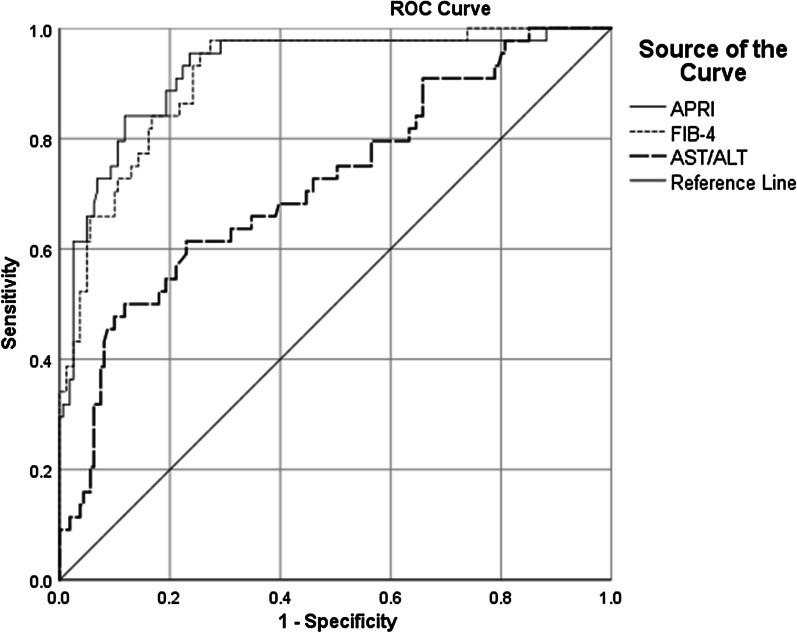
Of the 205 NAFLD patients included in this study with a mean age of 42.95 ± 10.97 years, 144 (70.2%) were male. Fibroscan results revealed that 94 patients (45.9%) had F1, 67 (32.7%) F2, 29 (14.1%) F3, and 15 (7.3%) F4 liver fibrosis. A significant correlation was found between FibroScan score and FIB-4 (r = 0.572), APRI (r = 0.667), and AST/ALT (r = 0.251) (P < 0.001). Sensitivity, specificity, positive predictive value, negative predictive value, and accuracy of APRI at the 0.702 cut-off for the differentiation of F3 and F4 from F2 and F1 were 84.1, 88.2, 66.1, 95.3, and 87.3%, FIB-4 at the 1.19 cut-off 97.7, 72.7, 49.4, 99.2 and 78%, and AST/ALT at the 0.94 cut-off 61.4, 77, 42.2, 87.9, and 73.7% respectively. Moreover, the area under the receiver operating curve of APRI, FIB-4, and AST/ALT for the differentiation of F3 and F4 from F2 and F1 was 0.923, 0.913, and 0.720, respectively.
Based on these results, APRI appears to be the most appropriate substitute of FibroScan for the detection of significant fibrosis in NAFLD patients. FIB-4 was the second best, suggesting that in case of FibroScan unavailability, APRI and FIB-4 are the best indices to assess liver fibrosis in NAFLD patients.
非酒精性脂肪性肝病(NAFLD)是全球最常见的慢性肝病。研究人员试图开发评估 NAFLD 患者肝纤维化的指数以避免肝活检。本研究旨在比较纤维化 4 指数(FIB-4)、天门冬氨酸氨基转移酶(AST)与血小板比值指数(APRI)和天门冬氨酸氨基转移酶/丙氨酸氨基转移酶(AST/ALT)比值与 FibroScan 在评估 NAFLD 患者肝纤维化中的作用。
本横断面研究纳入了 2019 年在伊朗班达尔阿巴斯沙希德莫哈马迪医院消化科就诊的 NAFLD 或非酒精性脂肪性肝炎(NASH)患者。记录了参与者的人口统计学特征,包括年龄和性别。所有参与者均接受了 FibroScan 检查,并在 FibroScan 检查后 1 个月内随机抽取一份血样,检测 AST、ALT 和血小板计数。
本研究共纳入 205 例平均年龄为 42.95±10.97 岁的 NAFLD 患者,其中 144 例(70.2%)为男性。Fibroscan 结果显示,94 例(45.9%)患者为 F1,67 例(32.7%)为 F2,29 例(14.1%)为 F3,15 例(7.3%)为 F4 肝纤维化。FibroScan 评分与 FIB-4(r=0.572)、APRI(r=0.667)和 AST/ALT(r=0.251)呈显著正相关(P<0.001)。APRI 在区分 F3 和 F4 与 F2 和 F1 的 0.702 截断值时的敏感性、特异性、阳性预测值、阴性预测值和准确性分别为 84.1%、88.2%、66.1%、95.3%和 87.3%,FIB-4 在 1.19 截断值时为 97.7%、72.7%、49.4%、99.2%和 78%,AST/ALT 在 0.94 截断值时为 61.4%、77%、42.2%、87.9%和 73.7%。此外,APRI、FIB-4 和 AST/ALT 区分 F3 和 F4 与 F2 和 F1 的受试者工作特征曲线下面积分别为 0.923、0.913 和 0.720。
基于这些结果,APRI 似乎是检测 NAFLD 患者显著纤维化的 FibroScan 最适宜替代物。FIB-4 是第二佳选择,提示在 FibroScan 不可用时,APRI 和 FIB-4 是评估 NAFLD 患者肝纤维化的最佳指数。