Medical Clinic 1, University Clinic, Friedrich Alexander University, Erlangen, Germany
Deutsches Zentrum Immuntherapie, Erlangen, Germany.
Gut. 2022 Dec;71(12):2414-2429. doi: 10.1136/gutjnl-2021-324725. Epub 2021 Dec 3.
Bleeding ulcers and erosions are hallmarks of active ulcerative colitis (UC). However, the mechanisms controlling bleeding and mucosal haemostasis remain elusive.
We used high-resolution endoscopy and colon tissue samples of active UC (n = 36) as well as experimental models of physical and chemical mucosal damage in mice deficient for peptidyl-arginine deiminase-4 (PAD4), gnotobiotic mice and controls. We employed endoscopy, histochemistry, live-cell microscopy and flow cytometry to study eroded mucosal surfaces during mucosal haemostasis.
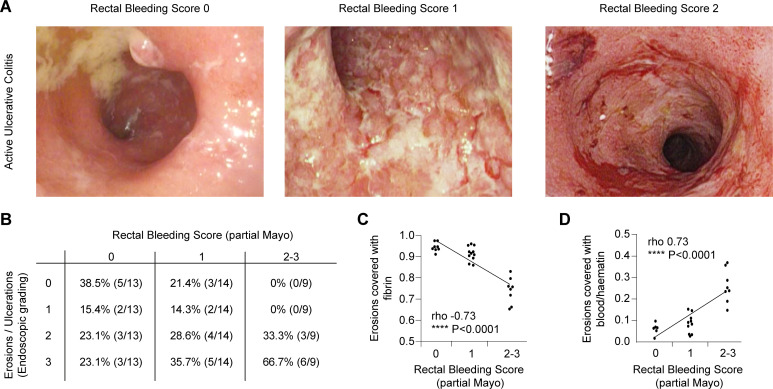
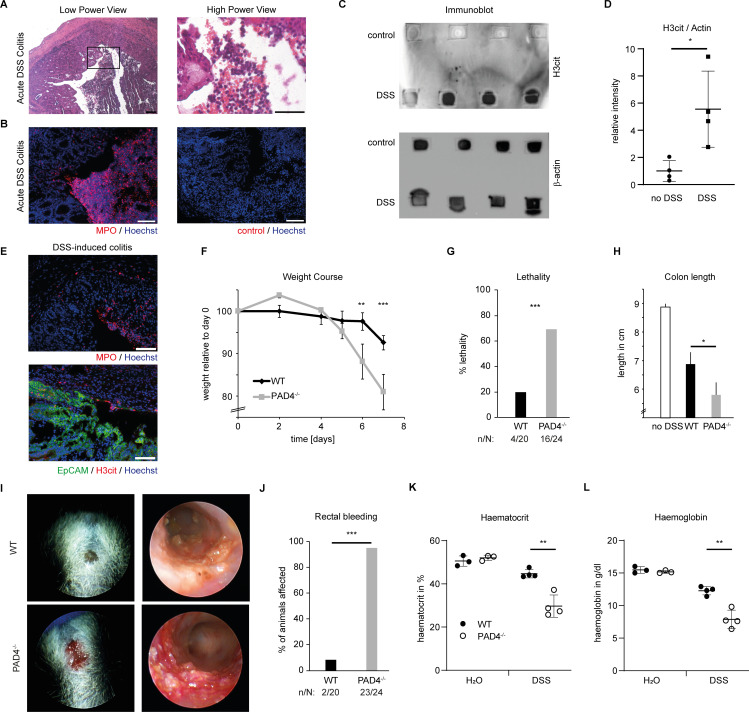
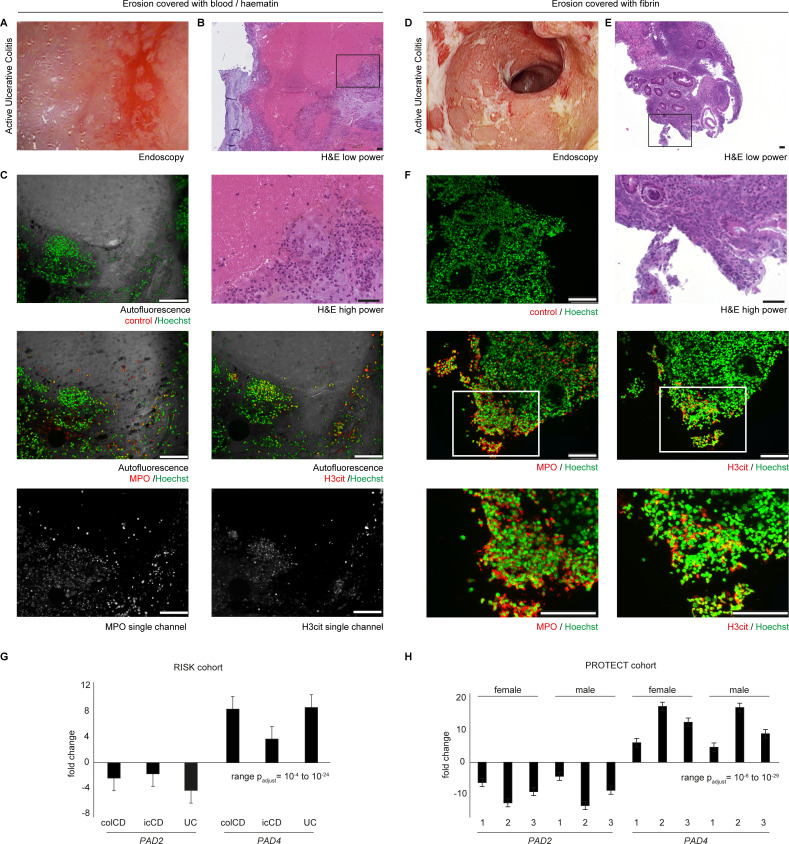
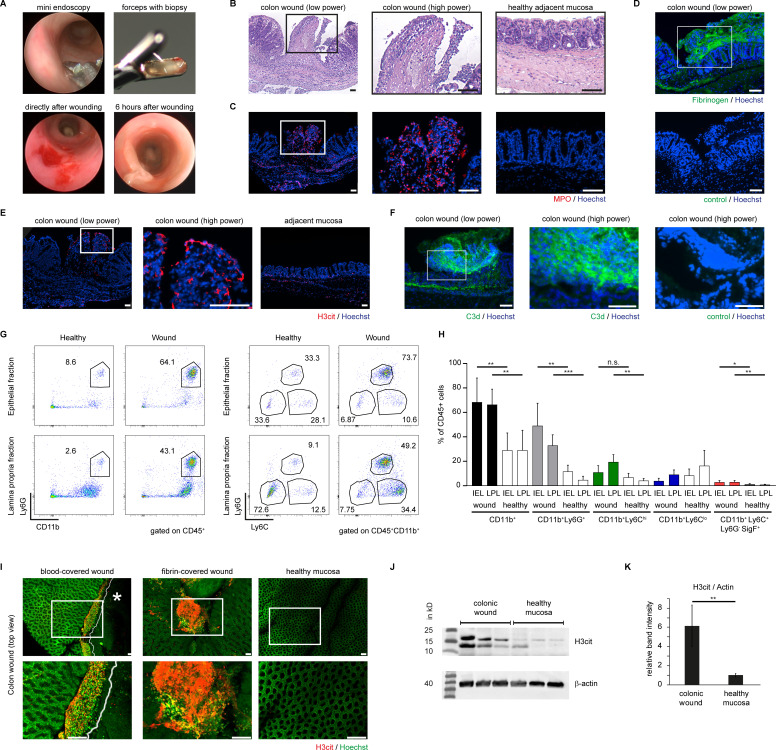
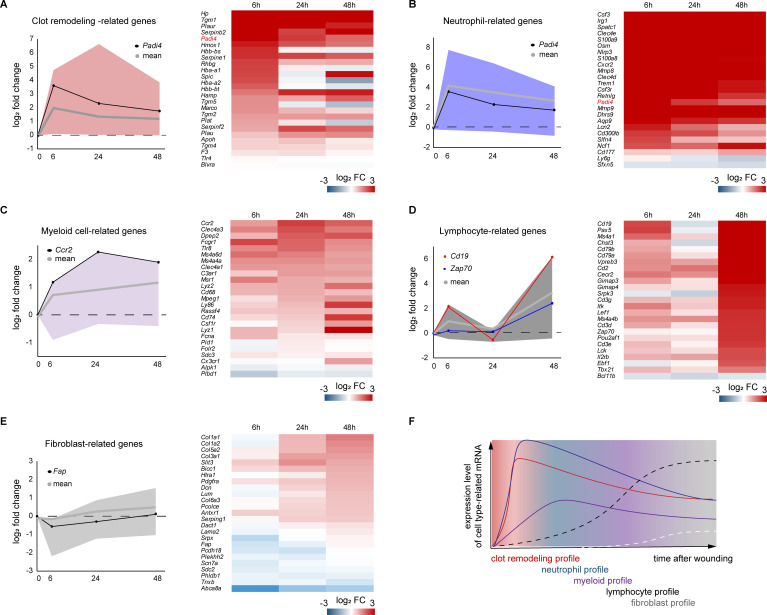
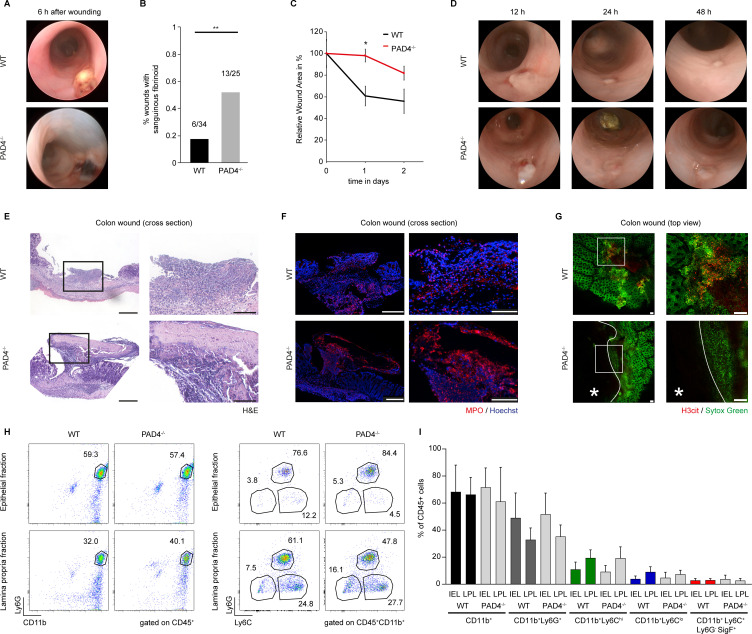
Erosions and ulcerations in UC were covered by fresh blood, haematin or fibrin visible by endoscopy. Fibrin layers rather than fresh blood or haematin on erosions were inversely correlated with rectal bleeding in UC. Fibrin layers contained ample amounts of neutrophils coaggregated with neutrophil extracellular traps (NETs) with detectable activity of PAD. Transcriptome analyses showed significantly elevated expression in active UC. In experimentally inflicted wounds, we found that neutrophils underwent NET formation in a PAD4-dependent manner hours after formation of primary blood clots, and remodelled clots to immunothrombi containing citrullinated histones, even in the absence of microbiota. PAD4-deficient mice experienced an exacerbated course of dextrane sodium sulfate-induced colitis with markedly increased rectal bleeding (96 % vs 10 %) as compared with controls. PAD4-deficient mice failed to remodel blood clots on mucosal wounds eliciting impaired healing. Thus, NET-associated immunothrombi are protective in acute colitis, while insufficient immunothrombosis is associated with rectal bleeding.
Our findings uncover that neutrophils induce secondary immunothrombosis by PAD4-dependent mechanisms. Insufficient immunothrombosis may favour rectal bleeding in UC.
出血性溃疡和糜烂是溃疡性结肠炎(UC)活动期的特征。然而,控制出血和黏膜止血的机制仍不清楚。
我们使用了高分辨率内镜和活动期 UC(n=36)的结肠组织样本,以及缺乏肽基精氨酸脱亚氨酶-4(PAD4)的小鼠、无菌小鼠和对照小鼠的物理和化学黏膜损伤实验模型。我们采用内镜、组织化学、活细胞显微镜和流式细胞术来研究黏膜止血过程中糜烂的黏膜表面。
UC 中的糜烂和溃疡被内镜下可见的新鲜血液、血铁素或纤维蛋白覆盖。在 UC 中,糜烂处的纤维蛋白层而不是新鲜血液或血铁素与直肠出血呈负相关。纤维蛋白层中含有大量与中性粒细胞细胞外陷阱(NETs)共聚集的中性粒细胞,并且可以检测到 PAD 的活性。转录组分析显示,在活动期 UC 中表达显著升高。在实验性伤口中,我们发现中性粒细胞在原发性血栓形成数小时后以 PAD4 依赖的方式发生 NET 形成,并将血栓重塑为含有瓜氨酸化组蛋白的免疫血栓,即使在没有微生物群的情况下也是如此。与对照组相比,葡聚糖硫酸钠诱导的结肠炎中 PAD4 缺陷型小鼠的疾病严重程度加重,直肠出血明显增加(96%对 10%)。PAD4 缺陷型小鼠未能在黏膜伤口上重塑血栓,导致愈合受损。因此,NET 相关的免疫血栓在急性结肠炎中具有保护作用,而免疫血栓形成不足与直肠出血相关。
我们的研究结果揭示了中性粒细胞通过 PAD4 依赖的机制诱导继发性免疫血栓形成。免疫血栓形成不足可能有利于 UC 中的直肠出血。