
三种用于量化慢性阻塞性肺疾病机械通气患者动态肺过度充气的床旁技术。
Three bedside techniques to quantify dynamic pulmonary hyperinflation in mechanically ventilated patients with chronic obstructive pulmonary disease.
作者信息
Roesthuis L H, van der Hoeven J G, Guérin C, Doorduin J, Heunks L M A
机构信息
Department of Intensive Care Medicine, Radboud University Medical Center, Geert Grooteplein-Zuid 10, 6525 GA, Nijmegen, The Netherlands.
Service de Medicine Intensive Réanimation, Hôpital Edouard Herriot, Lyon, France.
出版信息
Ann Intensive Care. 2021 Dec 4;11(1):167. doi: 10.1186/s13613-021-00948-9.
BACKGROUND
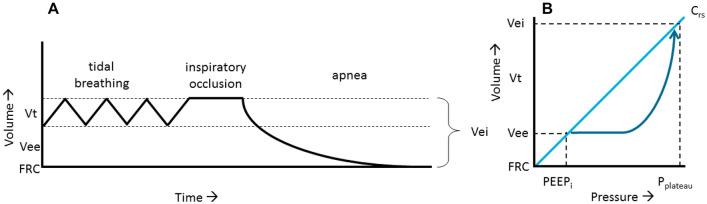
Dynamic pulmonary hyperinflation may develop in patients with chronic obstructive pulmonary disease (COPD) due to dynamic airway collapse and/or increased airway resistance, increasing the risk of volutrauma and hemodynamic compromise. The reference standard to quantify dynamic pulmonary hyperinflation is the measurement of the volume at end-inspiration (Vei). As this is cumbersome, the aim of this study was to evaluate if methods that are easier to perform at the bedside can accurately reflect Vei.
METHODS
Vei was assessed in COPD patients under controlled protective mechanical ventilation (7 ± mL/kg) on zero end-expiratory pressure, using three techniques in a fixed order: (1) reference standard (Vei): passive exhalation to atmosphere from end-inspiration in a calibrated glass burette; (2) ventilator maneuver (Vei): measuring the expired volume during a passive exhalation of 45s using the ventilator flow sensor; (3) formula (Vei): (Vt × P)/(P - PEEP), with Vt tidal volume, P is plateau pressure after an end-inspiratory occlusion, and PEEP is intrinsic positive end-expiratory pressure after an end-expiratory occlusion. A convenience sample of 17 patients was recruited.
RESULTS
Vei was 1030 ± 380 mL and had no significant correlation with P (r = 0.06; P = 0.3710) or PEEP (r = 0.11; P = 0.2156), and was inversely related with P (calculated as P -PEEP) (r = 0.49; P = 0.0024). A low bias but rather wide limits of agreement and fairly good correlations were found when comparing Vei and Vei to Vei. Vei remained stable during the study period (low bias 15 mL with high agreement (95% limits of agreement from - 100 to 130 mL) and high correlation (r = 0.98; P < 0.0001) between both measurements of Vei).
CONCLUSIONS
In patients with COPD, airway pressures are not a valid representation of Vei. The three techniques to quantify Vei show low bias, but wide limits of agreement.
背景
慢性阻塞性肺疾病(COPD)患者可能因动态气道塌陷和/或气道阻力增加而发生动态肺过度充气,从而增加容积伤和血流动力学受损的风险。量化动态肺过度充气的参考标准是吸气末容积(Vei)的测量。由于这一操作繁琐,本研究的目的是评估在床边更容易实施的方法是否能准确反映Vei。
方法
在7±mL/kg的控制性保护性机械通气、呼气末压力为零的情况下,对COPD患者的Vei进行评估,按固定顺序使用三种技术:(1)参考标准(Vei):在经过校准的玻璃量管中从吸气末被动呼气至大气;(2)通气机操作(Vei):使用通气机流量传感器测量45秒被动呼气期间的呼出容积;(3)公式(Vei):(潮气量×平台压)/(平台压-内源性呼气末正压),其中潮气量为Vt,平台压为吸气末屏气后的平台压,内源性呼气末正压为呼气末屏气后的内源性呼气末正压。招募了17例患者的便利样本。
结果
Vei为1030±380 mL,与平台压(r = 0.06;P = 0.3710)或内源性呼气末正压(r = 0.11;P = 0.2156)无显著相关性,与计算得出的平台压(平台压-内源性呼气末正压)呈负相关(r = 0.49;P = 0.0024)。比较Vei与Vei以及Vei与Vei时,发现偏差较小但一致性界限较宽且相关性较好。在研究期间Vei保持稳定(偏差为15 mL,一致性较高(95%一致性界限为-100至130 mL),两次Vei测量之间相关性较高(r = 0.98;P < 0.0001))。
结论
在COPD患者中,气道压力不能有效代表Vei。量化Vei的三种技术显示偏差较小,但一致性界限较宽。



 Zotero 插件