Department of Cardiology, Aarhus University Hospital, Palle Juul-Jensens Boulevard 99, Aarhus N, Denmark.
Department of Cardiology, Odense University Hospital, Odense, Denmark.
BMC Cardiovasc Disord. 2021 Dec 4;21(1):579. doi: 10.1186/s12872-021-02312-y.
It was recently shown that new-onset diabetes patients without previous cardiovascular disease have experienced a markedly reduced risk of adverse cardiovascular events from 1996 to 2011. However, it remains unknown if similar improvements are present following the diagnosis of chronic coronary syndrome. The purpose of this study was to examine the change in cardiovascular risk among diabetes patients with chronic coronary syndrome from 2004 to 2016.
We included patients with documentation of coronary artery disease by coronary angiography between 2004 and 2016 in Western Denmark. Patients were stratified by year of index coronary angiography (2004-2006, 2007-2009, 2010-2012, and 2013-2016) and followed for two years. The main outcome was major adverse cardiovascular events (MACE) defined as myocardial infarction, ischemic stroke, or death. Analyses were performed separately in patients with and without diabetes. We estimated two-year risk of each outcome and adjusted incidence rate ratios (aIRR) using patients examined in 2004-2006 as reference.
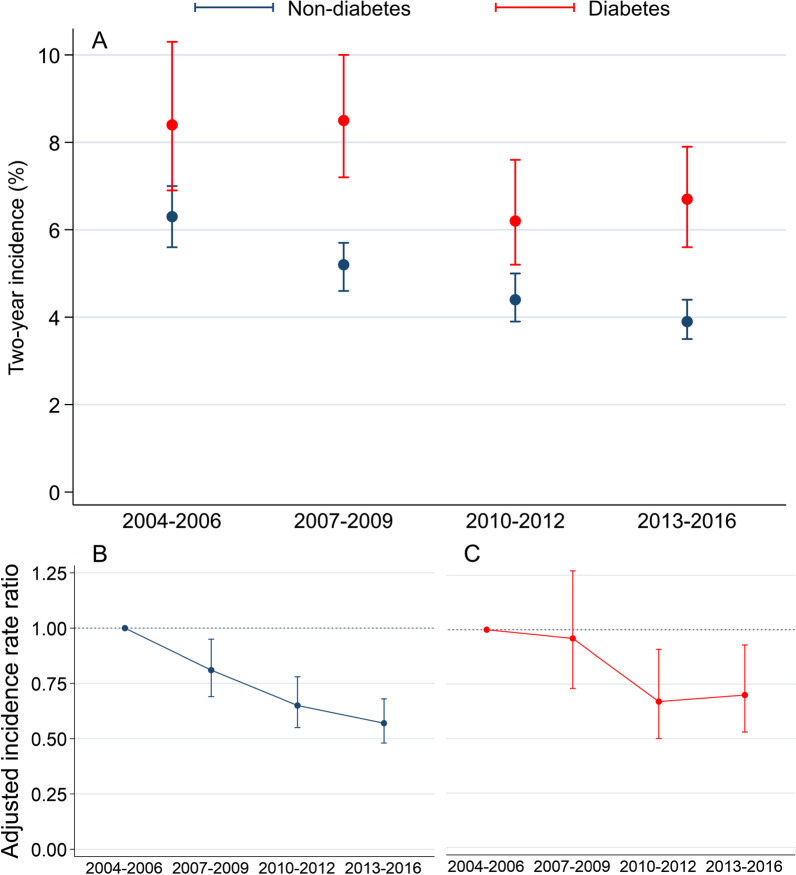
Among 5931 patients with diabetes, two-year MACE risks were 8.4% in 2004-2006, 8.5% in 2007-2009, and then decreased to 6.2% in 2010-2012 and 6.7% in 2013-2016 (2013-2016 vs 2004-2006: aIRR 0.70, 95% CI 0.53-0.93). In comparison, 23,540 patients without diabetes had event rates of 6.3%, 5.2%, 4.2%, and 3.9% for the study intervals (2013-2016 vs 2004-2006: aIRR 0.57, 95% CI 0.48-0.68).
Between 2004 and 2016, the two-year relative risk of MACE decreased by 30% in patients with diabetes and chronic coronary syndrome, but slightly larger absolute and relative reductions were observed in patients without diabetes.
最近的研究表明,1996 年至 2011 年期间,新发糖尿病患者且无既往心血管疾病史者发生不良心血管事件的风险显著降低。然而,在诊断为慢性冠状动脉综合征后是否存在类似的改善尚不清楚。本研究旨在探讨 2004 年至 2016 年间患有慢性冠状动脉综合征的糖尿病患者心血管风险的变化。
我们纳入了 2004 年至 2016 年期间在丹麦西部通过冠状动脉造影确诊为冠心病的患者。患者按索引冠状动脉造影年份分层(2004-2006 年、2007-2009 年、2010-2012 年和 2013-2016 年),随访两年。主要终点是主要不良心血管事件(MACE),定义为心肌梗死、缺血性卒中和死亡。分别在有和无糖尿病的患者中进行分析。我们估计了每种结局的两年风险,并使用 2004-2006 年检查的患者作为参考,调整了发病率比(aIRR)。
在 5931 名患有糖尿病的患者中,2004-2006 年、2007-2009 年和 2010-2012 年的两年 MACE 风险分别为 8.4%、8.5%和 6.2%,而 2013-2016 年的风险降至 6.7%(2013-2016 年与 2004-2006 年相比:aIRR 0.70,95%CI 0.53-0.93)。相比之下,23540 名无糖尿病的患者在研究期间的事件发生率分别为 6.3%、5.2%、4.2%和 3.9%(2013-2016 年与 2004-2006 年相比:aIRR 0.57,95%CI 0.48-0.68)。
2004 年至 2016 年间,患有糖尿病和慢性冠状动脉综合征的患者发生 MACE 的两年相对风险降低了 30%,但无糖尿病患者的绝对和相对降幅更大。