European Commission, Joint Research Centre (JRC), Ispra, Italy.
European Commission, Directorate-General Research and Innovation (DG RTD), Brussels, Belgium.
Regul Toxicol Pharmacol. 2022 Feb;128:105093. doi: 10.1016/j.yrtph.2021.105093. Epub 2021 Dec 2.
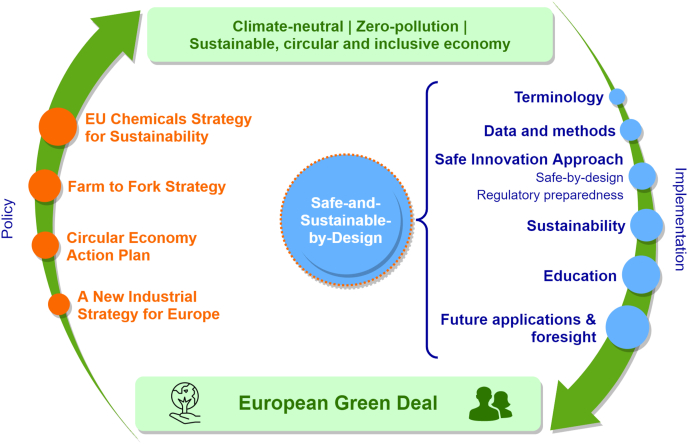
The European Commission's Green Deal is a major policy initiative aiming to achieve a climate-neutral, zero-pollution, sustainable, circular and inclusive economy, driving both the New Industrial Strategy for Europe and the Chemicals Strategy for Sustainability. Innovative materials can help to reach these policy goals, but they need to be safe and sustainable themselves. Thus, one aim is to shift the development of chemicals to Safe- and Sustainable-by-Design, and define a new systems approach and criteria for sustainability to achieve this. An online workshop was organised in September 2020 by the Joint Research Centre and the Directorate-General Research and Innovation of the European Commission, with participants from academia, non-governmental organisations, industry and regulatory bodies. The aims were to introduce the concept of Safe- and Sustainable-by-Design, to identify industrial and regulatory challenges in achieving safer and more sustainable Smart Nanomaterials as an example of innovative materials, and to deliver recommendations for directions and actions necessary to meet these challenges. The following needs were identified: (i) an agreed terminology, (ii) a common understanding of the principles of Safe- and Sustainable-by-Design, iii) criteria, assessment tools and incentives to achieve a transition from Safe-by-Design to Safe- and Sustainable-by-Design, and (iv) preparedness of regulators and legislation for innovative chemicals/nanomaterials. This paper presents the authors' view on the state of the art as well as the needs for future activities, based on discussions at the workshop and further considerations. The case of Smart Nanomaterials is used to illustrate the Safe- and Sustainable-by-Design concept and challenges for its implementation. Most of the considerations can be extended to other advanced materials and to chemicals and products in general.
欧盟委员会的绿色协议是一项重大政策倡议,旨在实现气候中和、零污染、可持续、循环和包容性的经济,推动欧洲新工业战略和化学品可持续性战略的发展。创新材料可以帮助实现这些政策目标,但它们本身需要安全和可持续。因此,目标之一是将化学品的发展转向安全和可持续设计,并定义新的可持续性系统方法和标准来实现这一目标。2020 年 9 月,欧盟联合研究中心和研究与创新总局联合举办了一次网络研讨会,来自学术界、非政府组织、工业界和监管机构的代表参加了会议。会议的目的是介绍安全和可持续设计的概念,确定在实现更安全和更可持续的智能纳米材料方面的工业和监管挑战,为应对这些挑战提出必要的方向和行动建议。会议确定了以下需求:(i)达成一致的术语,(ii)对安全和可持续设计原则的共同理解,(iii)实现从设计安全到安全和可持续设计的过渡的标准、评估工具和激励措施,以及(iv)监管机构和立法者对创新化学品/纳米材料的准备情况。本文根据研讨会的讨论和进一步的考虑,介绍了作者对现有技术水平以及未来活动需求的看法。智能纳米材料的案例被用来说明安全和可持续设计的概念以及实施所面临的挑战。大多数考虑因素都可以扩展到其他先进材料以及化学品和一般产品。