ZHAW Zurich University of Applied Sciences, School of Health Professions, Research Institute for Midwifery Science, Katharina-Sulzer-Platz 9, Winterthur 8401, Switzerland; ZHAW Zurich University of Applied Sciences, ZHAW digital, Gertrudstrasse 15, Winterthur 8401, Switzerland.
ZHAW Zurich University of Applied Sciences, School of Health Professions, Research Institute for Midwifery Science, Katharina-Sulzer-Platz 9, Winterthur 8401, Switzerland.
Midwifery. 2022 Feb;105:103201. doi: 10.1016/j.midw.2021.103201. Epub 2021 Nov 11.
To explore midwives' perceptions of the advantages of telemedicine during the COVID-19 pandemic in Switzerland.
Cross-sectional study based on an online survey using quantitative methods.
Midwives working in Switzerland.
Self-selected convenience sample of 630 members of the Swiss Federation of Midwives.
Open questions on advantages of health care at a distance and workrelated characteristics were used in the online questionnaire. The information was coded and integrative content analysis was applied.
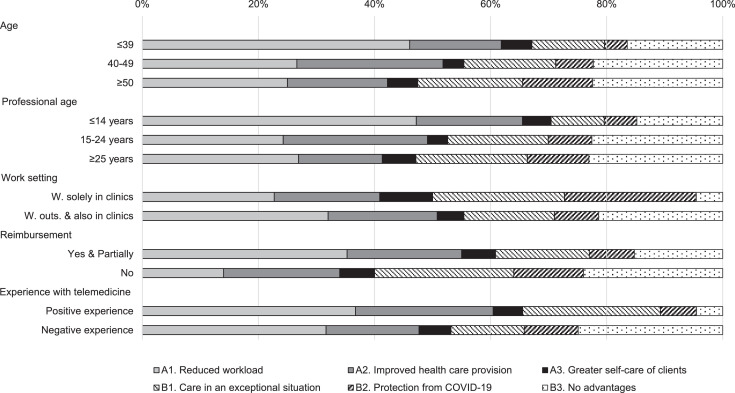
A good half of the respondents associated telemedicine with either an advantage beyond the pandemic ("Reduced workload", "Improved health care provision", "Greater self-care of clients"), while the others saw a pandemic-related advantage ("Protection from COVID-19", "Maintaining care/counseling in an exceptional situation"), or no advantage at all. Older, more experienced midwives were less likely to see an advantage beyond the pandemic. The motive "Reduced workload" was positively associated with professionals aged younger than 40 years and midwives with up to 14 years of professional experience, and "Protection from COVID-19" was more likely cited by midwives aged 50 and more and by midwives working solely in hospitals. Midwives who stated "Maintaining care" and "Improved health care provision" as motives to embrace telemedicine were more likely to experience health care at a distance as a positive treatment alternative.
Midwives' perceptions of the advantages of health care at a distance vary substantially with age and years of professional experience, as well as workrelated characteristics. Further research is necessary to acquire a sound understanding of underlying reasons, including the sources of the general attitudes involved.
Understanding the differences in perceptions of health care at a distance is important in order to improve the work situation of midwives and the health care they provide to women and families. Different sensitivities represent an important source in the ongoing discussion about the future use of telemedicine in health care.
探索瑞士助产士在 COVID-19 大流行期间对远程医疗优势的看法。
基于在线调查的横断面研究,采用定量方法。
在瑞士工作的助产士。
瑞士助产士联合会的 630 名成员自行选择的便利样本。
在线问卷中使用了关于远程医疗优势和与工作相关特征的开放性问题。信息进行了编码,并应用了综合内容分析。
一半以上的受访者认为远程医疗具有超越大流行的优势(“减轻工作量”、“改善医疗服务提供”、“增强客户自我护理”),而其他人则认为具有与大流行相关的优势(“免受 COVID-19 保护”、“在特殊情况下维持护理/咨询”),或者根本没有优势。年龄较大、经验较丰富的助产士不太可能看到超越大流行的优势。“减轻工作量”的动机与年龄在 40 岁以下的专业人士以及专业经验不超过 14 年的助产士呈正相关,而“免受 COVID-19 保护”则更有可能被年龄在 50 岁及以上的助产士以及仅在医院工作的助产士引用。将“维持护理”和“改善医疗服务提供”作为接受远程医疗的动机的助产士更有可能将远程医疗视为一种积极的治疗替代方案。
助产士对远程医疗优势的看法因年龄和专业经验年限以及工作相关特征而异。需要进一步研究以深入了解潜在原因,包括所涉及的一般态度的来源。
了解对远程医疗的看法差异对于改善助产士的工作状况以及他们为妇女和家庭提供的医疗保健非常重要。不同的敏感性是医疗保健中远程医疗未来使用持续讨论的一个重要来源。