Institute of Cancer and Genomic Sciences, University of Birmingham, Birmingham, UK.
Sandwell and West Birmingham NHS Trust, Birmingham, UK.
BJOG. 2022 Jun;129(7):1122-1132. doi: 10.1111/1471-0528.17041. Epub 2022 Jan 10.
To investigate quality of life (QoL) and association with surgical complexity and disease burden after surgical resection for advanced ovarian cancer in centres with variation in surgical approach.
Prospective multicentre observational study.
Gynaecological cancer surgery centres in the UK, Kolkata, India, and Melbourne, Australia.
Patients undergoing surgical resection (with low, intermediate or high surgical complexity score, SCS) for late-stage ovarian cancer.
Primary: change in global score on the European Organisation for Research and Treatment of Cancer (EORTC) core quality-of-life questionnaire (QLQ-C30). Secondary: EORTC ovarian cancer module (OV28), progression-free survival.
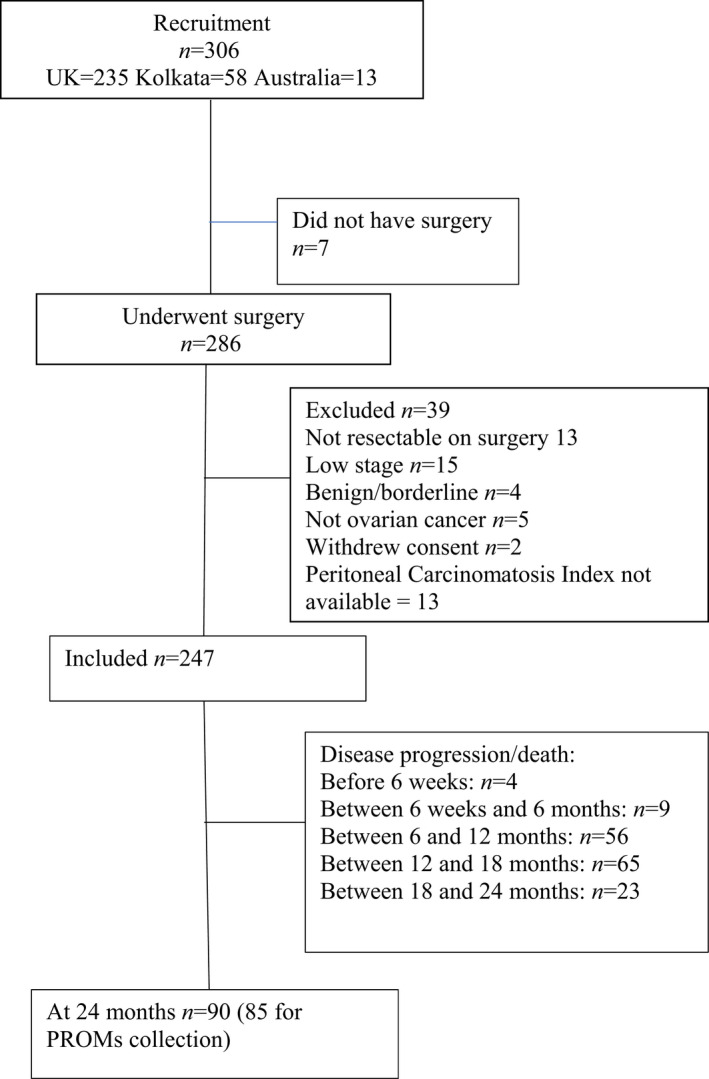
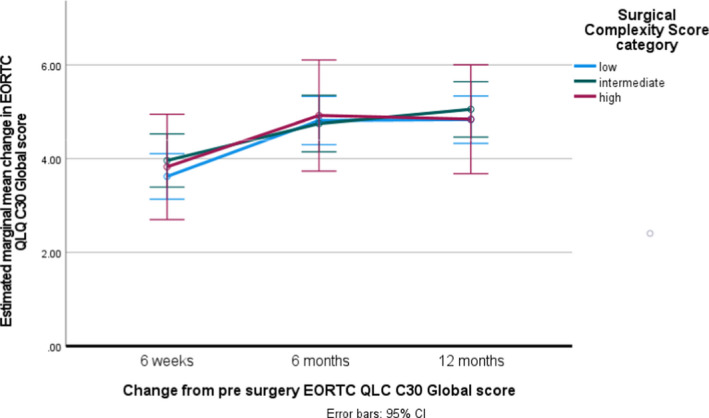
Patients' preoperative disease burden and SCS varied between centres, confirming differences in surgical ethos. QoL response rates were 90% up to 18 months. Mean change from the pre-surgical baseline in the EORTC QLQ-C30 was 3.4 (SD 1.8, n = 88) in the low, 4.0 (SD 2.1, n = 55) in the intermediate and 4.3 (SD 2.1, n = 52) in the high-SCS group after 6 weeks (p = 0.048), and 4.3 (SD 2.1, n = 51), 5.1 (SD 2.2, n = 41) and 5.1 (SD 2.2, n = 35), respectively, after 12 months (p = 0.133). In a repeated-measures model, there were no clinically or statistically meaningful differences in EORTC QLQ-C30 global scores between the three SCS groups (p = 0.840), but there was a small statistically significant improvement in all groups over time (p < 0.001). The high-SCS group experienced small to moderate decreases in physical (p = 0.004), role (p = 0.016) and emotional (p = 0.001) function at 6 weeks post-surgery, which resolved by 6-12 months.
The global QoL of patients undergoing low-, intermediate- and high-SCS surgery improved at 12 months after surgery and was no worse in patients undergoing extensive surgery.
Compared with surgery of lower complexity, extensive surgery does not result in poorer quality of life in patients with advanced ovarian cancer.
调查在手术方法存在差异的中心,接受高级卵巢癌手术切除后的生活质量(QoL)及其与手术复杂性和疾病负担的关系。
前瞻性多中心观察性研究。
英国、印度加尔各答和澳大利亚墨尔本的妇科癌症手术中心。
接受晚期卵巢癌手术切除(低、中、高手术复杂度评分,SCS)的患者。
主要指标:欧洲癌症研究与治疗组织(EORTC)核心生活质量问卷(QLQ-C30)全球评分的变化。次要指标:EORTC 卵巢癌模块(OV28)、无进展生存期。
患者术前疾病负担和 SCS 在中心之间存在差异,证实了手术理念的差异。QoL 缓解率在 18 个月内高达 90%。与术前基线相比,6 周后低 SCS 组的 EORTC QLQ-C30 平均变化为 3.4(SD 1.8,n=88),中 SCS 组为 4.0(SD 2.1,n=55),高 SCS 组为 4.3(SD 2.1,n=52)(p=0.048),12 个月后分别为 4.3(SD 2.1,n=51)、5.1(SD 2.2,n=41)和 5.1(SD 2.2,n=35)(p=0.133)。在重复测量模型中,三组 SCS 之间 EORTC QLQ-C30 全球评分在临床和统计学上均无显著差异(p=0.840),但所有组在随访期间均有较小的统计学显著改善(p<0.001)。高 SCS 组在手术后 6 周时经历了身体(p=0.004)、角色(p=0.016)和情绪(p=0.001)功能的小到中度下降,在 6-12 个月时得到缓解。
接受低、中、高 SCS 手术的患者的全球 QoL 在手术后 12 个月时得到改善,广泛手术的患者 QoL 并不更差。
与低复杂性手术相比,广泛手术不会导致晚期卵巢癌患者的生活质量更差。