MSc programme, King's College London, Institute of Psychiatry, Psychology and Neuroscience, London, UK.
Occupational Health Department, Guy's and St Thomas' NHS Foundation Trust and King's College, London, UK.
BMC Med Educ. 2021 Dec 5;21(1):599. doi: 10.1186/s12909-021-03032-9.
Although medical students have a duty to seek advice for their health conditions, they tend to avoid disclosure and help-seeking behaviours, therefore potentially posing a risk to themselves and their patients. The literature regarding their decisions to seek help or disclose health conditions is limited. The study's purpose was to explore the factors that determine disclosure and help-seeking decision processes by medical students who have health conditions with or without disability.
We recruited by purposive sampling and conducted in-depth semi-structured interviews with 11 male and female medical students from a UK medical school, who had physical or mental health disorders. Thematic analysis was used to identify themes. A mix of inductive and deductive techniques was used while using an organising framework proposed by Llewellyn-Thomas (1995).
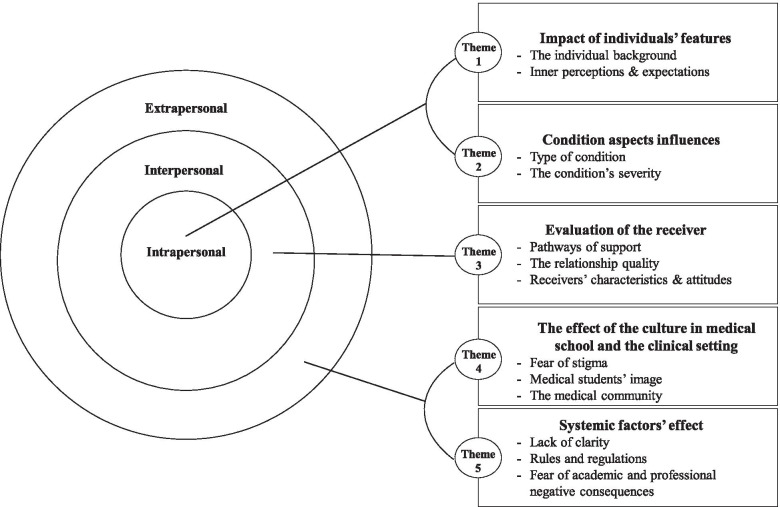
The impact of individuals' features, such as personality traits on medical students' disclosure and help-seeking decisions were identified. Different aspects of the condition, such as its type and severity were found to influence these decisions. Participants made an evaluation of the potential receiver of a disclosure, consisting of factors such as the receiver's characteristics and attitudes. The culture of the medical environment, such as role models, had a major impact on their decisions. Finally, systemic factors, such as the lack of clarity of policies influenced students' decisions.
Medical students' disclosure and help-seeking decision processes are influenced by risk-benefit evaluations and factors in interlinked spheres of their lives. They tend to avoid or postpone disclosure and seeking help, especially when the university is involved, due to a perceived risk to their future. Future research should examine the role of personality traits and the medical culture. Medical schools should encourage earlier help-seeking and disclosure behaviours by clarifying procedures and building trust via online and confidential platforms; interpersonal channels and normalisation processes within the medical education and the profession as a whole.
尽管医学生有义务为自己的健康状况寻求建议,但他们往往避免披露和寻求帮助的行为,因此可能对自己和患者构成风险。关于他们寻求帮助或披露健康状况的决定的文献有限。本研究的目的是探讨有或没有残疾的健康状况的医学生决定披露和寻求帮助的过程中的决定因素。
我们通过目的性抽样招募,并对来自英国一所医学院的 11 名男女医学生进行了深入的半结构化访谈,这些学生患有身体或精神健康障碍。使用主题分析来确定主题。在使用 Llewellyn-Thomas(1995 年)提出的组织框架的同时,使用了归纳和演绎技术的混合。
确定了个人特征(如个性特征)对医学生披露和寻求帮助的决定的影响。还发现病情的不同方面,例如病情的类型和严重程度,会影响这些决定。参与者对披露的潜在接受者进行了评估,其中包括接受者的特征和态度等因素。医学环境的文化,例如榜样,对他们的决定产生了重大影响。最后,系统因素,例如政策缺乏明确性,影响了学生的决策。
医学生的披露和寻求帮助的决策过程受到风险-收益评估和他们生活中相互关联领域的因素的影响。由于未来可能存在风险,他们往往会避免或推迟披露和寻求帮助,尤其是当涉及到大学时。未来的研究应该研究个性特征和医学文化的作用。医学院应该通过澄清程序并通过在线和保密平台建立信任,鼓励更早地寻求帮助和披露行为;在医学教育和整个专业中建立人际渠道和正常化进程。