Rocky Mountain Regional Veterans Affairs Medical Center, Aurora, Colorado.
Division of Nephrology and Hypertension, Department of Medicine, University of Colorado, Aurora, Colorado.
Am J Physiol Renal Physiol. 2022 Jan 1;322(1):F105-F119. doi: 10.1152/ajprenal.00214.2021. Epub 2021 Dec 6.
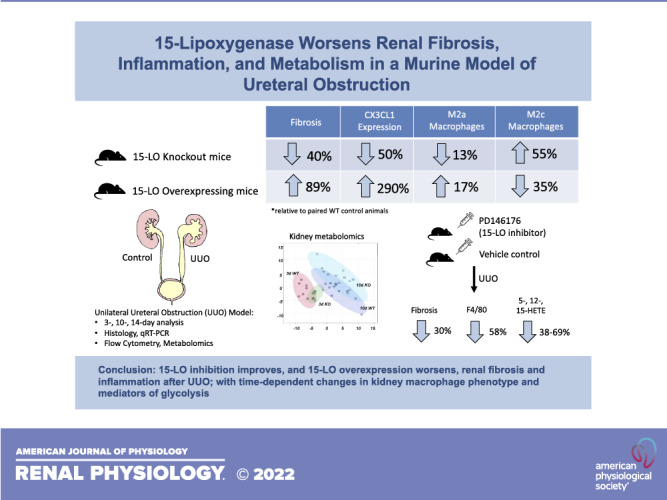
15-Lipoxygenase (15-LO) is a nonheme iron-containing dioxygenase that has both pro- and anti-inflammatory roles in many tissues and disease states. 15-LO is thought to influence macrophage phenotype, and silencing 15-LO reduces fibrosis after acute inflammatory triggers. The goal of the present study was to determine whether altering 15-LO expression influences inflammation and fibrogenesis in a murine model of unilateral ureteral obstruction (UUO). C57BL/6J mice, 15-LO knockout () mice, and 15-LO transgenic overexpressing (15LOTG) mice were subjected UUO, and kidneys were analyzed at 3, 10, and 14 days postinjury. Histology for fibrosis, inflammation, cytokine quantification, flow cytometry, and metabolomics were performed on injured tissues and controls. PD146176, a specific 15-LO inhibitor, was used to complement experiments involving knockout animals. Compared with wild-type animals undergoing UUO, mouse kidneys had less proinflammatory, profibrotic message along with less fibrosis and macrophage infiltration. PD146176 inhibited 15-LO and resulted in reduced fibrosis and macrophage infiltration similar to mice. Flow cytometry revealed that UUO-injured kidneys had a dynamic change in macrophage phenotype, with an early blunting of CD11bLy6C "M1" macrophages and an increase in anti-inflammatory CD11bLy6C "M2c" macrophages and reduced expression of the fractalkine receptor chemokine (C-X3-C motif) receptor 1. Many of these findings were reversed when UUO was performed on 15LOTG mice. Metabolomics analysis revealed that wild-type kidneys developed a glycolytic shift postinjury, while kidneys exhibited increased oxidative phosphorylation. In conclusion, 15-LO manipulation by genetic or pharmacological means induces dynamic changes in the inflammatory microenvironment in the UUO model and appears to be critical in the progression of UUO-induced fibrosis. 15-Lipoxygenase (15-LO) has both pro- and anti-inflammatory functions in leukocytes, and its role in kidney injury and repair is unexplored. Our study showed that 15-LO worsens inflammation and fibrosis in a rodent model of chronic kidney disease using genetic and pharmacological manipulation. Silencing 15-LO promotes an increase in M2c-like wound-healing macrophages in the kidney and alters kidney metabolism globally, protecting against anaerobic glycolysis after injury.
15-脂氧合酶(15-LO)是一种非血红素铁双加氧酶,在许多组织和疾病状态中具有促炎和抗炎作用。15-LO 被认为会影响巨噬细胞表型,而沉默 15-LO 可减少急性炎症触发后的纤维化。本研究的目的是确定改变 15-LO 表达是否会影响单侧输尿管梗阻(UUO)小鼠模型中的炎症和纤维化。C57BL/6J 小鼠、15-LO 基因敲除()小鼠和 15-LO 转基因过表达(15LOTG)小鼠接受 UUO 治疗,并在损伤后 3、10 和 14 天分析肾脏。对损伤组织和对照组织进行纤维化、炎症、细胞因子定量、流式细胞术和代谢组学分析。使用特定的 15-LO 抑制剂 PD146176 补充涉及基因敲除动物的实验。与接受 UUO 的野生型动物相比,小鼠肾脏的促炎、促纤维化信号减少,纤维化和巨噬细胞浸润减少。PD146176 抑制 15-LO 导致纤维化和巨噬细胞浸润减少,类似于 小鼠。流式细胞术显示,在 UUO 损伤的肾脏中,巨噬细胞表型发生了动态变化,早期 CD11bLy6C“M1”巨噬细胞钝化,抗炎性 CD11bLy6C“M2c”巨噬细胞增加,趋化因子(C-X3-C 基序)受体 1 的表达减少。当在 15LOTG 小鼠上进行 UUO 时,许多这些发现都得到了逆转。代谢组学分析显示,野生型肾脏在损伤后发生糖酵解转移,而 肾脏表现出增加的氧化磷酸化。总之,通过遗传或药理学手段对 15-LO 进行操作会导致 UUO 模型中炎症微环境的动态变化,并且在 UUO 诱导的纤维化进展中似乎至关重要。15-LO 在白细胞中具有促炎和抗炎功能,但其在肾脏损伤和修复中的作用尚未得到探索。我们的研究表明,通过遗传和药理学操作,15-LO 在慢性肾脏病的啮齿动物模型中加重了炎症和纤维化。沉默 15-LO 可促进肾脏中 M2c 样伤口愈合巨噬细胞的增加,并改变肾脏的整体代谢,防止损伤后无氧糖酵解。