Department of Nephrology, The First People's Hospital of Wenling, Zhejiang, Wenling 317500, China.
Contrast Media Mol Imaging. 2021 Nov 16;2021:4649139. doi: 10.1155/2021/4649139. eCollection 2021.
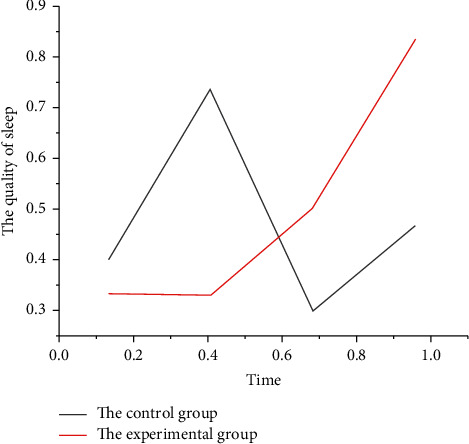
This study aimed to analyze the related factors and remote diagnosis of sleep disorders in patients with uremia and to provide the basis for clinical intervention measures. The Pittsburgh Sleep Quality Index (PSQI) was used to evaluate the sleep quality of 100 patients with uremia. The experimental results show that among 100 patients with uremia, 83 patients (83%) were complicated with sleep disorder, and the average PSQI score was (10.73 ± 1.36). The PSQI score was significantly higher in the elderly, patients with long duration of dialysis, patients with elevated CRP, patients with substandard anemia, and patients with substandard calcium and phosphorus, with statistical significance ( < 0.05). The sleep quality of patients with uremia is correlated with depression, age, and penetration age. The worse the sleep quality is, the more severe the depression is. It proved that the sleep quality of dialysis patients is an important factor. . Sleep disorder is a common complication in patients with uremia. Age, anemia, calcium and phosphorus abnormality, permeation age, and inflammatory status are important factors affecting sleep quality in dialysis patients.
本研究旨在分析尿毒症患者睡眠障碍的相关因素及远程诊断,为临床干预措施提供依据。采用匹兹堡睡眠质量指数(PSQI)对 100 例尿毒症患者的睡眠质量进行评价。实验结果显示,100 例尿毒症患者中 83 例(83%)存在睡眠障碍,PSQI 评分平均为(10.73±1.36)。高龄、透析时间长、CRP 升高、贫血未达标、钙磷未达标患者 PSQI 评分显著升高,差异有统计学意义(<0.05)。尿毒症患者的睡眠质量与抑郁、年龄和透龄有关,睡眠质量越差,抑郁越严重。证明了透析患者的睡眠质量是一个重要因素。睡眠障碍是尿毒症患者的常见并发症。年龄、贫血、钙磷异常、透龄和炎症状态是影响透析患者睡眠质量的重要因素。