Lee Davin, Seo Jinsoo, Jeong Hae Chan, Lee Hyosang, Lee Sung Bae
Department of Brain and Cognitive Sciences, Daegu Gyeongbuk Institute of Science and Technology, Daegu, South Korea.
Front Mol Neurosci. 2021 Nov 12;14:756613. doi: 10.3389/fnmol.2021.756613. eCollection 2021.
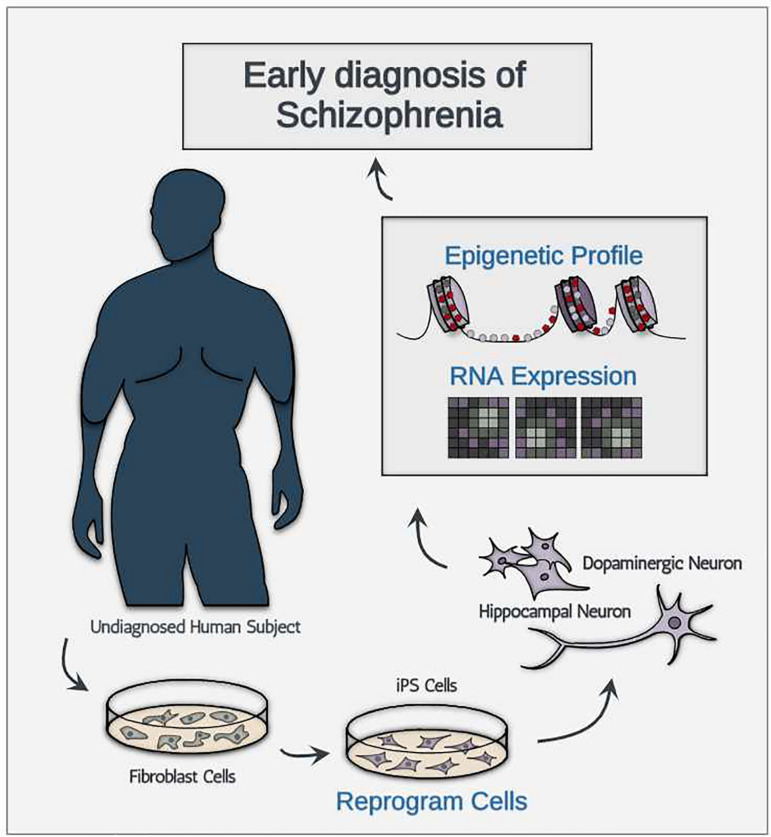
The lack of early diagnostic biomarkers for schizophrenia greatly limits treatment options that deliver therapeutic agents to affected cells at a timely manner. While previous schizophrenia biomarker research has identified various biological signals that are correlated with certain diseases, their reliability and practicality as an early diagnostic tool remains unclear. In this article, we discuss the use of atypical epigenetic and/or consequent transcriptional alterations (ETAs) as biomarkers of early-stage schizophrenia. Furthermore, we review the viability of discovering and applying these biomarkers through the use of cutting-edge technologies such as human induced pluripotent stem cell (iPSC)-derived neurons, brain models, and single-cell level analyses.
精神分裂症早期诊断生物标志物的缺乏极大地限制了及时将治疗药物送达受影响细胞的治疗选择。虽然先前的精神分裂症生物标志物研究已经确定了与某些疾病相关的各种生物信号,但它们作为早期诊断工具的可靠性和实用性仍不明确。在本文中,我们讨论了使用非典型表观遗传和/或随之而来的转录改变(ETA)作为早期精神分裂症的生物标志物。此外,我们还综述了通过使用前沿技术,如人诱导多能干细胞(iPSC)衍生的神经元、脑模型和单细胞水平分析来发现和应用这些生物标志物的可行性。