Gardener Samantha L, Rainey-Smith Stephanie R, Villemagne Victor L, Fripp Jurgen, Doré Vincent, Bourgeat Pierrick, Taddei Kevin, Fowler Christopher, Masters Colin L, Maruff Paul, Rowe Christopher C, Ames David, Martins Ralph N
Centre of Excellence for Alzheimer's Disease Research and Care, School of Medical and Health Sciences, Edith Cowan University, Joondalup, WA, Australia.
Australian Alzheimer's Research Foundation, Sarich Neuroscience Research Institute, Perth, WA, Australia.
Front Aging Neurosci. 2021 Nov 19;13:744872. doi: 10.3389/fnagi.2021.744872. eCollection 2021.
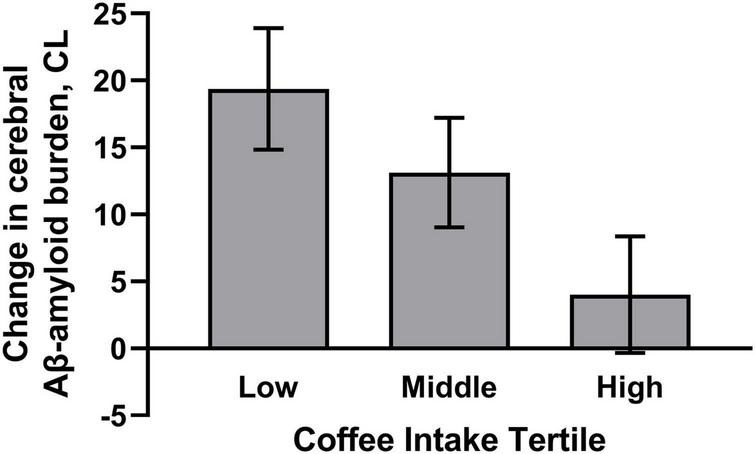
Worldwide, coffee is one of the most popular beverages consumed. Several studies have suggested a protective role of coffee, including reduced risk of Alzheimer's disease (AD). However, there is limited longitudinal data from cohorts of older adults reporting associations of coffee intake with cognitive decline, in distinct domains, and investigating the neuropathological mechanisms underpinning any such associations. The aim of the current study was to investigate the relationship between self-reported habitual coffee intake, and cognitive decline assessed using a comprehensive neuropsychological battery in 227 cognitively normal older adults from the Australian Imaging, Biomarkers, and Lifestyle (AIBL) study, over 126 months. In a subset of individuals, we also investigated the relationship between habitual coffee intake and cerebral Aβ-amyloid accumulation ( = 60) and brain volumes ( = 51) over 126 months. Higher baseline coffee consumption was associated with slower cognitive decline in executive function, attention, and the AIBL Preclinical AD Cognitive Composite (PACC; shown reliably to measure the first signs of cognitive decline in at-risk cognitively normal populations), and lower likelihood of transitioning to mild cognitive impairment or AD status, over 126 months. Higher baseline coffee consumption was also associated with slower Aβ-amyloid accumulation over 126 months, and lower risk of progressing to "moderate," "high," or "very high" Aβ-amyloid burden status over the same time-period. There were no associations between coffee intake and atrophy in total gray matter, white matter, or hippocampal volume. Our results further support the hypothesis that coffee intake may be a protective factor against AD, with increased coffee consumption potentially reducing cognitive decline by slowing cerebral Aβ-amyloid accumulation, and thus attenuating the associated neurotoxicity from Aβ-amyloid-mediated oxidative stress and inflammatory processes. Further investigation is required to evaluate whether coffee intake could be incorporated as a modifiable lifestyle factor aimed at delaying AD onset.
在全球范围内,咖啡是消费最为广泛的饮品之一。多项研究表明咖啡具有保护作用,包括降低患阿尔茨海默病(AD)的风险。然而,关于老年人队列中咖啡摄入量与认知衰退在不同领域的关联,以及支撑此类关联的神经病理学机制的纵向数据有限。本研究的目的是调查自我报告的习惯性咖啡摄入量与认知衰退之间的关系,认知衰退通过综合神经心理测试组进行评估,研究对象为来自澳大利亚影像、生物标志物和生活方式(AIBL)研究的227名认知正常的老年人,随访时间为126个月。在一部分个体中,我们还研究了习惯性咖啡摄入量与126个月内脑Aβ淀粉样蛋白积累(n = 60)和脑容量(n = 51)之间的关系。较高的基线咖啡消费量与执行功能、注意力以及AIBL临床前AD认知综合评分(PACC;已可靠地证明可测量有认知衰退风险的认知正常人群的认知衰退早期迹象)方面较慢的认知衰退相关,并且在126个月内转变为轻度认知障碍或AD状态的可能性较低。较高的基线咖啡消费量还与126个月内较慢的Aβ淀粉样蛋白积累相关,并且在同一时间段内进展为“中度”、“高度”或“非常高度”Aβ淀粉样蛋白负担状态的风险较低。咖啡摄入量与总灰质、白质或海马体体积萎缩之间没有关联。我们的结果进一步支持了以下假设:咖啡摄入可能是预防AD的保护因素,增加咖啡消费量可能通过减缓脑Aβ淀粉样蛋白积累来减少认知衰退,从而减轻Aβ淀粉样蛋白介导的氧化应激和炎症过程相关的神经毒性。需要进一步研究以评估咖啡摄入是否可以作为一种可改变的生活方式因素来延迟AD的发病。