Normansell-Mossa Karys M, Top D Nicholas, Russell Nicholas, Freeston Mark, Rodgers Jacqui, South Mikle
Department of Psychology, Brigham Young University, Provo, UT, United States.
Student Health Services, Utah Valley University, Orem, UT, United States.
Front Psychol. 2021 Nov 16;12:731753. doi: 10.3389/fpsyg.2021.731753. eCollection 2021.
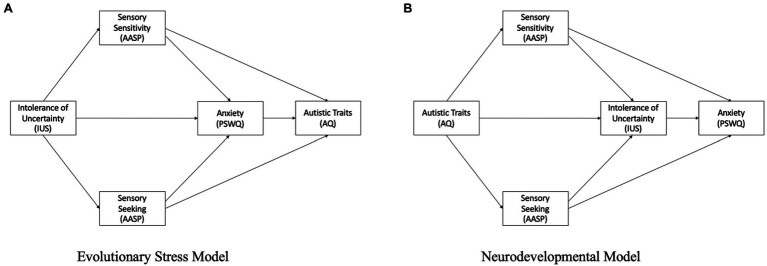
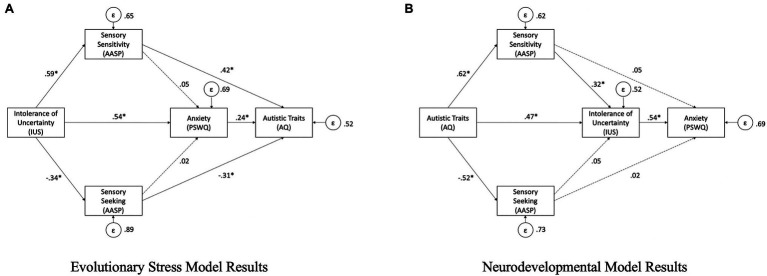
Several models of anxiety in autistic adults have focused on the role of intolerance of uncertainty which has biological and evolutionary bases, as a cognitive explanation for the high prevalence of anxiety in autism. This framework suggests that all people are born with a healthy level of intolerance of uncertainty, and as we develop, this intolerance is lessened as we learn when situations are safe and begin to understand and manage the uncertainty. This process of learning about managing uncertainty does not happen in the same way in those who are high in autistic traits, which could be the reason for the high levels of anxiety symptoms commonly seen in this population. We examined archival data of 199 non-autistic and 55 autistic adults from prior studies in which we collected self-report measures of autistic traits, intolerance of uncertainty, sensory processing, and anxiety. We conducted two path analyses to examine the role of intolerance of uncertainty in anxiety in autistic adults. The first model tested the idea that intolerance of uncertainty, an evolutionary phenomenon common for all people, could explain some of the cognitive aspects of anxiety in autism. The second model suggests that primary neurodevelopmental differences associated with autistic traits underlie the sensory sensitivity and sensory seeking behaviors, which in turn increase intolerance of uncertainty and subsequent anxiety. We found that the "neurodevelopmental" model had better model fit than the "evolutionary stress" model, suggesting that the neurodevelopmental impact of higher levels of autistic traits could moderate a non-autistic trajectory of learning to manage uncertainty as children develop and understand that uncertainty is common and acceptable.
针对成年自闭症患者的几种焦虑模型都聚焦于不确定性不耐受的作用,这种不耐受具有生物学和进化基础,是对自闭症中焦虑症高患病率的一种认知解释。该框架表明,所有人天生都有一定程度的不确定性不耐受,随着我们的成长,当我们了解到哪些情况是安全的,并开始理解和应对不确定性时,这种不耐受就会减轻。对于那些自闭症特征明显的人来说,学习应对不确定性的过程并非以同样的方式发生,这可能就是该人群中常见高焦虑症状的原因。我们研究了来自先前研究的199名非自闭症成年人和55名自闭症成年人的档案数据,在这些研究中,我们收集了关于自闭症特征、不确定性不耐受、感觉加工和焦虑的自我报告测量数据。我们进行了两项路径分析,以检验不确定性不耐受在成年自闭症患者焦虑中的作用。第一个模型检验了这样一种观点,即不确定性不耐受是一种所有人都有的进化现象,可以解释自闭症中焦虑的一些认知方面。第二个模型表明,与自闭症特征相关的主要神经发育差异是感觉敏感性和感觉寻求行为的基础,而这反过来又会增加对不确定性的不耐受以及随后的焦虑。我们发现,“神经发育”模型比“进化压力”模型具有更好的模型拟合度,这表明较高水平的自闭症特征所产生的神经发育影响可能会改变非自闭症儿童在成长过程中学习应对不确定性的轨迹,使其明白不确定性是常见且可接受的。