Belardi Angelo, Pedrett Salome, Rothen Nicolas, Reber Thomas P
Faculty of Psychology, UniDistance Suisse, Brig, Switzerland.
Department of Epileptology, University of Bonn, Bonn, Germany.
Front Psychol. 2021 Nov 15;12:757262. doi: 10.3389/fpsyg.2021.757262. eCollection 2021.
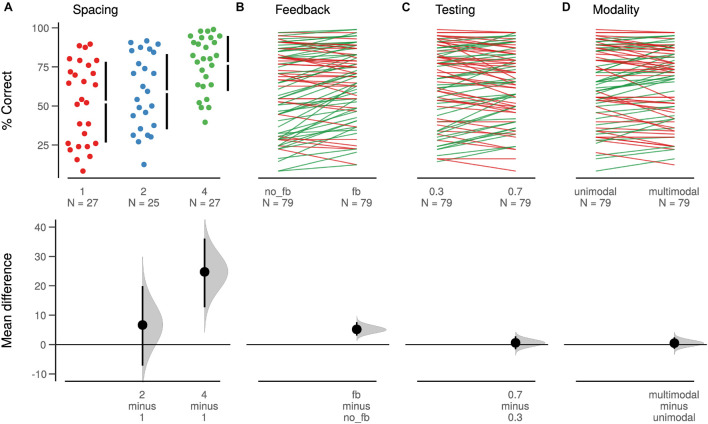
Information and communication technology (ICT) becomes more prevalent in education but its general efficacy and that of specific learning applications are not fully established yet. One way to further improve learning applications could be to use insights from fundamental memory research. We here assess whether four established learning principles (spacing, corrective feedback, testing, and multimodality) can be translated into an applied ICT context to facilitate vocabulary learning in a self-developed web application. Effects on the amount of newly learned vocabulary were assessed in a mixed factorial design (3×2×2×2) with the independent variables Spacing (between-subjects; one, two, or four sessions), Feedback (within-subjects; with or without), Testing (within-subjects, 70 or 30% retrieval trials), and Multimodality (within-subjects; unimodal or multimodal). Data from 79 participants revealed significant main effects for Spacing [(2,76) = 8.51, = 0.0005, ] and Feedback [(1,76) = 21.38, < 0.0001, ], and a significant interaction between Feedback and Testing [(1,76) = 14.12, = 0.0003, ]. Optimal Spacing and the presence of corrective Feedback in combination with Testing together boost learning by 29% as compared to non-optimal realizations (massed learning, testing with the lack of corrective feedback). Our findings indicate that established learning principles derived from basic memory research can successfully be implemented in web applications to optimize vocabulary learning.
信息通信技术(ICT)在教育中越来越普遍,但其总体效果以及特定学习应用的效果尚未完全确立。进一步改进学习应用的一种方法可能是借鉴基础记忆研究的见解。我们在此评估四个既定的学习原则(间隔、纠正性反馈、测试和多模态)是否可以转化为应用ICT环境,以促进在一个自主开发的网络应用程序中学习词汇。在一个混合因子设计(3×2×2×2)中评估对新学词汇量的影响,自变量包括间隔(组间;一次、两次或四次课程)、反馈(组内;有或无)、测试(组内,70%或30%的检索试验)和多模态(组内;单模态或多模态)。来自79名参与者的数据显示,间隔[F(2,76)=8.51,p = 0.0005,η² = 0.20]和反馈[F(1,76)=21.38,p < 0.0001,η² = 0.22]有显著的主效应,以及反馈和测试之间有显著的交互作用[F(1,76)=14.12,p = 0.0003,η² = 0.15]。与非最优实现方式(集中学习、缺乏纠正性反馈的测试)相比,最优间隔以及纠正性反馈与测试相结合可使学习提高29%。我们的研究结果表明,源自基础记忆研究的既定学习原则可以成功地在网络应用程序中实施,以优化词汇学习。