Center for Reproductive Medicine, The First Affiliated Hospital of Zhengzhou University, Zhengzhou, China.
Henan Key Laboratory of Reproduction and Genetics, The First Affiliated Hospital of Zhengzhou University, Zhengzhou, China.
Front Endocrinol (Lausanne). 2021 Nov 18;12:740377. doi: 10.3389/fendo.2021.740377. eCollection 2021.
To investigate the results of fertilization among polycystic ovary syndrome (PCOS) patients using the long-acting long protocol regarding the relationship between menstrual patterns and adverse pregnancy outcomes.
Retrospective cohort study.
University-affiliated reproductive medical center.
The menstrual patterns of patients with PCOS is considered related to metabolism; however, no study has analyzed the outcome of fertilization/intracytoplasmic sperm injection (IVF/ICSI) in patients with PCOS who have different menstrual patterns. This study aimed to observe the outcomes of IVF/ICSI in patients with PCOS with different menstrual patterns who used the long-acting long protocol.
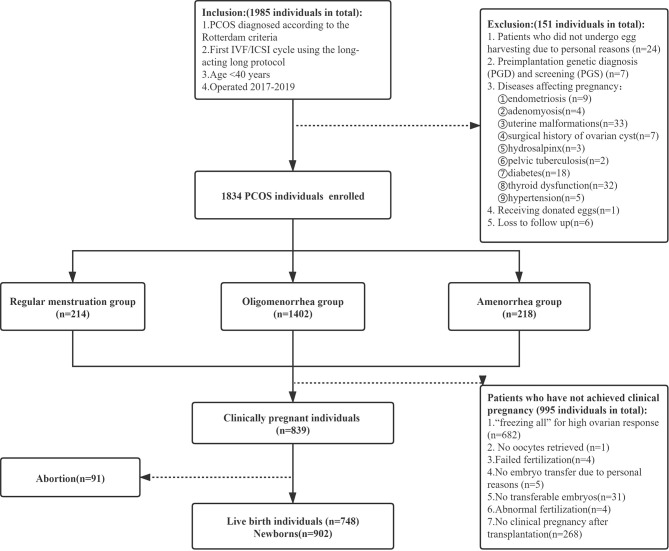
This was a retrospective analysis in the first cycle of IVF/ICSI at the Reproductive Medicine Center of the First Affiliated Hospital of Zhengzhou University from January 2017 to December 2019. In total, 1834 patients with PCOS were classified into the regular menstruation group (n=214), the oligomenorrhea group (n=1402), and the amenorrhea group (n=218).
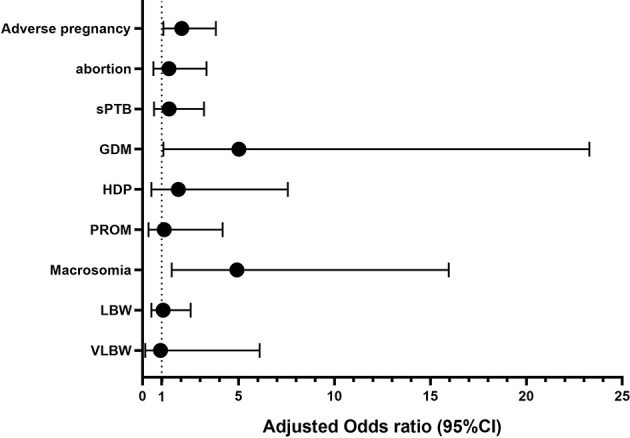
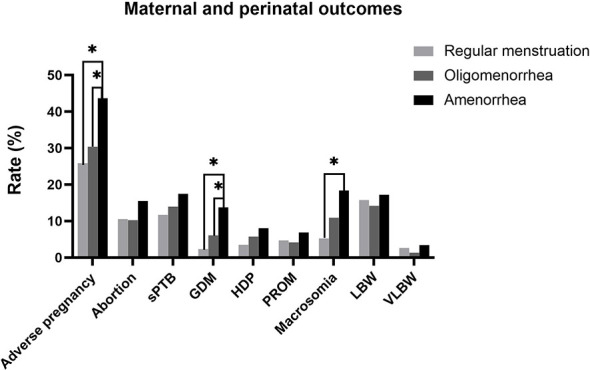
PCOS patients who used the long-acting long protocol of IVF/ICSI had similar clinical pregnancy rates and live birth rates despite having different menstrual patterns. The overall incidence of adverse pregnancy outcomes, including abortion, spontaneous preterm birth (sPTB), gestational diabetes(GDM), hypertensive disorder inpregnancy (HDP), and premature rupture of membranes(PROM, was significantly higher in the amenorrhea group than in the regular menstrual and oligomenorrhea groups (25.88% . 30.41% . 43.69%; P = 0.013). Additionally, the rates of GDM (2.35% . 6.10% . 13.79%; P=0.015) and macrosomia (5.26% . 10.94% . 18.39%; P=0.026) in the amenorrhea group were significantly higher than those in the other two groups. Correction for confounding factors showed that menstrual patterns are related to the occurrence of adverse pregnancy outcomes. Amenorrhea is an independent risk factor for adverse pregnancy outcome (OR [odds ratio]: 2.039, 95% CI [confidence interval]: 1.087-3.822), GDM (OR: 5.023, 95% CI: 1.083-23.289), and macrosomia (OR: 4.918, 95% CI: 1.516-15.954).
IVF/ICSI can achieve similar pregnancy and live birth rates in PCOS patients with different menstrual patterns. However, the overall incidence of adverse pregnancy outcomes in PCOS patients with amenorrhea is higher than that in patients with regular menstruation or oligomenorrhea.
探讨长效长方案中多囊卵巢综合征(PCOS)患者受精结果与月经模式和不良妊娠结局的关系。
回顾性队列研究。
大学附属生殖医学中心。
PCOS 患者的月经模式被认为与代谢有关;然而,尚无研究分析过不同月经模式的 PCOS 患者接受体外受精/胞浆内单精子注射(IVF/ICSI)后的受精结果。本研究旨在观察不同月经模式的 PCOS 患者使用长效长方案后的 IVF/ICSI 结局。
这是郑州大学第一附属医院生殖医学中心 2017 年 1 月至 2019 年 12 月首次 IVF/ICSI 周期的回顾性分析。共有 1834 例 PCOS 患者分为月经规律组(n=214)、稀发月经组(n=1402)和闭经组(n=218)。
尽管 PCOS 患者的月经模式不同,但使用 IVF/ICSI 的长效长方案的临床妊娠率和活产率相似。闭经组的不良妊娠结局总发生率(流产、自发性早产(sPTB)、妊娠期糖尿病(GDM)、妊娠高血压疾病(HDP)和胎膜早破(PROM)显著高于月经规律组和稀发月经组(25.88%、30.41%、43.69%;P=0.013)。此外,闭经组的 GDM 发生率(2.35%、6.10%、13.79%;P=0.015)和巨大儿发生率(5.26%、10.94%、18.39%;P=0.026)明显高于其他两组。校正混杂因素后显示,月经模式与不良妊娠结局的发生有关。闭经是不良妊娠结局的独立危险因素(OR[比值比]:2.039,95%CI[置信区间]:1.087-3.822)、GDM(OR:5.023,95%CI:1.083-23.289)和巨大儿(OR:4.918,95%CI:1.516-15.954)。
不同月经模式的 PCOS 患者接受 IVF/ICSI 可获得相似的妊娠和活产率。然而,闭经的 PCOS 患者的不良妊娠结局总发生率高于月经规律或稀发月经的患者。