Lin Shudan, Sun Bianjin, Shi Xinrui, Xu Yi, Gu Yunfeng, Gu Xiaobin, Ma Xueli, Wan Tian, Xu Jie, Su Jianzhong, Lou Yongliang, Zheng Meiqin
Zhejiang Provincial Key Laboratory for Technology and Application of Model Organisms, Key Laboratory of Laboratory Medicine, Ministry of Education, School of Laboratory Medicine and Life Sciences, Wenzhou Medical University, Wenzhou, China.
School of Ophthalmology and Optometry and Eye Hospital, School of Biomedical Engineering, Wenzhou Medical University, Wenzhou, China.
Front Microbiol. 2021 Nov 15;12:770191. doi: 10.3389/fmicb.2021.770191. eCollection 2021.
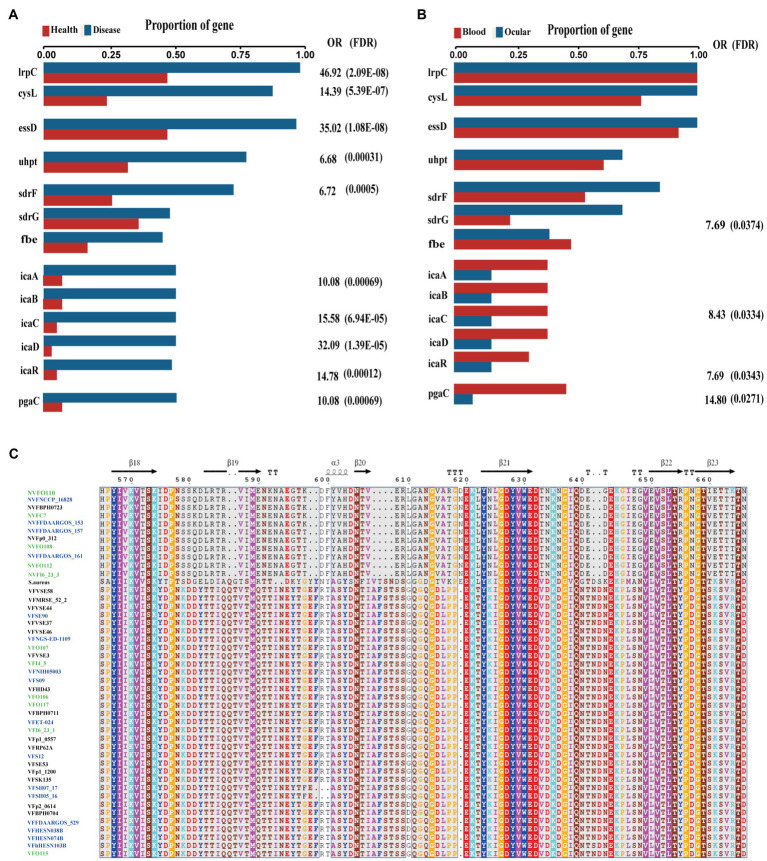
Coagulase-negative (CoNS) is the most common pathogen causing traumatic endophthalmitis. Among which, is the most common species that colonizes human skin, eye surfaces, and nasal cavity. It is also the main cause of nosocomial infection, specially foreign body-related bloodstream infections (FBR-BSIs). Although some studies have reported the genome characteristics of , the genome of ocular trauma-sourced strain and a comprehensive understanding of its pathogenicity are still lacking. Our study sequenced, analyzed, and reported the whole genomes of 11 ocular trauma-sourced samples of that caused traumatic endophthalmitis. By integrating publicly available genomes, we obtained a total of 187 samples from healthy and diseased eyes, skin, respiratory tract, and blood. Combined with pan-genome, phylogenetic, and comparative genomic analyses, our study showed that , regardless of niche source, exhibits two founder lineages with different pathogenicity. Moreover, we identified several potential biomarkers associated with the virulence of , including , , , , , and . and have high homology with and in , showing that the genomes of and may have communicated during evolution. , , , and are related to biofilm formation. Compared to from blood sources, ocular-sourced strains causing intraocular infection had no direct relationship with biofilm formation. In conclusion, this study provided additional data resources for studies on and improved our understanding of the evolution and pathogenicity among strains of different sources.
凝固酶阴性葡萄球菌(CoNS)是引起外伤性眼内炎最常见的病原体。其中,是人类皮肤、眼表和鼻腔中最常见的定植菌种。它也是医院感染的主要原因,特别是与异物相关的血流感染(FBR-BSIs)。尽管一些研究报道了的基因组特征,但源自眼外伤的菌株基因组及其致病性的全面了解仍然缺乏。我们的研究对11例导致外伤性眼内炎的源自眼外伤的样本进行了全基因组测序、分析和报道。通过整合公开可用的基因组,我们总共获得了来自健康和患病眼睛、皮肤、呼吸道和血液的187个样本。结合泛基因组、系统发育和比较基因组分析,我们的研究表明,无论生态位来源如何,都表现出两个具有不同致病性的祖先谱系。此外,我们鉴定了几种与的毒力相关的潜在生物标志物,包括、、、、和。和与中的和具有高度同源性,表明和的基因组在进化过程中可能发生了交流。、、和与生物膜形成有关。与血液来源的相比,引起眼内感染的眼源菌株与生物膜形成没有直接关系。总之,本研究为的研究提供了额外的数据资源,并增进了我们对不同来源菌株进化和致病性的理解。