Chua Caroline Lin Lin, Khoo Sebastian Kah Ming, Ong Jun Long Ernest, Ramireddi Gaurav Kumar, Yeo Tsin Wen, Teo Andrew
School of Biosciences, Taylor's University, Subang Jaya, Malaysia.
Lee Kong Chian School of Medicine, Nanyang Technological University, Singapore, Singapore.
Front Microbiol. 2021 Nov 11;12:777343. doi: 10.3389/fmicb.2021.777343. eCollection 2021.
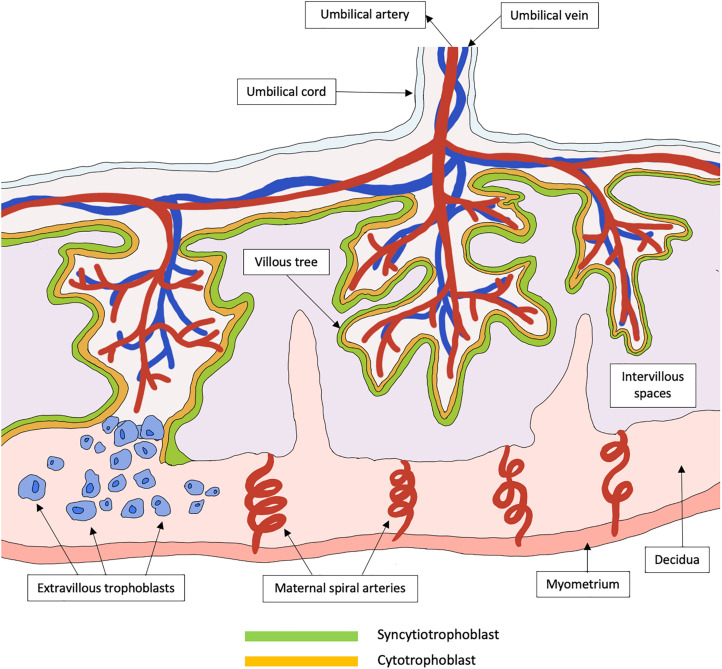
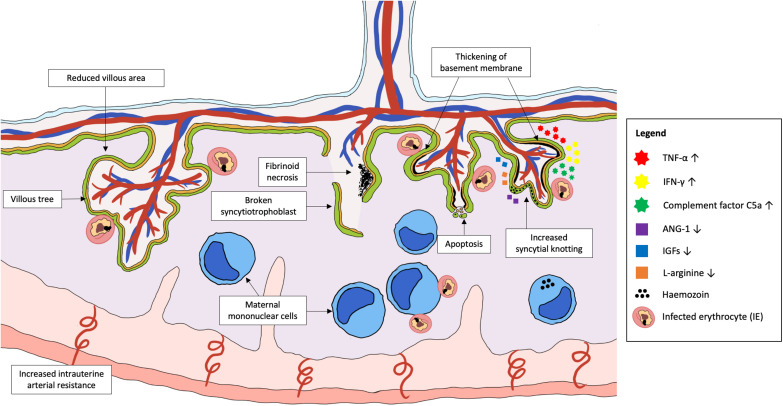
Malaria remains a global health burden with accounting for the highest mortality and morbidity. Malaria in pregnancy can lead to the development of placental malaria, where -infected erythrocytes adhere to placental receptors, triggering placental inflammation and subsequent damage, causing harm to both mother and her infant. Histopathological studies of -infected placentas revealed various placental abnormalities such as excessive perivillous fibrinoid deposits, breakdown of syncytiotrophoblast integrity, trophoblast basal lamina thickening, increased syncytial knotting, and accumulation of mononuclear immune cells within intervillous spaces. These events in turn, are likely to impair placental development and function, ultimately causing placental insufficiency, intrauterine growth restriction, preterm delivery and low birth weight. Hence, a better understanding of the mechanisms behind placental alterations and damage during placental malaria is needed for the design of effective interventions. In this review, using evidence from human studies and murine models, an integrated view on the potential mechanisms underlying placental pathologies in malaria in pregnancy is provided. The molecular, immunological and metabolic changes in infected placentas that reflect their responses to the parasitic infection and injury are discussed. Finally, potential models that can be used by researchers to improve our understanding on the pathogenesis of malaria in pregnancy and placental pathologies are presented.
疟疾仍然是一个全球健康负担,其死亡率和发病率最高。妊娠疟疾可导致胎盘疟疾的发生,即受感染的红细胞粘附于胎盘受体,引发胎盘炎症及随后的损伤,对母亲及其婴儿均造成伤害。对受感染胎盘的组织病理学研究揭示了各种胎盘异常,如绒毛周围纤维蛋白样沉积物过多、合体滋养层完整性破坏、滋养层基膜增厚、合体结增加以及绒毛间隙内单核免疫细胞积聚。这些情况反过来可能会损害胎盘发育和功能,最终导致胎盘功能不全、胎儿生长受限、早产和低出生体重。因此,为了设计有效的干预措施,需要更好地了解胎盘疟疾期间胎盘改变和损伤背后的机制。在这篇综述中,利用来自人体研究和小鼠模型的证据,对妊娠疟疾中胎盘病理的潜在机制提供了一个综合观点。讨论了受感染胎盘中反映其对寄生虫感染和损伤反应的分子、免疫和代谢变化。最后,介绍了研究人员可用于增进我们对妊娠疟疾发病机制和胎盘病理理解的潜在模型。