Department of Clinical Laboratory, The Affiliated Drum Tower Hospital of Nanjing University Medical School, Nanjing, China.
College of Life Science, Yangtze University, Jingzhou, China.
Front Immunol. 2021 Nov 11;12:735105. doi: 10.3389/fimmu.2021.735105. eCollection 2021.
Dysregulation of transfer RNA (tRNA)-derived small noncoding RNA (tsRNA) signatures in human serum has been found in various diseases. Here, we determine whether the signatures of tsRNAs in serum can serve as biomarkers for diagnosis or prognosis of systemic lupus erythematosus (SLE).
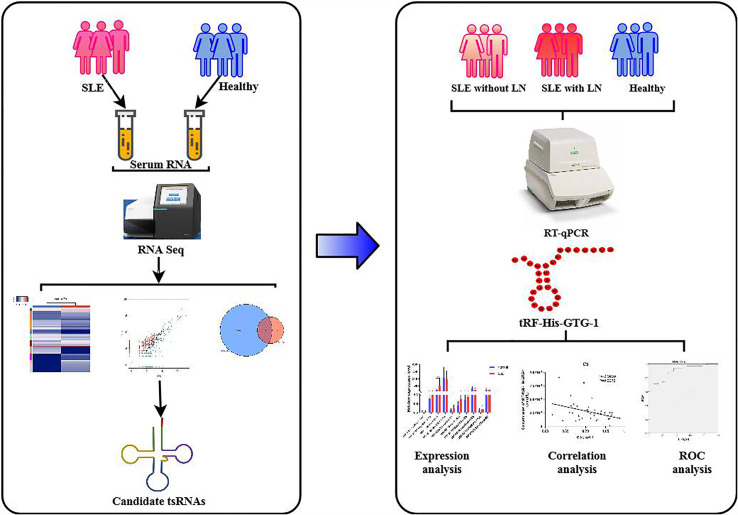
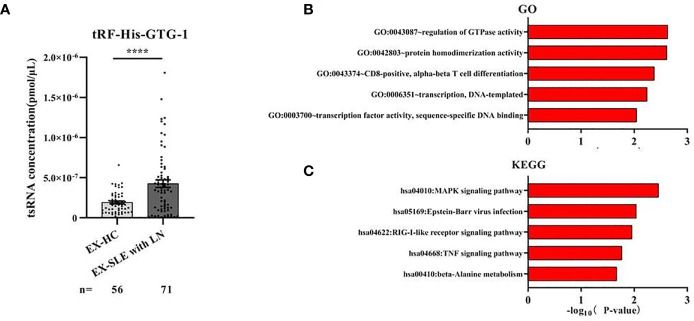
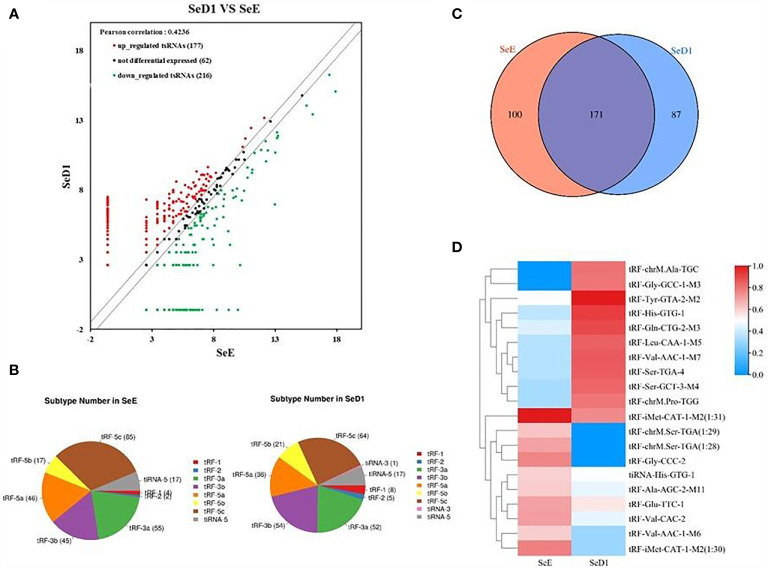
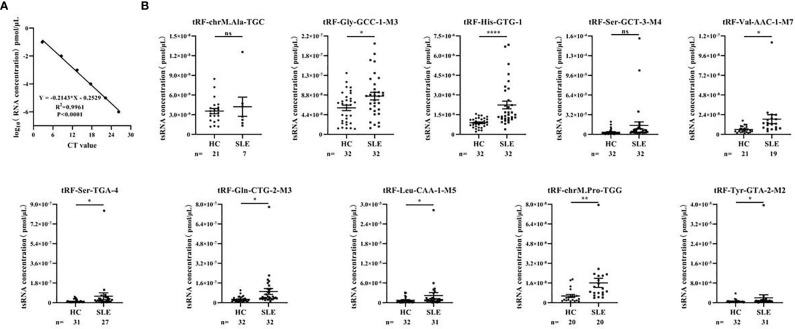
Initially, small RNA sequencing was employed for the screening serum tsRNAs obtained from SLE patients, followed by validation with TaqMan probe-based quantitative reverse transcription-PCR (RT-PCR) assay. Receiver operating characteristic (ROC) curve analysis was used to assess the diagnostic efficacy. The biological functions of tsRNAs were identified by Gene Ontology (GO) and Kyoto Encyclopedia of Genes and Genomes (KEGG) assay.
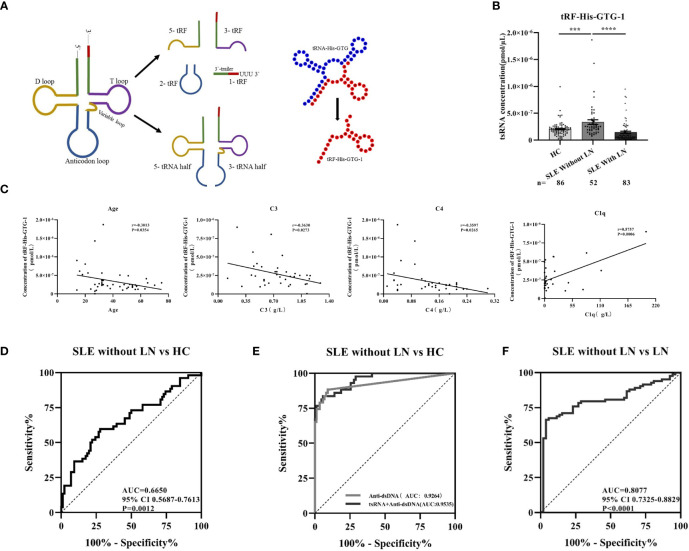
We first analyzed tsRNA signatures in SLE serum and identified that tRF-His-GTG-1 was significantly upregulated in SLE serum. The combination of tRF-His-GTG-1 and anti-dsDNA could serve as biomarkers for diagnosing SLE with a high area under the curve (AUC) of 0.95 (95% CI = 0.92-0.99), sensitivity (83.72%), and specificity (94.19%). Importantly, the noninvasive serum tRF-His-GTG-1 could also be used to distinguish SLE with LN or SLE without LN with AUC of 0.81 (95% CI, 0.73-0.88) and performance (sensitivity 66.27%, specificity 96.15%). Moreover, the serum tsRNA is mainly secreted exosome and can directly target signaling molecules that play crucial roles in regulating the immune system.
In this study, it has been demonstrated for the first time that serum tsRNAs can be employed as noninvasive biomarkers for the efficient diagnosis and prediction of nephritis in SLE.
在各种疾病中发现,人血清中转录 RNA(tRNA)衍生的小非编码 RNA(tsRNA)特征失调。在这里,我们确定血清中 tsRNA 的特征是否可以作为系统性红斑狼疮(SLE)诊断或预后的生物标志物。
最初,使用小 RNA 测序筛选来自 SLE 患者的血清 tsRNA,然后使用 TaqMan 探针定量逆转录-PCR(RT-PCR)检测进行验证。接收者操作特征(ROC)曲线分析用于评估诊断效果。通过基因本体论(GO)和京都基因与基因组百科全书(KEGG)分析鉴定 tsRNA 的生物学功能。
我们首先分析了 SLE 血清中的 tsRNA 特征,发现 tRF-His-GTG-1 在 SLE 血清中显著上调。tRF-His-GTG-1 和抗 dsDNA 的组合可作为诊断 SLE 的生物标志物,具有高曲线下面积(AUC)为 0.95(95%CI=0.92-0.99)、敏感性(83.72%)和特异性(94.19%)。重要的是,无创性血清 tRF-His-GTG-1 也可用于区分有 LN 的 SLE 和无 LN 的 SLE,AUC 为 0.81(95%CI,0.73-0.88)和性能(敏感性 66.27%,特异性 96.15%)。此外,血清 tsRNA 主要以外泌体形式分泌,可直接靶向在调节免疫系统中起关键作用的信号分子。
在这项研究中,首次证明血清 tsRNA 可作为 SLE 有效诊断和肾炎预测的无创生物标志物。