Macedo-Osorio Karla S, Martínez-Antonio Agustino, Badillo-Corona Jesús A
Instituto Politécnico Nacional, Unidad Profesional Interdisciplinaria de Biotecnología, México City, México.
Biological Engineering Laboratory, Genetic Engineering Department, Centro de Investigación y Estudios Avanzados del Instituto Politécnico Nacional-Unidad Irapuato, Irapuato, México.
Front Plant Sci. 2021 Nov 17;12:775366. doi: 10.3389/fpls.2021.775366. eCollection 2021.
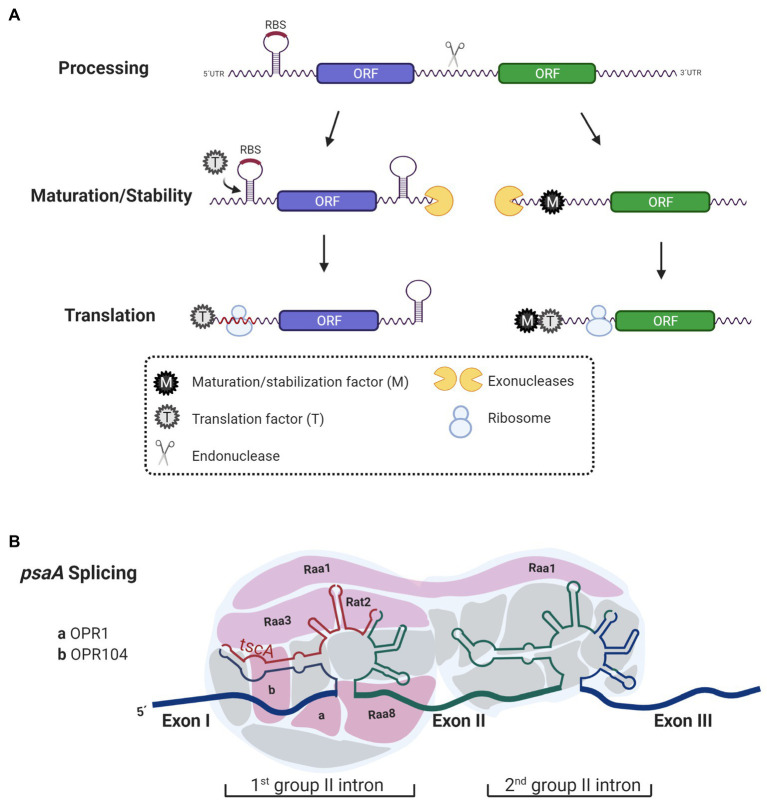
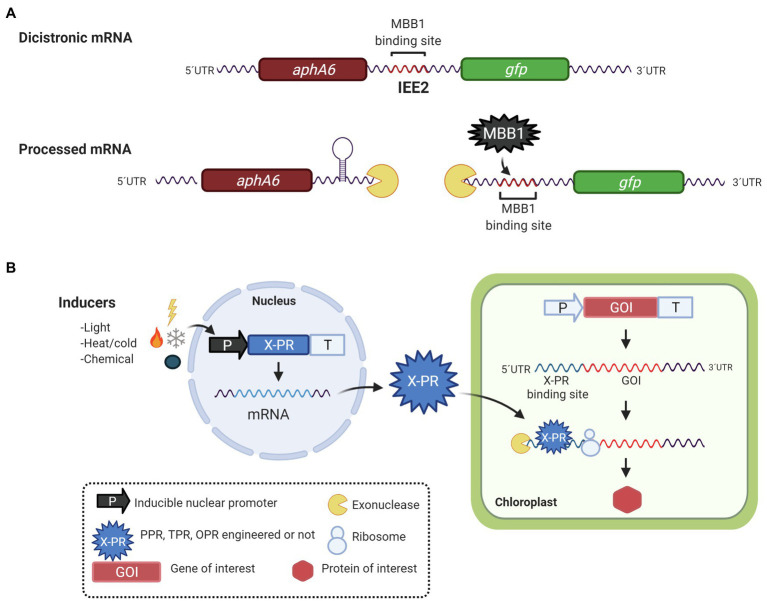
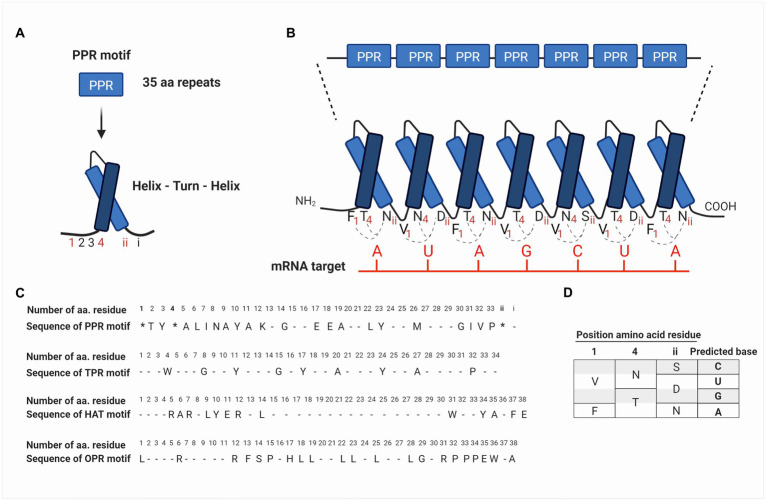
Penta-, Tetra-, and Octo-tricopeptide repeat (PPR, TPR, and OPR) proteins are nucleus-encoded proteins composed of tandem repeats of 35, 34, and 38-40 amino acids, respectively. They form helix-turn-helix structures that interact with mRNA or other proteins and participate in RNA stabilization, processing, maturation, and act as translation enhancers of chloroplast and mitochondrial mRNAs. These helical repeat proteins are unevenly present in plants and algae. While PPR proteins are more abundant in plants than in algae, OPR proteins are more abundant in algae. In , maize, and rice there have been 450, 661, and 477 PPR proteins identified, respectively, which contrasts with only 14 PPR proteins identified in . Likewise, more than 120 OPR proteins members have been predicted from the nuclear genome of and only one has been identified in . Due to their abundance in land plants, PPR proteins have been largely characterized making it possible to elucidate their RNA-binding code. This has even allowed researchers to generate engineered PPR proteins with defined affinity to a particular target, which has served as the basis to develop tools for gene expression in biotechnological applications. However, fine elucidation of the helical repeat proteins code in Chlamydomonas is a pending task. In this review, we summarize the current knowledge on the role PPR, TPR, and OPR proteins play in chloroplast gene expression in the green algae , pointing to relevant similarities and differences with their counterparts in plants. We also recapitulate on how these proteins have been engineered and shown to serve as mRNA regulatory factors for biotechnological applications in plants and how this could be used as a starting point for applications in algae.
五肽、四肽和八肽三肽重复(PPR、TPR和OPR)蛋白是核编码蛋白,分别由35、34和38 - 40个氨基酸的串联重复序列组成。它们形成螺旋 - 转角 - 螺旋结构,与mRNA或其他蛋白质相互作用,参与RNA的稳定、加工、成熟,并作为叶绿体和线粒体mRNA的翻译增强子。这些螺旋重复蛋白在植物和藻类中的分布不均。虽然PPR蛋白在植物中比在藻类中更丰富,但OPR蛋白在藻类中更丰富。在玉米和水稻中,分别鉴定出450、661和477个PPR蛋白,相比之下,在[具体藻类名称未给出]中仅鉴定出14个PPR蛋白。同样,从[具体藻类名称未给出]的核基因组中预测出超过120个OPR蛋白成员,而在[具体藻类名称未给出]中仅鉴定出一个。由于它们在陆地植物中含量丰富,PPR蛋白已得到大量表征,从而有可能阐明其RNA结合密码。这甚至使研究人员能够生成对特定靶标具有确定亲和力的工程化PPR蛋白,这为开发生物技术应用中的基因表达工具奠定了基础。然而,对衣藻中螺旋重复蛋白密码的精细阐明仍是一项未完成的任务。在本综述中,我们总结了关于PPR、TPR和OPR蛋白在绿藻[具体藻类名称未给出]叶绿体基因表达中作用的现有知识,指出了它们与植物中对应蛋白的相关异同。我们还概述了这些蛋白如何被工程化并已被证明可作为植物生物技术应用中的mRNA调节因子,以及这如何可作为藻类应用的起点。