Cardozo Gizzi Andres M
Centro de Investigación en Medicina Traslacional Severo Amuchastegui (CIMETSA), Instituto Universitario de Ciencias Biomédicas de Córdoba (IUCBC), CONICET, Córdoba, Argentina.
Front Genet. 2021 Nov 19;12:780822. doi: 10.3389/fgene.2021.780822. eCollection 2021.
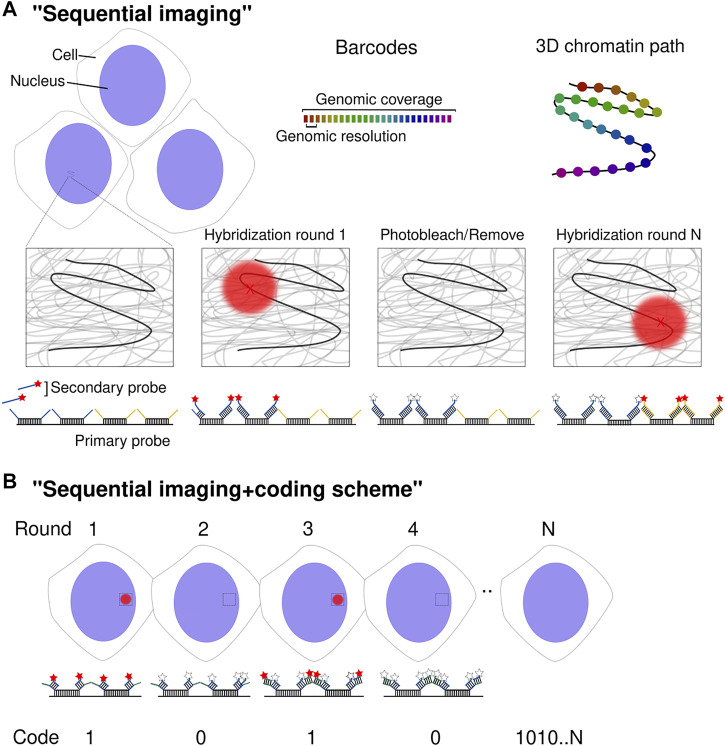
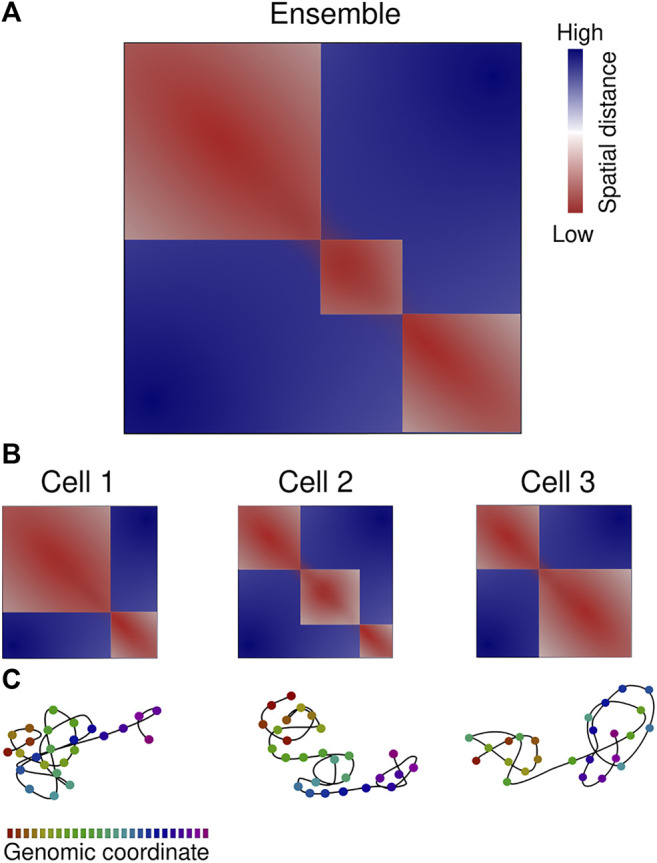
The genome tridimensional (3D) organization and its role towards the regulation of key cell processes such as transcription is currently a main question in biology. Interphase chromosomes are spatially segregated into "territories," epigenetically-defined large domains of chromatin that interact to form "compartments" with common transcriptional status, and insulator-flanked domains called "topologically associating domains" (TADs). Moreover, chromatin organizes around nuclear structures such as lamina, speckles, or the nucleolus to acquire a higher-order genome organization. Due to recent technological advances, the different hierarchies are being solved. Particularly, advances in microscopy technologies are shedding light on the genome structure at multiple levels. Intriguingly, more and more reports point to high variability and stochasticity at the single-cell level. However, the functional consequences of such variability in genome conformation are still unsolved. Here, I will discuss the implication of the cell-to-cell heterogeneity at the different scales in the context of newly developed imaging approaches, particularly multiplexed Fluorescence in situ hybridization methods that enabled "chromatin tracing." Extensions of these methods are now combining spatial information of dozens to thousands of genomic with the localization of nuclear features such as the nucleolus, nuclear speckles, or even histone modifications, creating the fast-moving field of "spatial genomics." As our view of genome organization shifts the focus from ensemble to single-cell, new insights to fundamental questions begin to emerge.
基因组的三维(3D)组织及其在调控转录等关键细胞过程中的作用,是当前生物学领域的一个主要问题。间期染色体在空间上被分隔成“区域”,即表观遗传定义的染色质大结构域,这些结构域相互作用形成具有共同转录状态的“区室”,以及被绝缘子侧翼包围的称为“拓扑相关结构域”(TADs)的结构域。此外,染色质围绕核结构(如核纤层、核斑或核仁)进行组织,以形成更高层次的基因组组织。由于最近的技术进步,不同层次的问题正在得到解决。特别是,显微镜技术的进步正在揭示多个层面的基因组结构。有趣的是,越来越多的报告指出单细胞水平存在高度变异性和随机性。然而,基因组构象中这种变异性的功能后果仍未得到解决。在这里,我将在新开发的成像方法的背景下,讨论不同尺度下细胞间异质性的影响,特别是能够实现“染色质追踪”的多重荧光原位杂交方法。这些方法的扩展现在正在将数十到数千个基因组的空间信息与核仁、核斑甚至组蛋白修饰等核特征的定位相结合,创造了快速发展的“空间基因组学”领域。随着我们对基因组组织的认识从整体转向单细胞,对基本问题的新见解开始出现。