Liu Yuan, Yin Xiaojian, Zhang Feng, Li Yuqiang, Bi Cunjian, Sun Yi, Li Ming, Zhang Ting
Key Laboratory of Adolescent Health Assessment and Exercise Intervention of the Ministry of Education, East China Normal University, Shanghai, 200241, China.
College of Physical Education and Health, East China Normal University, Shanghai, 200241, China.
J Exerc Sci Fit. 2022 Jan;20(1):1-8. doi: 10.1016/j.jesf.2021.10.004. Epub 2021 Nov 3.
This article assessed the relationship between waist circumference (WC) and cardiorespiratory fitness (CRF) of children and adolescents aged 7-18 years.
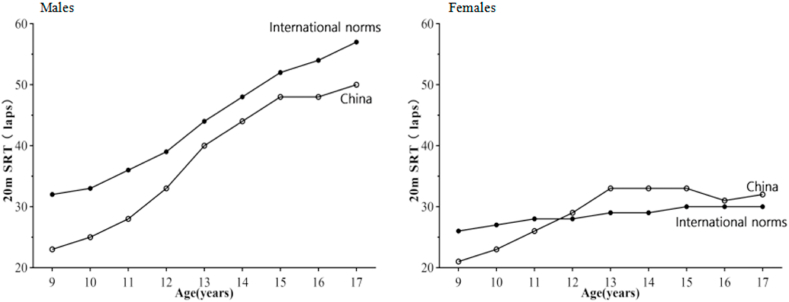
Using a stratified cluster random sampling method, 92,574 children and adolescents (47,364 males and 45,210 females) were extracted. CRF was measured by performance in the 20 m shuttle run test (20mSRT) and the subsequent estimation of maximal oxygen consumption ( O) using the Léger equations. Participants were divided into five groups of WC percentiles and three groups of CRF percentiles by the Lambda Mu Sigma (LMS). The correlation between WC and CRF was examined by one-way ANOVA and curvilinear regression analysis.
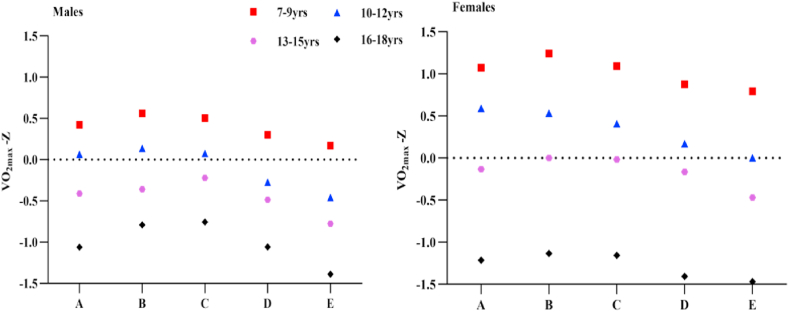
WC increased with age, while O showed an age-related decline. Controlling for gender, urban, and rural factors, for children and adolescents aged 10-12, 13-15, and 16-18 years, the O Z-score of the normal WC group was significantly higher than the very low WC group ( < 0.05). Controlling for gender, urban, and rural factors, for participants aged 7-18 years, the O Z-score of the normal WC group was significantly higher than the high WC group and the very high WC group ( < 0.05).
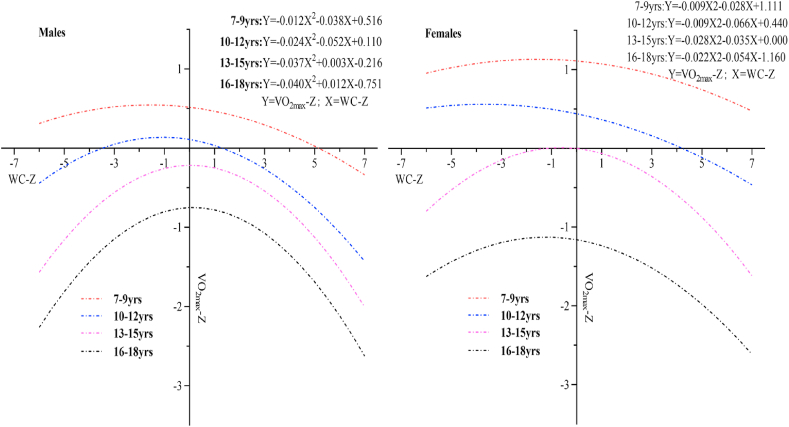
It generally shows a "parabolic" trend between WC-Z and O-Z. The CRF among children and adolescents in the normal WC group is significantly higher than that in the low and the high WC groups.
本文评估了7至18岁儿童和青少年的腰围(WC)与心肺适能(CRF)之间的关系。
采用分层整群随机抽样方法,抽取了92574名儿童和青少年(男性47364名,女性45210名)。通过20米往返跑测试(20mSRT)的表现及随后使用勒热方程估算最大耗氧量( O)来测量CRF。参与者按Lambda Mu Sigma(LMS)法分为五组WC百分位数组和三组CRF百分位数组。通过单因素方差分析和曲线回归分析检验WC与CRF之间的相关性。
WC随年龄增加,而 O呈与年龄相关的下降。在控制性别、城乡因素后,对于10至12岁、13至15岁和16至18岁的儿童和青少年,正常WC组的 O Z分数显著高于极低WC组( < 0.05)。在控制性别、城乡因素后,对于7至18岁的参与者,正常WC组的 O Z分数显著高于高WC组和极高WC组( < 0.05)。
WC-Z与 O-Z之间总体呈“抛物线”趋势。正常WC组儿童和青少年的CRF显著高于低WC组和高WC组。