Elices Matilde, Pérez-Sola Víctor, Pérez-Aranda Adrián, Colom Francesc, Polo Maria, Martín-López Luis Miguel, Gárriz Miguel
Institut de Neuropsiquiatria i Addiccions (INAD), Institut Hospital del Mar d'Investigacions Mèdiques, (IMIM), Parc de Salut Mar, Barcelona, Spain.
Centro de Investigación Biomédica en Red de Salud Mental, CIBERSAM, Madrid, Spain.
Mindfulness (N Y). 2022;13(2):362-372. doi: 10.1007/s12671-021-01794-3. Epub 2021 Nov 29.
Evidence suggests the efficacy of mindfulness-based cognitive therapy (MBCT) to prevent depression relapse and decrease depressive symptoms during the acute phase. However, the effectiveness of MBCT in real-world heterogeneous samples treated in clinical health settings, including primary care, has received little attention. This study had two aims: (1) to evaluate the effectiveness of MBCT delivered in primary care considering pre-treatment depression scores and (2) to explore the role of participants' characteristics on symptom improvement.
Data were obtained from 433 individuals who received MBCT. Participants completed the Personality Inventory for ICD-11 (PiCD) pretreatment and the Beck Depression Inventory (BDI-II) pre- and post-treatment.
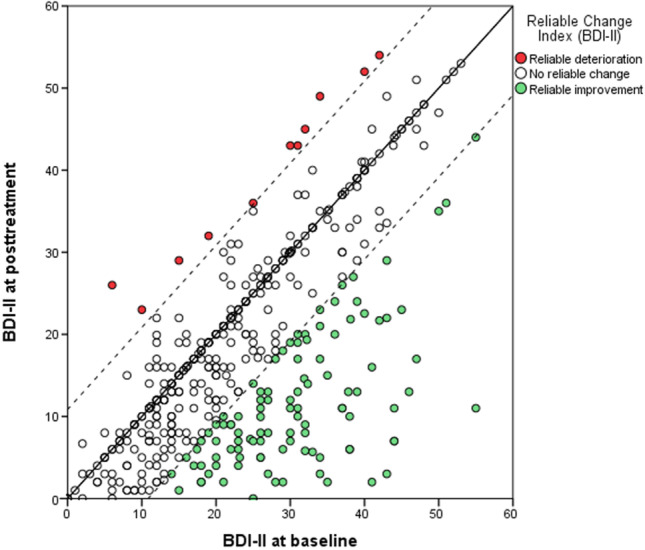
Sixty percent presented moderate-to-severe depression according to scores on the BDI-II, 18.1% presented mild depression, and 21.7% were in the non-depressed range. The severity of pre-treatment depressive symptoms was associated with outcomes. Most individuals who lacked depressive symptoms at baseline remained in the non-clinical range after the treatment. Those in the severe group benefited the most from the intervention, since 35.6% were considered recovered. Rates of deterioration ranged from 2.1 to 2.7%, depending on the depression-baseline scores. Depression severity at the entrance, attendance, and age, but not personality traits, appear to be related to symptom improvement.
According to our results, MBCT can be effectively and safely delivered in primary care.
有证据表明,基于正念的认知疗法(MBCT)在预防抑郁症复发以及减轻急性期抑郁症状方面具有疗效。然而,在包括初级保健在内的临床健康环境中对现实世界中的异质性样本进行治疗时,MBCT的有效性很少受到关注。本研究有两个目的:(1)考虑治疗前的抑郁评分,评估在初级保健中实施MBCT的有效性;(2)探讨参与者特征对症状改善的作用。
数据来自433名接受MBCT治疗的个体。参与者在治疗前完成了国际疾病分类第11版人格量表(PiCD),并在治疗前后完成了贝克抑郁量表(BDI-II)。
根据BDI-II评分,60%的人表现为中度至重度抑郁,18.1%的人表现为轻度抑郁,21.7%的人处于非抑郁范围。治疗前抑郁症状的严重程度与治疗结果相关。大多数基线时没有抑郁症状的个体在治疗后仍处于非临床范围。重度组从干预中获益最大,因为35.6%的人被认为康复。恶化率在2.1%至2.7%之间,具体取决于抑郁基线评分。治疗开始时的抑郁严重程度、出勤率和年龄,而非人格特质,似乎与症状改善有关。
根据我们的结果,MBCT可以在初级保健中有效且安全地实施。