Qian Jie, Wang Weimin, Wang Lin, Lu Jun, Zhang Lele, Zhang Bo, Wang Shuyuan, Nie Wei, Zhang Yanwei, Lou Yuqing, Han Baohui
Department of Emergency Medicine, Shanghai Chest Hospital, Shanghai Jiao Tong University, Shanghai, China.
Department of Pulmonary Medicine, Shanghai Chest Hospital, Shanghai Jiao Tong University, Shanghai, China.
Front Oncol. 2021 Nov 16;11:745150. doi: 10.3389/fonc.2021.745150. eCollection 2021.
Diabetes mellitus (DM) is a frequent comorbidity in patients with cancer. This study aimed to evaluate the prognosis of advanced non-small cell lung cancer (NSCLC) patients with DM and to assess whether an optimal glycemic control improves overall survival (OS).
A total of 1279 advanced NSCLC patients including 300 (23.5%) with preexisting DM were retrospectively reviewed. The continuous relationship between glycated hemoglobin A1C (HbA1c) level and OS was analyzed by restricted cubic spline (RCS) function. Optimal HbA1c cut-off point was determined using X-tile analysis. Survival was analyzed with the Kaplan-Meier method and compared among groups stratified by diabetes status and HbA1c. Multivariable Cox proportional hazards regression analysis was employed to identify prognostic factors for OS after adjusting for baseline characteristics.
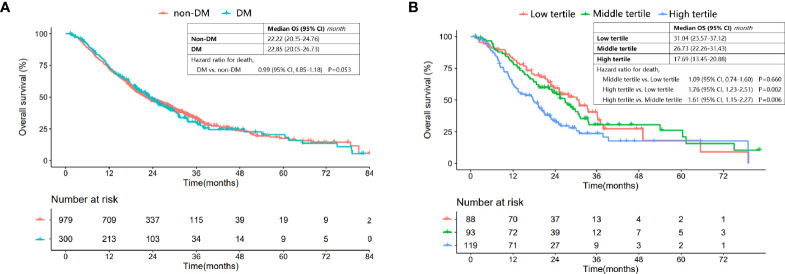
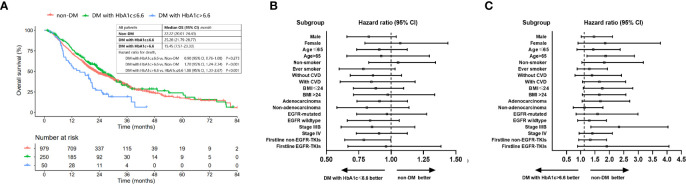
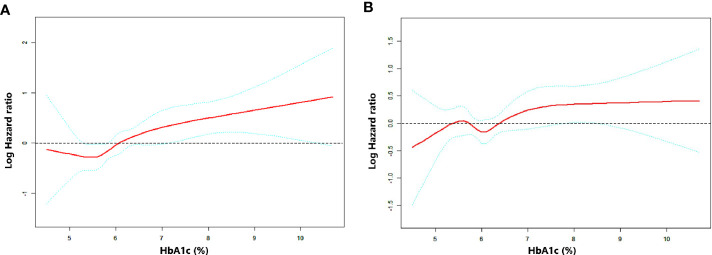
DM and non-DM patients had similar OS (median (95% CI): 22.85 (20.05-26.73) 22.22 (20.35-24.76) months, P=0.950). The multivariate Cox regression analyses showed that DM status was not a prognostic factor for OS (HR: 0.952, 95% CI: 0.808-1.122, P=0.559). However, there existed a non-linear but generally positive relationship between the elevated HbA1c level and increased risk of overall mortality. HbA1c > 6.6% was a negative prognostic factor for OS (HR: 1.593, 95% CI: 1.113-2.280, P=0.011). The median OS (95% CI) for nondiabetic patients, DM patients with HbA1c ≤6.6% and those with HbA1c > 6.6% was 22.22 (20.01-24.43), 25.28 (21.79-28.77) and 15.45 (7.57-23.33) months, respectively. Well-controlled DM patients had a comparable crude OS (HR (95% CI): 0.90 (0.76-1.08), P=0.273] compared to nondiabetic patients while patients with HbA1c>6.6% had a worse crude OS than patients without DM (HR (95% CI): 1.70 (1.24-2.34), P=0.001]. The survival benefit of good HbA1c control was prominent in all subgroups.
Impaired glycemic level negatively affects survival for patients with advanced NSCLC while proper glycemic control with HbA1c ≤6.6% improves the OS.
糖尿病(DM)是癌症患者中常见的合并症。本研究旨在评估晚期非小细胞肺癌(NSCLC)合并DM患者的预后,并评估最佳血糖控制是否能改善总生存期(OS)。
回顾性分析了1279例晚期NSCLC患者,其中300例(23.5%)患有DM。采用受限立方样条(RCS)函数分析糖化血红蛋白A1C(HbA1c)水平与OS之间的连续关系。使用X-tile分析确定最佳HbA1c切点。采用Kaplan-Meier法分析生存率,并在根据糖尿病状态和HbA1c分层的组间进行比较。采用多变量Cox比例风险回归分析,在调整基线特征后确定OS的预后因素。
DM患者和非DM患者的OS相似(中位数(95%CI):22.85(20.05 - 26.73)个月和22.22(20.35 - 24.76)个月,P = 0.950)。多变量Cox回归分析显示,DM状态不是OS的预后因素(HR:0.952,95%CI:0.808 - 1.122,P = 0.559)。然而,HbA1c水平升高与总死亡风险增加之间存在非线性但总体呈正相关的关系。HbA1c > 6.6%是OS的负性预后因素(HR:1.593, 95%CI:1.113 - 2.280, P = 0.011)。非糖尿病患者、HbA1c≤6.6%的DM患者和HbA1c > 6.6%的DM患者的OS中位数(95%CI)分别为22.22(20.01 - 24.43)、25.28(21.79 - 28.77)和15.45(7.57 - 23.33)个月。血糖控制良好的DM患者与非糖尿病患者的粗OS相当(HR(95%CI):0.90(0.76 - 1.08),P = 0.273),而HbA1c>6.6%的患者的粗OS比无DM的患者更差(HR(95%CI):1.70(1.24 - 2.34),P = 0.001)。良好的HbA1c控制的生存获益在所有亚组中都很显著。
血糖水平受损对晚期NSCLC患者的生存有负面影响,而HbA1c≤6.6%的适当血糖控制可改善OS。