Yan Wei, Shen Yingchun, Huang Jinny, Lu Ling, Zhang Qian
Hepatobiliary Center, The First Affiliated Hospital, Nanjing Medical University, Nanjing, China.
Department of Surgery, School of Medicine, Johns Hopkins University, Baltimore, MD, United States.
Front Med (Lausanne). 2021 Nov 19;8:752223. doi: 10.3389/fmed.2021.752223. eCollection 2021.
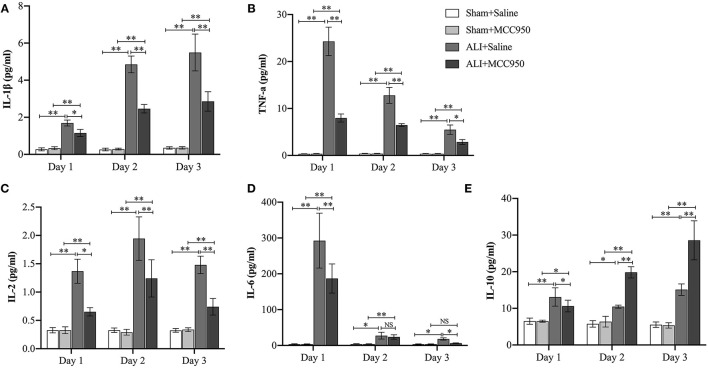
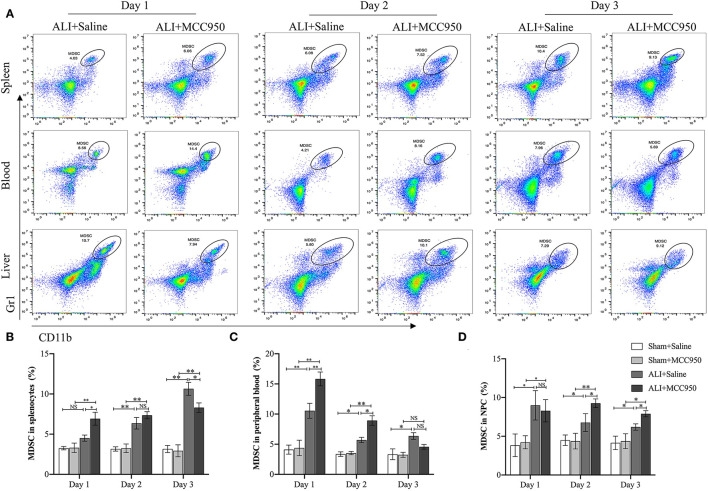
Acute liver injury (ALI) raises high mortality rates due to a rapid pathological process. MCC950, a highly selective nod-like receptor family pyrin domain containing 3 (NLRP3) inhibitor, has already been reported to show strong hepatoprotective effects in many different liver diseases. In this study, we unveiled the role of MCC950 in carbon tetrachloride (CCl)-induced ALI and its underlying molecular mechanisms on days 1, 2, and 3. MCC950 could significantly inhibit liver injury, evidenced by decreased serum alamine aminotransferase (ALT) and aspartate aminotransferase (AST) levels on days 1 and 2, increased Albumin (ALB) level on day 3, and decreased histological score during the whole period. Moreover, lower M1 macrophage related to pro-inflammatory genes expression was observed in MCC950-treated ALI mice on day 1, while MCC950 pretreatment also polarized macrophage to M2 phenotype indicating anti-inflammatory response on days 2 and 3. Additionally, MDSC was significantly increased in blood, liver, and spleen in ALI mice at different time courses. Specifically, upregulated myeloid-derived suppressor cell (MDSC) proportions were found in blood and spleen on days 1 and 2, but showed decreased trend on day 3. However, liver MDSC numbers were increased on days 2 and 3, but no significance on day 1. In conclusion, MCC950 pretreatment alleviates CCl-induced ALI through enhanced M2 macrophage and MDSC function at different time points of ALI. Further understanding of MCC950 in ALI may be a new potential therapeutic strategy.
急性肝损伤(ALI)由于其快速的病理过程而导致高死亡率。MCC950是一种高度选择性的含吡啉结构域的NOD样受体家族3(NLRP3)抑制剂,已有报道表明其在多种不同的肝脏疾病中具有强大的肝脏保护作用。在本研究中,我们揭示了MCC950在四氯化碳(CCl)诱导的ALI中第1、2和3天的作用及其潜在分子机制。MCC950可显著抑制肝损伤,第1天和第2天血清丙氨酸氨基转移酶(ALT)和天冬氨酸氨基转移酶(AST)水平降低、第3天白蛋白(ALB)水平升高以及整个期间组织学评分降低均证明了这一点。此外,第1天在MCC950处理的ALI小鼠中观察到与促炎基因表达相关的M1巨噬细胞减少,而MCC950预处理在第2天和第3天也使巨噬细胞极化为M2表型,表明具有抗炎反应。此外,在不同时间点,ALI小鼠血液、肝脏和脾脏中的髓源性抑制细胞(MDSC)显著增加。具体而言,第1天和第2天血液和脾脏中髓源性抑制细胞(MDSC)比例上调,但在第3天呈下降趋势。然而,肝脏MDSC数量在第2天和第3天增加,但在第1天无显著变化。总之,MCC950预处理通过在ALI的不同时间点增强M2巨噬细胞和MDSC功能来减轻CCl诱导的ALI。进一步了解MCC950在ALI中的作用可能是一种新的潜在治疗策略。