Department of Parasitology, School of Basic Medicine, Tongji Medical College, Huazhong University of Science and Technology, Wuhan, 430070, Hubei, People's Republic of China.
Parasit Vectors. 2019 Jan 11;12(1):29. doi: 10.1186/s13071-018-3223-8.
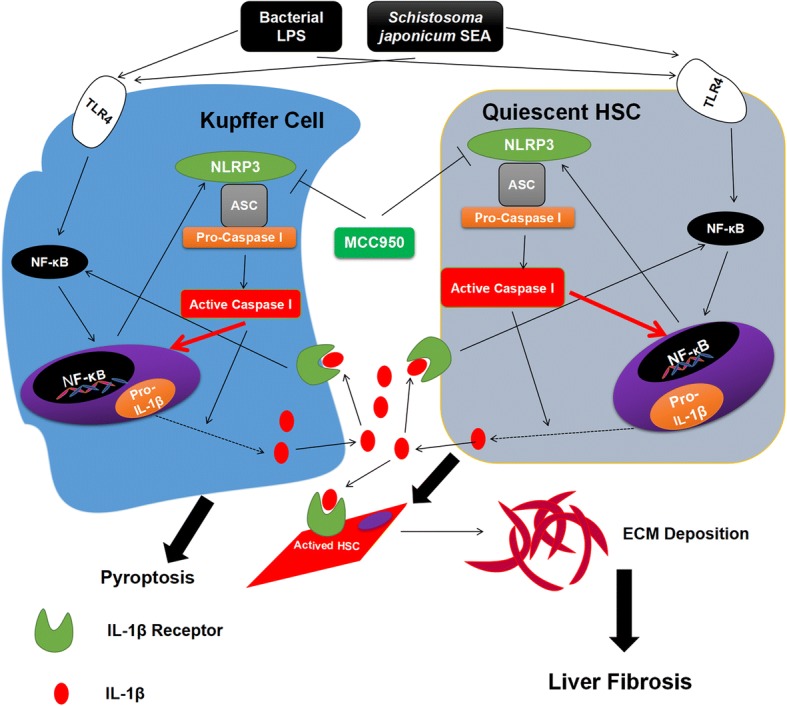
NOD-like receptor protein 3 (NLRP3) inflammasome was reported as expressed in schistosomiasis-induced liver fibrosis (SSLF). We used an NLRP3 inflammasome inhibitor, MCC950, to investigate whether it inhibited liver fibrosis, and explored the preliminary molecular mechanism.
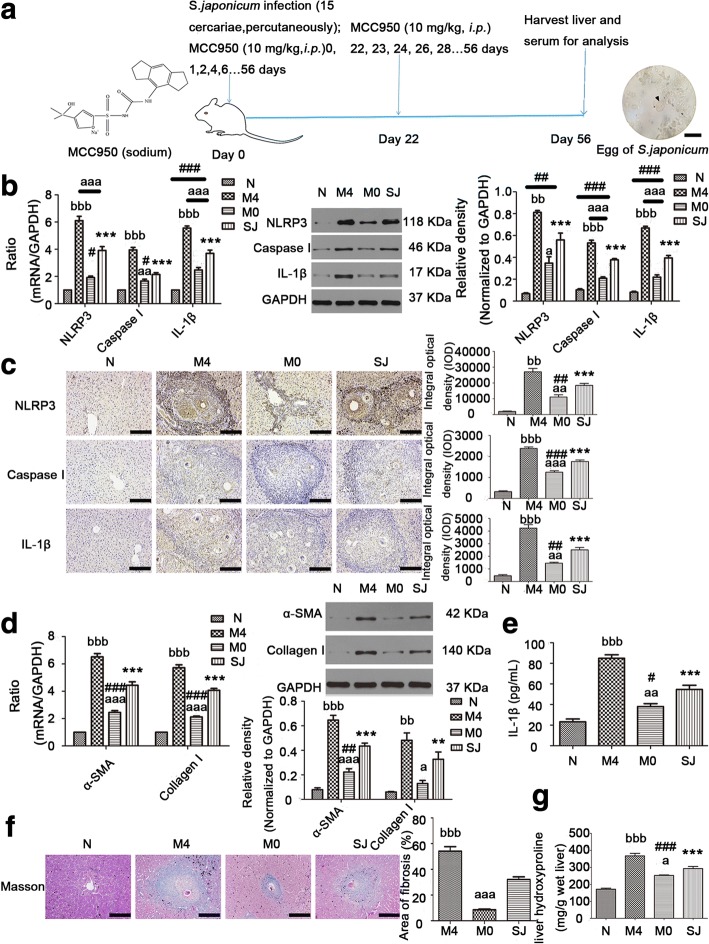
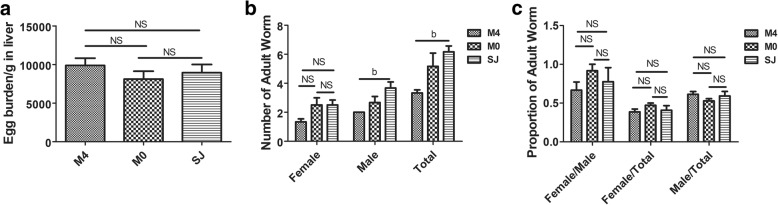
BALB/c mice were infected with 15 cercariae through the abdominal skin. They received intraperitoneal injections of MCC950 on the day of infection and at day 22 post-infection. We examined their SSLF phenotype and the effect on liver fibrosis, primary Kupffer cells (KCs), and HSCs. Human hepatic stellate cell lines (human LX-2 cells) were treated with soluble egg antigen (SEA) released from the eggs. We then determined the expression of NLRP3 inflammasome and liver fibrosis-associated markers, liver granuloma and ALT/AST.
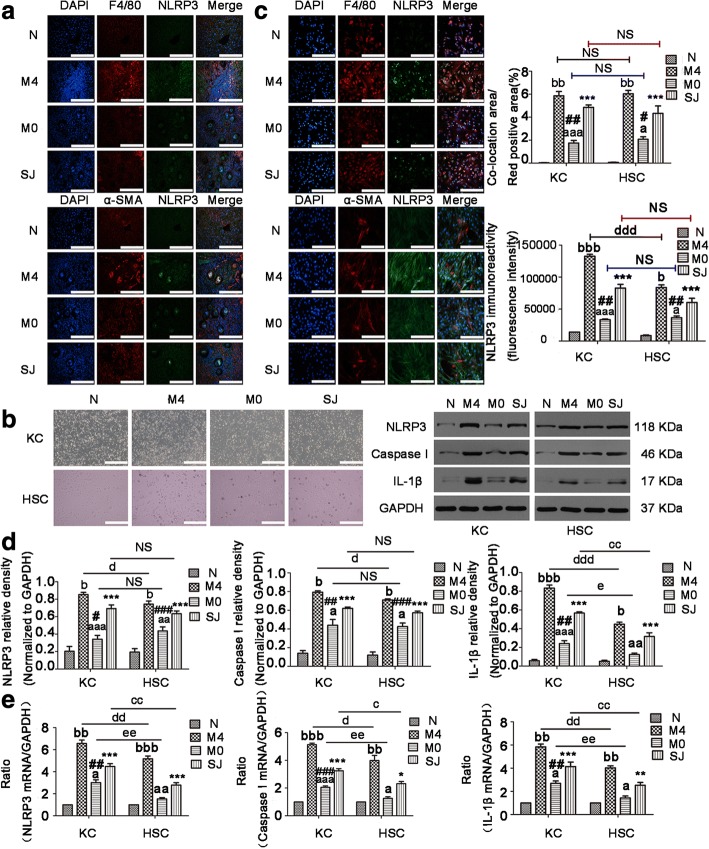
NLRP3 inflammasome expression in the liver was significantly increased, and eosinophilic granuloma and collagen deposition were found around the eggs in mice infected for 56 days. Additionally, IL-1β, ALT/AST in plasma, and NF-κB in liver tissue and in KCs were all greatly significantly increased. The above-mentioned indicators were largely reduced in mice treated with MCC950 on the day of infection. In vitro, lipopolysaccharide (LPS)/SEA could induce LX-2 cells to express NLRP3 and fibrosis markers, and the SEA-treated group was reversed by MCC950. Furthermore, NLRP3 inflammasome and liver fibrosis-associated markers were both increased in the primary KCs and HSCs isolated from infected mice. However, this effect was not observed in the same cells from the mice treated with MCC950 on the day of infection. Contrary to the aforementioned results, MCC950 treatment at day 22 post-infection aggravated this process. Surprisingly, NLRP3 inflammasome was involved in liver fibrosis mostly from KCs.
MCC950 acts dually on SSLF pathology and fibrosis in infected mice. Although MCC950 treatment improved SSLF on the day of infection, it exacerbated the pathological effects at day 22 post-infection. These dual effects were mediated via NF-κB. Moreover, NLRP3 inflammasome mainly came from KCs. Our results suggest that blocking NLRP3 on the day of infection may prove to be a promising direction in preventing SSLF.
NOD 样受体蛋白 3(NLRP3)炎症小体在血吸虫病诱导的肝纤维化(SSLF)中被报道表达。我们使用 NLRP3 炎症小体抑制剂 MCC950 来研究它是否抑制肝纤维化,并探索初步的分子机制。
BALB/c 小鼠通过腹部皮肤感染 15 尾蚴。它们在感染当天和感染后第 22 天接受腹腔注射 MCC950。我们检查了它们的 SSLF 表型和对肝纤维化、原代枯否细胞(KCs)和 HSCs 的影响。人肝星状细胞系(人 LX-2 细胞)用从卵中释放的可溶性卵抗原(SEA)处理。然后,我们测定了 NLRP3 炎症小体和肝纤维化相关标志物、肝肉芽肿和 ALT/AST 的表达。
在感染 56 天的小鼠中,肝脏中 NLRP3 炎症小体的表达明显增加,并且在卵周围发现嗜酸性粒细胞肉芽肿和胶原沉积。此外,血浆中的 IL-1β、ALT/AST 和肝组织以及 KCs 中的 NF-κB 均显著增加。在感染当天用 MCC950 处理的小鼠中,上述指标均显著降低。体外,脂多糖(LPS)/SEA 可诱导 LX-2 细胞表达 NLRP3 和纤维化标志物,而 MCC950 可逆转 SEA 处理组的表达。此外,从感染小鼠分离的原代 KCs 和 HSCs 中 NLRP3 炎症小体和肝纤维化相关标志物均增加,但在感染当天用 MCC950 处理的相同细胞中未观察到这种作用。与上述结果相反,MCC950 在感染后第 22 天的治疗加重了这一过程。令人惊讶的是,NLRP3 炎症小体主要参与了感染小鼠的肝纤维化。
MCC950 对感染小鼠的 SSLF 病理和纤维化均有双重作用。虽然感染当天 MCC950 治疗改善了 SSLF,但在感染后第 22 天加重了病理效应。这些双重作用是通过 NF-κB 介导的。此外,NLRP3 炎症小体主要来自 KCs。我们的结果表明,在感染当天阻断 NLRP3 可能是预防 SSLF 的一个有前途的方向。