Virág Marcell, Rottler Máté, Ocskay Klementina, Leiner Tamás, Horváth Balázs, Blanco Daniel Adam, Vasquez Alexa, Bucsi László, Sárkány Ágnes, Molnár Zsolt
Medical School, Institute for Translational Medicine, University of Pécs, Pécs, Hungary.
Department of Anesthesiology and Intensive Therapy, Szent György University Teaching Hospital of Fejér County, Székesfehérvár, Hungary.
Front Med (Lausanne). 2021 Nov 19;8:760435. doi: 10.3389/fmed.2021.760435. eCollection 2021.
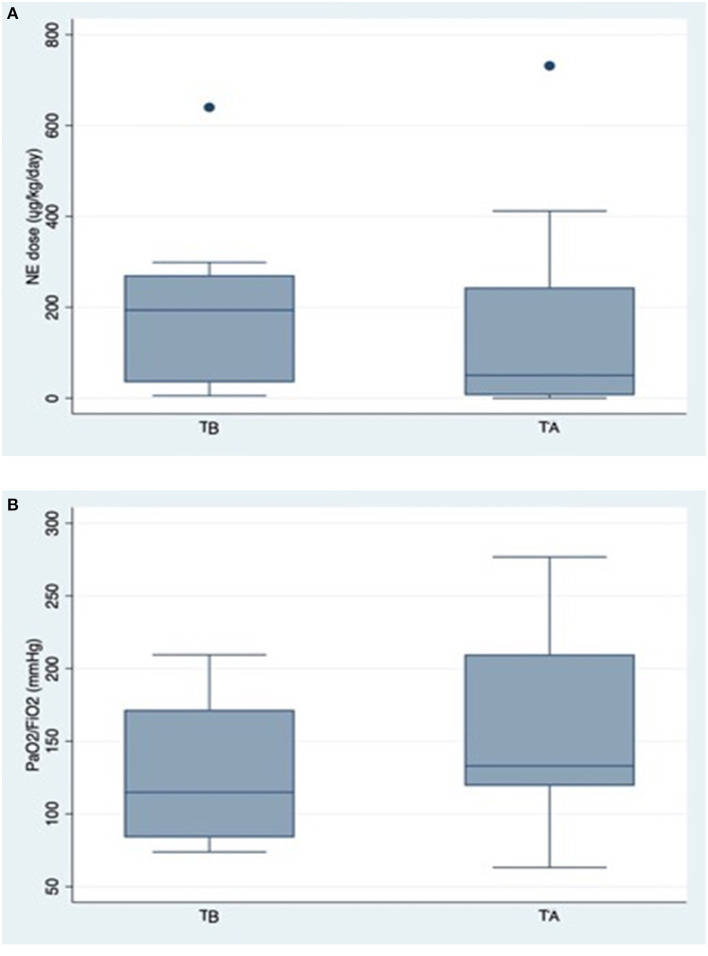
Extracorporeal hemoadsorption (HA) is a potential adjunctive therapy in severe cases of COVID-19 associated pneumonia. In this retrospective study we report data from critically ill patients treated with HA during the first and second wave of the pandemic. All patients, who received HA therapy with CytoSorb within the first 96 h of intensive care unit (ICU) admission without hospital-acquired bacterial superinfection, were included. Clinical and laboratory data were collected: on admission, before (T) and after (T) HA therapy. Out of the 367 COVID-19 cases, 13 patients were treated with CytoSorb, also requiring mechanical ventilation and renal replacement therapy. All patients were alive at the end of HA, but only 3 survived hospital stay. From T-T there was a tendency of decreasing norepinephrine requirement: 193.7 [IQR: 34.8-270.4] to 50.2 [6.5-243.5] ug/kg/day and increasing PaO2/FiO2 ratio 127.8 (95% CI: 96.0-159.6) to 155.0 (115.3-194.6) mmHg but they did not reach statistical significance ( = 0.14 and 0.58, respectively). Treatment related adverse events were not reported. The treatment was well-tolerated, and there was a tendency toward an improvement in vasopressor need and oxygenation during the course of HA. These observations render the need for prospective randomized trials.
体外血液吸附(HA)是COVID-19相关肺炎重症病例的一种潜在辅助治疗方法。在这项回顾性研究中,我们报告了在疫情第一波和第二波期间接受HA治疗的危重症患者的数据。纳入了所有在重症监护病房(ICU)入院的前96小时内接受CytoSorb HA治疗且无医院获得性细菌重叠感染的患者。收集了临床和实验室数据:入院时、HA治疗前(T)和治疗后(T)。在367例COVID-19病例中,13例患者接受了CytoSorb治疗,同时还需要机械通气和肾脏替代治疗。所有患者在HA治疗结束时均存活,但只有3例存活至出院。从T到T,去甲肾上腺素需求量有下降趋势:从193.7[四分位间距:34.8 - 270.4]降至50.2[6.5 - 243.5]μg/kg/天,动脉血氧分压/吸入氧浓度(PaO2/FiO2)比值有升高趋势:从127.8(95%置信区间:96.0 - 159.6)升至155.0(115.3 - 194.6)mmHg,但未达到统计学显著性(分别为P = 0.14和0.58)。未报告与治疗相关的不良事件。该治疗耐受性良好,在HA治疗过程中血管升压药需求和氧合有改善趋势。这些观察结果表明需要进行前瞻性随机试验。