Zhao Li, Zhou Yan, Wang Chuan, Li Yifei, Zhu Qi, Hua Yimin, Qiao Lina, Wu Jinlin, Zhou Kaiyu
Key Laboratory of Birth Defects and Related Diseases of Women and Children of Ministry of Education, Department of Pediatrics, West China Second University Hospital, Sichuan University, Chengdu, China.
Respiratory Department of Pengzhou Hospital of Traditional Chinese Medicine, Chengdu, China.
Front Cardiovasc Med. 2021 Nov 12;8:759260. doi: 10.3389/fcvm.2021.759260. eCollection 2021.
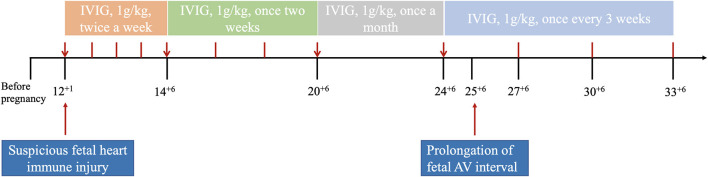
A fetal autoimmune-mediated atrioventricular block is a passively acquired autoimmune disease in which maternal autoantibodies enter the fetal circulation via the placenta and subsequently cause inflammation and fibrosis of the atrioventricular node. Once fetal autoimmune-mediated atrioventricular block occurs, it only takes a short time to progress from first-degree atrioventricular block to complete atrioventricular block, meaning that the damage is often irreversible. Autoimmune-associated AVB, a rare but life-threatening disorder, occurs in 2-5% of pregnancies with positive anti-Ro/SSA (the most common one) and La/SSB antibodies. The perinatal mortality of neonates with AVB outlined in research is approximately 30%. Thus far, for autoimmune-associated AVB fetuses, currently used treatments include corticosteroids, hydroxychloroquine, intravenous immunoglobulin (IVIG), b-sympathomimetic agent, and even plasma exchange. Currently, approaches for preventing the progression and recurrence of a fetal atrioventricular block are still controversial. Here, we reported a baby of successful prevention from the fate of the fetal atrioventricular block by adopting prophylactic comprehensive prenatal therapy.
胎儿自身免疫介导的房室传导阻滞是一种被动获得性自身免疫性疾病,母体自身抗体通过胎盘进入胎儿循环,随后导致房室结炎症和纤维化。一旦胎儿自身免疫介导的房室传导阻滞发生,从一度房室传导阻滞发展到完全性房室传导阻滞只需要很短的时间,这意味着损害往往是不可逆的。自身免疫相关的房室传导阻滞是一种罕见但危及生命的疾病,在抗Ro/SSA(最常见)和La/SSB抗体阳性的妊娠中发生率为2%-5%。研究中概述的患有房室传导阻滞的新生儿围产期死亡率约为30%。迄今为止,对于自身免疫相关的房室传导阻滞胎儿,目前使用的治疗方法包括皮质类固醇、羟氯喹、静脉注射免疫球蛋白(IVIG)、β-拟交感神经药,甚至血浆置换。目前,预防胎儿房室传导阻滞进展和复发的方法仍存在争议。在此,我们报告了一例通过采用预防性综合产前治疗成功预防胎儿房室传导阻滞命运的婴儿。