Department of Orthopaedic Surgery, Beijing Jishuitan Hospital, Fourth Clinical College of Peking University, Jishuitan Orthopaedic College of Tsinghua University, Beijing, China.
Orthop Surg. 2022 Jan;14(1):96-103. doi: 10.1111/os.13178. Epub 2021 Dec 6.
To analyze the deformity origins and distribution among valgus knees to individualize their morphological features.
Radiographic images of 105 valgus knees were analyzed. Long-film radiographs and computed tomography were collected for every knee. A malalignment test was performed on standing long-film radiographs. The hip-knee-ankle angle (HKA), the anatomical lateral distal femoral angle (aLDFA), and the anatomical medial proximal tibial angle (aMPTA) were measured on long-film radiographs. The distal condylar angle and posterior condylar angle on distal femur were further measured on computed tomography scans. The tibial bone varus angle was measured on long-film radiographs as well. All the valgus knees were sorted into different subtypes according to the origins of bony deformity, and the prevalence of each subtype was reported. Finally, to examine the inter-observer reproducibility of this classification system, two observers measured the deformities and did the classification for all the 105 knees independently and then the intraclass correlation coefficient (ICC) was calculated.
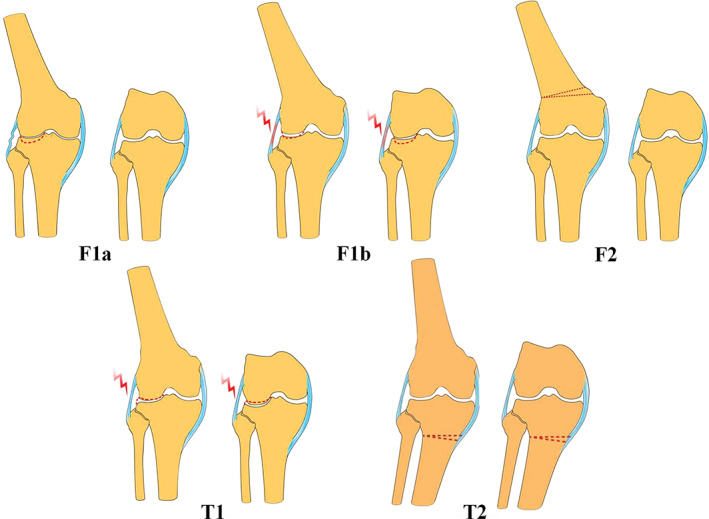
Among the 105 knees, 48 knees (45.7%) had apparent deformity from the tibial plateau, and 62 knees (59.0%) had apparent deformity from the supracondylar region of the femur. Eighteen knees (17.1%) had distal condylar angle >7°, among which 11 knees had posterior condylar angle >3° simultaneously. Valgus knees had five subtypes of bone deformity origins-the supracondylar part of the femur, the distal aspect of the lateral femoral condyle, both distal and posterior aspects of the lateral femoral condyle, the tibial plateau, or the metaphyseal segment of the tibia. A valgus knee could be labeled as only one subtype, or a combination of two or more subtypes. Labeling 105 knees with origin of the most severe deformity, the prevalence of each subtype was 40.0%, 5.7%, 9.5%, 28.6%, and 16.2%, respectively. The intra-observer and inter-observer ICC of this classification system was 0.992 and 0.976, respectively.
Valgus knees can be classified into different subtypes according to deformity origins. This radiological classification system has satisfactory reproducibility. It helps surgeons better individualize morphological features of valgus knees.
分析内翻膝畸形的起源和分布,以实现个体化的形态学特征分析。
分析了 105 例内翻膝的影像学资料。对每例膝关节采集长胶片和计算机断层扫描(CT)图像。在站立长胶片上进行对线测试。在长胶片上测量髋膝踝角(HKA)、解剖外侧远端股骨角(aLDFA)和解剖内侧近端胫骨角(aMPTA)。进一步在 CT 扫描上测量股骨远端的髁间角和后髁角。在长胶片上测量胫骨骨内翻角。根据骨畸形的起源,将所有内翻膝分为不同亚型,并报告各亚型的患病率。最后,为了检验该分类系统的观察者间可重复性,两名观察者独立测量了所有 105 例膝关节的畸形并进行了分类,然后计算了组内相关系数(ICC)。
在 105 例膝关节中,48 例(45.7%)胫骨平台有明显的畸形,62 例(59.0%)股骨髁上区有明显的畸形。18 例(17.1%)有外侧髁间角>7°,其中 11 例同时有后髁角>3°。内翻膝有五种骨畸形起源的亚型——股骨髁上部分、外侧股骨髁远端、外侧股骨髁远端和后髁、胫骨平台或胫骨干骺端。一个内翻膝可以被标记为只有一个亚型,或两个或更多亚型的组合。以最严重畸形起源标记 105 例膝关节,各亚型的患病率分别为 40.0%、5.7%、9.5%、28.6%和 16.2%。该分类系统的观察者内和观察者间 ICC 分别为 0.992 和 0.976。
根据畸形起源,内翻膝可以分为不同的亚型。这种影像学分类系统具有良好的可重复性,有助于外科医生更好地个体化分析内翻膝的形态学特征。