Civil, Architectural and Environmental Engineering, The University of Texas at Austin, 301 East Dean Keaton Street C1752, Austin, TX, 78712, United States.
Management Science and Statistics, The University of Texas at San Antonio, One UTSA Cir., San Antonio, TX, 78249, United States.
J Environ Manage. 2022 Jan 15;302(Pt A):113949. doi: 10.1016/j.jenvman.2021.113949. Epub 2021 Oct 16.
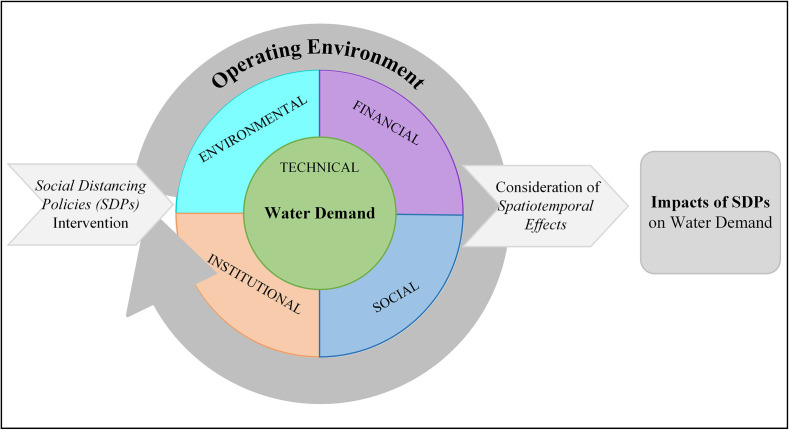
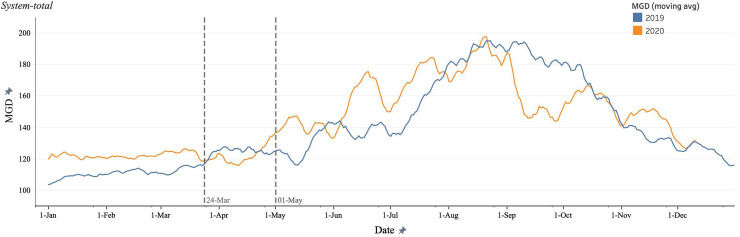
Social distancing policies (SDPs) implemented in response to the COVID-19 pandemic have led to temporal and spatial shifts in water demand across cities. Water utilities need to understand these demand shifts to respond to potential operational and water-quality issues. Aided by a fixed-effects model of citywide water demand in Austin, Texas, we explore the impacts of various SDPs (e.g., time after the stay home-work safe order, reopening phases) using daily demand data gathered between 2013 and 2020. Our approach uses socio-technical determinants (e.g., climate, water conservation policy) with SDPs to model water demand, while accounting for spatial and temporal effects (e.g., geographic variations, weekday patterns). Results indicate shifts in behavior of residential and nonresidential demands that offset the change at the system scale, demonstrating a spatial redistribution of water demand after the stay home-work safe order. Our results show that some phases of Texas's reopening phases had statistically significant relationships to water demand. While this yielded only marginal net effects on overall demand, it underscores behavioral changes in demand at sub-system spatial scales. Our discussions shed light on SDPs' impacts on water demand. Equipped with our empirical findings, utilities can respond to potential vulnerabilities in their systems, such as water-quality problems that may be related to changes in water pressure in response to demand variations.
为应对 COVID-19 大流行而实施的社交距离政策 (SDP) 导致城市的用水量在时间和空间上发生了转移。水公用事业公司需要了解这些需求变化,以应对潜在的运营和水质问题。我们借助德克萨斯州奥斯汀市全市用水需求的固定效应模型,利用 2013 年至 2020 年间收集的每日需求数据,探讨了各种 SDP(例如居家令发布后的时间、重新开放阶段)的影响。我们的方法使用社会技术决定因素(例如气候、水保护政策)与 SDP 相结合来模拟用水需求,同时考虑空间和时间效应(例如地理变化、工作日模式)。结果表明,住宅和非住宅需求的行为发生了变化,抵消了系统规模的变化,表明居家令发布后用水量在空间上重新分配。我们的结果表明,德克萨斯州重新开放阶段的某些阶段与用水需求存在统计学上的显著关系。虽然这对总需求的影响仅略有净影响,但突显了子系统空间尺度上需求的变化。我们的讨论阐明了 SDP 对用水需求的影响。有了我们的经验发现,公用事业公司可以应对系统中的潜在脆弱性,例如与响应需求变化而导致的水压变化有关的水质问题。