Institute for Exercise and Environmental Medicine, Texas Health Presbyterian Hospital, Dallas, Texas, USA.
University of Texas Southwestern Medical Center, Dallas, Texas, USA.
Physiol Rep. 2021 Dec;9(23):e15129. doi: 10.14814/phy2.15129.
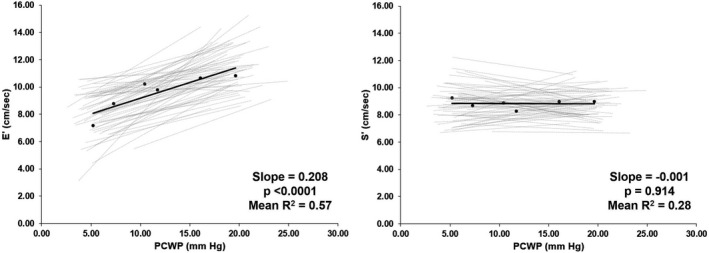
Left ventricular (LV) restoring forces are primed by ventricular deformation during systole and contribute to cardiac relaxation and early diastolic suction. Systolic-diastolic coupling, the relationship between systolic contraction and diastolic recoil, is a novel marker of restoring forces, but the effect of left atrial pressure (LAP) is unknown. We tested preliminary methods of systolic-diastolic coupling comparing mitral annular velocities versus excursion distances and hypothesized a recoil/contraction distance ratio would remain unaffected across varying LAP, providing a surrogate for quantifying LV restoring forces.
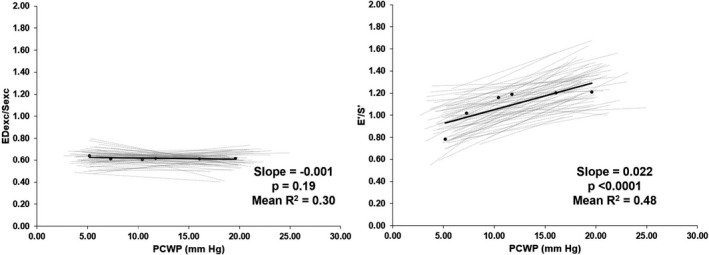
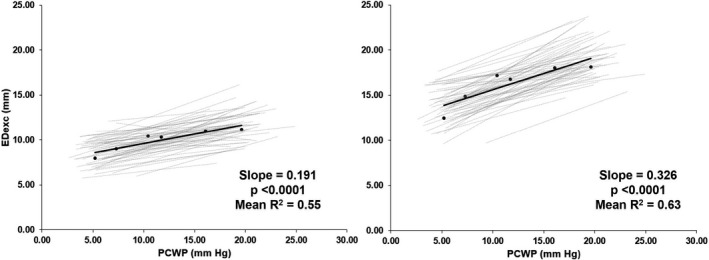
Healthy subjects (n = 61, age 52 ± 5 years) underwent manipulation of LAP with lower body negative pressure (LBNP) and rapid normal saline (NS) infusion. Pulmonary capillary wedge pressure (PCWP; pulmonary artery catheter) and tissue Doppler imaging of the mitral annulus were measured. Two models of systolic-diastolic coupling--early diastolic excursion (ED )/systolic contraction (S ) distances and e'/systolic (s') velocities were compared. Velocity (e'/s') coupling ratios varied significantly (mean e'/s', slope = 0.022, p < 0.001) in relationship with PCWP (5-20 mmHg). Excursion (ED /S ) coupling ratio did not vary in relationship with PCWP (ED /S : slope = -0.001, p = 0.19).
Systolic-diastolic coupling using mitral annular distance ratios to standardize early diastolic recoil to systolic contraction was not significantly impacted by LAP, in contrast to coupling ratios using velocities. The pressure invariance of annular distance coupling ratios suggests this metric quantifies the efficiency of LV restoring forces by isolating systolic contributions to early diastolic restoring forces independent from changes in LAP.
左心室(LV)恢复力是由收缩期心室变形引发的,并有助于心脏舒张和早期 diastolic 抽吸。收缩-舒张偶联是恢复力的一个新标志物,是收缩期收缩与舒张回弹之间的关系,但左心房压(LAP)的影响尚不清楚。我们测试了初步的收缩-舒张偶联方法,比较了二尖瓣环速度与偏移距离,并假设回弹/收缩距离比在不同的 LAP 下保持不变,这为量化 LV 恢复力提供了替代方法。
健康受试者(n=61,年龄 52±5 岁)接受了下体负压(LBNP)和快速生理盐水(NS)输注对 LAP 的操作。测量了肺毛细血管楔压(PCWP;肺动脉导管)和二尖瓣环的组织多普勒成像。比较了两种收缩-舒张偶联模型——早期 diastolic 偏移(ED)/收缩期(S)距离和 e'/收缩期(s')速度。速度(e'/s')偶联比与 PCWP(5-20mmHg)显著相关(平均 e'/s',斜率为 0.022,p<0.001)。ED/S 偏移比与 PCWP 无关(ED/S:斜率为-0.001,p=0.19)。
与使用速度的偶联比相比,使用二尖瓣环距离比来标准化早期 diastolic 回弹到收缩期的收缩-舒张偶联不受 LAP 的显著影响。与使用速度的偶联比相比,使用二尖瓣环距离比来标准化早期 diastolic 回弹到收缩期的收缩-舒张偶联不受 LAP 的显著影响。这种距离偶联比的压力不变性表明,该指标通过隔离与 LAP 变化无关的收缩期对早期 diastolic 恢复力的贡献,量化了 LV 恢复力的效率。