Associate Professor in Sociology of Sustainability at the Institute of Social Sciences, University of Tartu, Estonia.
PhD candidate at the Institute of Social Sciences, University of Tartu, Estonia.
Disasters. 2021 Dec;45 Suppl 1(Suppl 1):S48-S75. doi: 10.1111/disa.12526. Epub 2021 Dec 7.
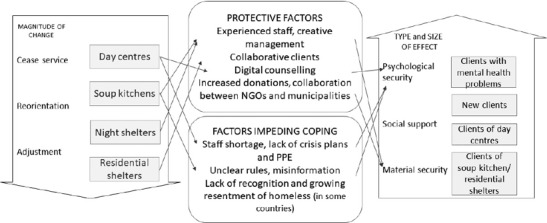
The Covid-19 pandemic has challenged the resilience of care organisations (and those dependent on them), especially when services are stopped or restricted. This study focuses on the experiences of care organisations that offer services to individuals in highly precarious situations in 10 European countries. It is based on 32 qualitative interviews and three workshops with managers and staff. The four key types of organisations reviewed largely had the same adaptation patterns in all countries. The most drastic changes were experienced by day centres, which had to suspend or digitise services, whereas night shelters and soup kitchens had to reorganise broadly their work; residential facilities were minimally affected. Given the drastic surge in demand for services, reliance on an overburdened (volunteer) workforce, and a lack of crisis plans, the care organisations with long-term trust networks with clients and intra-organisational cooperation adapted easier. The outcomes were worse for new clients, migrants, psychologically vulnerable people, and those with limited communicative abilities.
Covid-19 大流行挑战了护理组织(和依赖它们的组织)的适应能力,尤其是在服务停止或受到限制时。本研究关注的是在 10 个欧洲国家为处于高度不稳定状况的个人提供服务的护理组织的经验。它基于对管理人员和工作人员的 32 次定性访谈和三次研讨会。审查的四类主要组织在所有国家基本上都有相同的适应模式。日托中心经历了最剧烈的变化,不得不暂停或数字化服务,而夜间避难所和施粥所则不得不广泛重组工作;住宿设施受到的影响最小。鉴于对服务的需求急剧增加、依赖负担过重的(志愿)劳动力以及缺乏危机计划,与客户和组织内合作具有长期信任网络的护理组织更容易适应。对于新客户、移民、心理脆弱的人和沟通能力有限的人来说,结果更差。