Poulin Herron Alex, Agbadje Titilayo Tatiana, Guay-Bélanger Sabrina, Ngueta Gérard, Roch Geneviève, Rousseau François, Légaré France
VITAM - Research Center on Sustainable Health, Centre intégré universitaire de santé et de services sociaux de la Capitale-Nationale, Quebec City, QC, Canada.
Faculty of Nursing, University of Laval, Quebec City, QC, Canada.
JMIR Nurs. 2022 Jan 25;5(1):e31380. doi: 10.2196/31380.
Nurses play an important role in supporting pregnant women making decisions about prenatal screening for Down syndrome. We developed a web-based shared decision-making (SDM) training program for health professionals focusing on Down syndrome screening decisions.
In this study, we aim to assess the impact of an SDM training program on nurses' intention to use a decision aid with pregnant women deciding on prenatal screening for Down syndrome.
In this 2-arm, parallel controlled trial, French-speaking nurses working with pregnant women in the province of Quebec were recruited by a private survey firm. They were allocated by convenience either to the intervention group (web-based SDM course that included prenatal screening) or to the control group (web-based course focusing on prenatal screening alone, with no SDM content). The primary outcome was the intention to use a decision aid. Secondary outcomes were psychosocial variables of intention, knowledge, satisfaction, acceptability, perceived usefulness, and reaction to the pedagogical approach. All outcomes were self-assessed through web-based questionnaires, including the space for written comments. We used 2-tailed Student t test and Fisher exact test to compare continuous and categorical variables between groups, respectively.
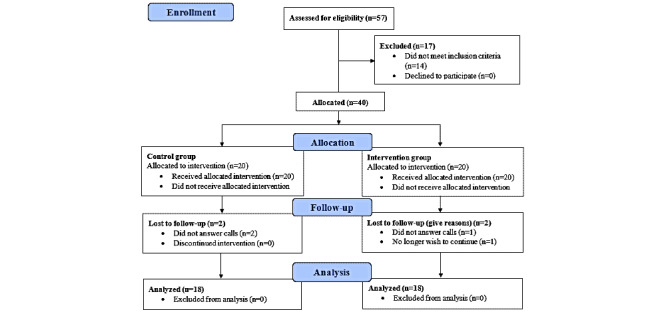
Of the 57 participants assessed for eligibility, 40 (70%) were allocated to the intervention (n=20) or control group (n=20) and 36 (n=18 in each) completed the courses. The mean age of the participants was 41 (SD 9) years. Most were women (39/40, 98%), White (38/40, 95%), clinical nurses (28/40, 70%), and had completed at least a bachelor's degree (30/40, 75%). After the intervention, the mean score of intention was 6.3 (SD 0.8; 95% CI 5.9-6.7) for the intervention group and 6.0 (SD 1.2; 95% CI 5.42-6.64) for the control group (scale 1-7). The differences in intention and other psychosocial variable scores between the groups were not statistically significant. Knowledge scores for SDM were significantly higher in the intervention group (79%, 95% CI 70-89 vs 64%, 95% CI 57-71; P=.009). The intervention was significantly more acceptable in the intervention group (4.6, 95% CI 4.4-4.8 vs 4.3, 95% CI 4.1-4.5; P=.02), and reaction to the pedagogical approach was also significantly more positive in the intervention group (4.7, 95% CI 4.5-4.8 vs 4.4, 95% CI 4.2-4.5; P=.02). There was no significant difference in overall satisfaction (or in perceived usefulness). Furthermore, 17 participants (9 in the intervention group and 8 in the control group) provided written comments on the intervention.
This study focuses on web-based nursing education and its potential to support pregnant women's decision-making needs. It shows that nurses' intention to use a decision aid to enhance SDM in prenatal care is high, with or without training, but that their knowledge about SDM can be improved with web-based training.
INTERNATIONAL REGISTERED REPORT IDENTIFIER (IRRID): RR2-10.2196/17878.
护士在支持孕妇做出唐氏综合征产前筛查决策方面发挥着重要作用。我们为卫生专业人员开发了一个基于网络的共享决策(SDM)培训项目,重点是唐氏综合征筛查决策。
在本研究中,我们旨在评估SDM培训项目对护士在与孕妇进行唐氏综合征产前筛查决策时使用决策辅助工具意愿的影响。
在这项双臂平行对照试验中,一家私人调查公司招募了在魁北克省为孕妇服务的法语护士。根据便利原则,她们被分配到干预组(包含产前筛查的基于网络的SDM课程)或对照组(仅专注于产前筛查的基于网络的课程,无SDM内容)。主要结局是使用决策辅助工具的意愿。次要结局是意愿、知识、满意度、可接受性、感知有用性以及对教学方法的反应等心理社会变量。所有结局均通过基于网络的问卷进行自我评估,问卷包括书面评论空间。我们分别使用双尾学生t检验和费舍尔精确检验来比较两组之间的连续变量和分类变量。
在评估的57名符合条件的参与者中,40名(70%)被分配到干预组(n = 20)或对照组(n = 20),36名(每组18名)完成了课程。参与者的平均年龄为41(标准差9)岁。大多数是女性(39/40,98%)、白人(38/40,95%)、临床护士(28/40,70%),并且至少拥有学士学位(30/40,75%)。干预后,干预组使用决策辅助工具意愿的平均得分为6.3(标准差0.8;95%置信区间5.9 - 6.7),对照组为6.0(标准差1.2;95%置信区间5.42 - 6.64)(量表1 - 7)。两组之间在使用决策辅助工具的意愿和其他心理社会变量得分上的差异无统计学意义。干预组中关于SDM的知识得分显著更高(79%,95%置信区间70 - 89 vs 64%,95%置信区间57 - 71;P = 0.009)。干预组对干预的接受度显著更高(4.6,95%置信区间4.4 - 4.
