Department of Biology, University of Turku, Turku, Finland.
RSPB Centre for Conservation Science, Sandy, UK.
Mol Ecol. 2022 Dec;31(23):5966-5978. doi: 10.1111/mec.16312. Epub 2021 Dec 20.
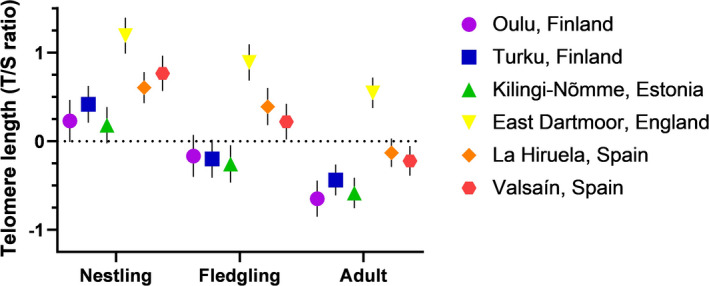
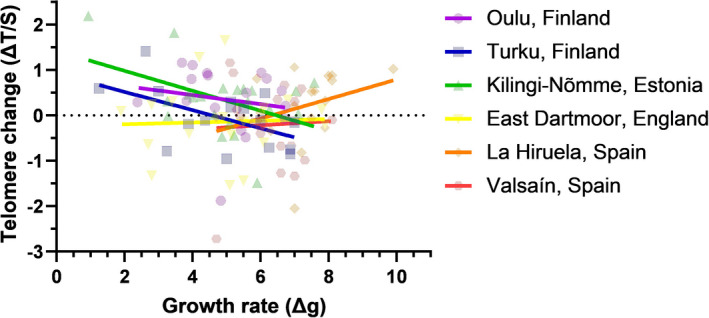
Telomere length and shortening rate are increasingly being used as biomarkers for long-term costs in ecological and evolutionary studies because of their relationships with survival and fitness. Both early-life conditions and growth, and later-life stressors can create variation in telomere shortening rate. Studies on between-population telomere length and dynamics are scarce, despite the expectation that populations exposed to varying environmental constraints would present divergent telomere length patterns. The pied flycatcher (Ficedula hypoleuca) is a passerine bird breeding across Eurasia (from Spain to western Siberia) and migrating through the Iberian Peninsula to spend the nonbreeding period in sub-Saharan Africa. Thus, different populations show marked differences in migration distance. We studied the large-scale variation of telomere length and early-life dynamics in the pied flycatcher by comparing six European populations across a north-south gradient (Finland, Estonia, England and Spain) predicting a negative effect of migration distance on adult telomere length, and of nestling growth on nestling telomere dynamics. There were clear population differences in telomere length, with English birds from midlatitudes having the longest telomeres. Telomere length did not thus show consistent latitudinal variation and was not linearly linked to differences in migration distance. Early-life telomere shortening rate tended to vary between populations. Fast growth was associated with shorter telomeres in the early life, but faster nestling growth affected telomeres more negatively in northern than southern populations. While the sources of between-population differences in telomere-related biology remain to be more intensively studied, our study illustrates the need to expand telomere studies at the between-population level.
端粒长度和缩短率越来越多地被用作生态和进化研究中长期成本的生物标志物,因为它们与生存和适应度有关。早期生活条件和生长以及后期生活压力都会导致端粒缩短率的变化。尽管人们期望暴露于不同环境约束下的种群会表现出不同的端粒长度模式,但关于种群间端粒长度和动态的研究仍然很少。斑胸草雀(Ficedula hypoleuca)是一种雀形目鸟类,分布于欧亚大陆(从西班牙到西西伯利亚),并通过伊比利亚半岛迁徙到撒哈拉以南非洲度过非繁殖期。因此,不同的种群在迁徙距离上存在显著差异。我们通过比较六个欧洲种群(从芬兰、爱沙尼亚、英国和西班牙的南北梯度)研究了斑胸草雀的端粒长度和早期生活动态的大规模变化,预测迁徙距离对成体端粒长度的负面影响,以及雏鸟生长对雏鸟端粒动态的影响。端粒长度存在明显的种群差异,中纬度的英国鸟类具有最长的端粒。因此,端粒长度没有表现出一致的纬度变化,也与迁徙距离的差异没有线性关联。早期生活端粒缩短率在种群之间存在差异。快速生长与早期较短的端粒有关,但在北部种群中,快速的雏鸟生长对端粒的影响更为负面。虽然种群间端粒相关生物学差异的来源仍需要更深入地研究,但我们的研究表明需要在种群间水平上扩展端粒研究。